

Jurors in Sean Combs Trial Reach Verdict on All but One Count

On Tuesday, a Manhattan federal jury reached a partial decision in the high-profile case against music industry icon Sean Combs, widely known by his stage names Puff Daddy and Diddy. However, the jury stopped short of delivering a complete verdict due to an ongoing disagreement over one of the most serious charges: racketeering conspiracy. Deliberations will resume Wednesday morning as jurors attempt to resolve their deadlock.
The jury, made up of eight men and four women, informed the court late Tuesday afternoon that they had reached agreement on four of the five charges—two related to sex trafficking and two involving the transportation of individuals for the purposes of prostitution. However, when it came to the charge of racketeering conspiracy, they reported being at an impasse. Some members of the jury held firm, opposing views that could not be reconciled despite hours of discussion.
Deliberations had gone on for more than 12 hours when the jury submitted a note to the court at approximately 4:05 p.m. The note revealed their struggle to come to a unanimous decision on the racketeering count. U.S. District Judge Arun Subramanian, who is overseeing the trial, addressed the jurors in the courtroom and encouraged them to keep deliberating, gently reminding them of their duty to listen to each other’s perspectives while remaining true to their own convictions.

“I ask at this time that you keep deliberating,” Judge Subramanian told the panel. He then read a portion of the jury instructions again, emphasizing that no juror should abandon their deeply held beliefs simply for the sake of reaching a unanimous decision. “Each juror must decide the case for themselves,” he reiterated.
Following the judge’s guidance, the jury agreed to pause deliberations for the day and return to continue discussions the next morning at 9 a.m.
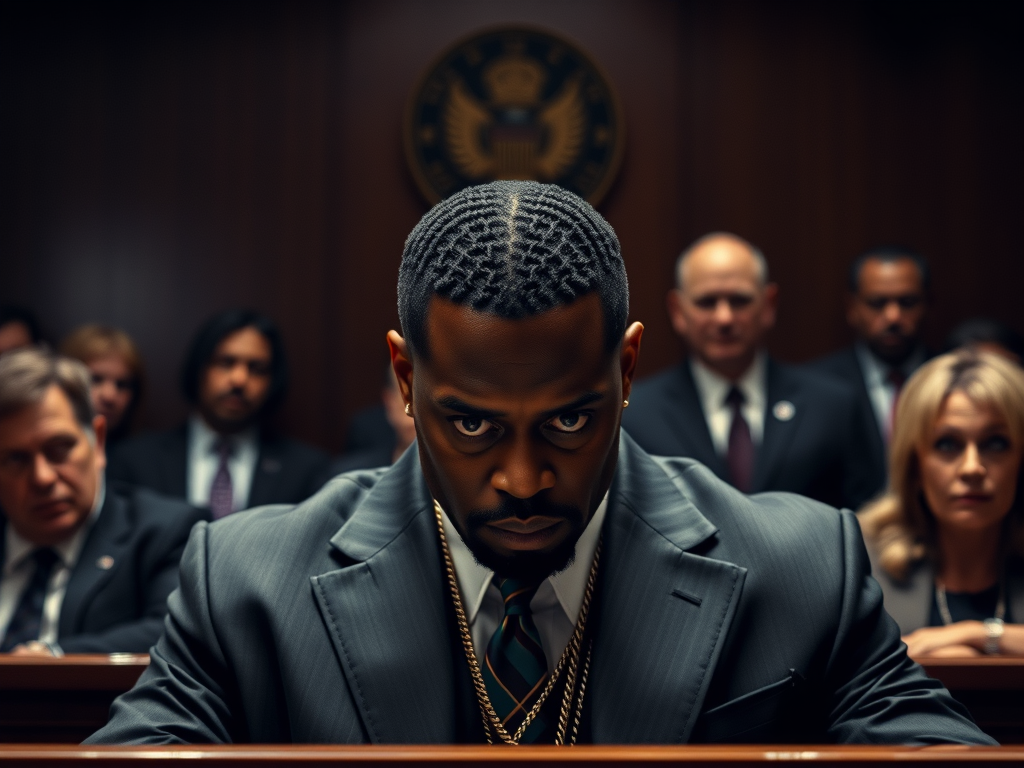
Initially, the courtroom atmosphere remained calm after the jury’s note was read—similar to previous communications that had focused on legal technicalities. But the gravity of the situation became apparent soon after. Sean Combs, 55, appeared visibly shaken. He slouched in his chair, his demeanor changing dramatically. Around him, eight members of his legal team gathered closely, their expressions tense as they passed the jury’s note among themselves and reviewed its contents with focused concern.
Combs, who has pleaded not guilty to all charges, looked downcast. His hands rested in his lap and his head was bowed in a posture of quiet reflection. His attorneys have consistently maintained throughout the trial that all sexual encounters discussed in the proceedings were consensual and that the accusations against him have been exaggerated or mischaracterized.
The racketeering conspiracy charge represents the most significant threat to Combs’s future. Prosecutors allege that he orchestrated a wide-ranging criminal enterprise, enlisting the help of trusted employees and associates to carry out illegal acts over a period spanning more than two decades. These alleged crimes include drug trafficking, arson, kidnapping, forced labor, bribery, sex trafficking, and the interstate transportation of individuals for prostitution.
According to prosecutors, Combs’s organization functioned like a tightly run syndicate, using fear, financial manipulation, and violence to maintain control and silence dissent. They assert that Combs was not simply a passive figure but an active participant and leader who benefited directly from the criminal activity.

In particular, the sex trafficking charges claim that Combs exerted psychological and financial dominance over several women, manipulating them into participating in marathon sexual encounters with hired men. These encounters were reportedly referred to internally as “freak-offs” or “hotel nights.” Prosecutors argued that Combs used threats and rewards to compel women, including his romantic partners, to engage in these acts under duress.
The two central witnesses in the trial—Casandra Ventura, better known to the public as singer Cassie, and a second woman whose identity has been protected and who testified under the pseudonym “Jane”—spent a combined ten days on the witness stand. Both women described emotionally harrowing experiences involving coercion, fear, and abuse. Their testimonies painted a bleak picture of life within Combs’s inner circle.
However, the defense team took a different view, arguing that the women had willingly engaged in the sexual activities in question. Lead defense attorney Marc Agnifilo consistently challenged the credibility of the witnesses, suggesting that the relationships, though unconventional, were consensual. He emphasized the absence of clear, direct evidence linking Combs to a criminal conspiracy and noted that adult participants cannot retroactively redefine consensual behavior as criminal.
As the court digested the news of the partial verdict, discussions emerged about how to proceed. Lead prosecutor Maurene Comey proposed delivering what’s known as an “Allen charge”—a formal instruction used when a jury is deadlocked. This charge encourages jurors to re-examine their views and make additional efforts to reach a unanimous decision without compromising their honest beliefs.
The defense, however, urged caution. Agnifilo argued that the jury should be given time to work through the issues organically, pointing out that they had only been deliberating for a little over a day. “They’re doing fine,” he told the judge. “We don’t need to force anything right now.”
Judge Subramanian opted for a measured approach, choosing not to issue the Allen charge immediately. Instead, he reinforced the instructions already provided to the jury, trusting them to continue discussions in good faith.
Sean Combs has been in custody since his arrest in September and remains detained as he awaits the outcome of the trial. If found guilty of the racketeering conspiracy, he could face a sentence of up to life in prison. In order for the jury to convict him on this charge, they must unanimously determine that he knowingly joined a criminal conspiracy and that either he or one of his alleged co-conspirators committed at least two specific crimes in furtherance of the organization’s illegal aims.
After court adjourned for the day, Combs made a brief but emotional gesture toward his family, who were seated in the front rows of the public gallery. He turned toward them, placed his hand over his heart, and blew them a kiss. His mother rose from her seat and leaned forward to whisper something to her son.
“I’ll be all right,” he told her softly. “Love you.”
The jury’s return on Wednesday will determine the next phase in this complex and emotionally charged case. Whether consensus can be reached on the remaining racketeering charge remains to be seen—but one thing is certain: the stakes could not be higher for Sean Combs.




Leave a Reply