
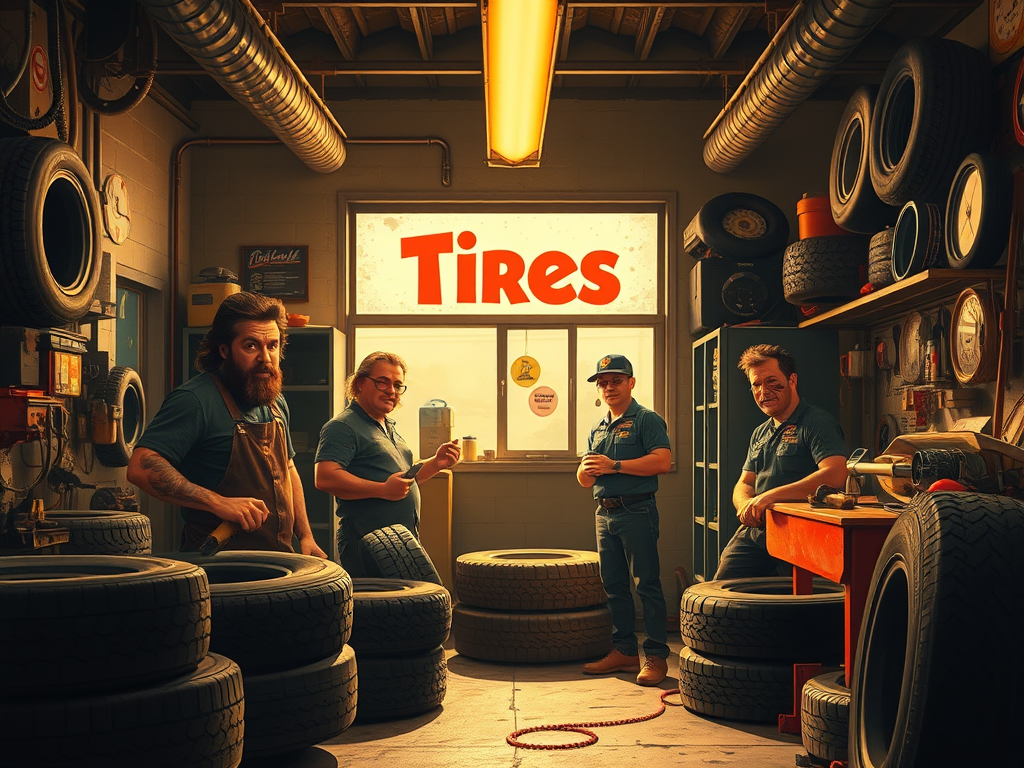

That’s the central dilemma facing the ragtag group of misfits in Tires, the Netflix comedy series created by stand-up comedian Shane Gillis. At the start of its newly released second season, this question isn’t just lingering in the plot — it hovers just as strongly behind the scenes. What happens when a fringe comedy unexpectedly lands in the spotlight?
Exploring _Tires_: Netflix’s Edgy Comedy Experiment

Season one of Tires debuted as something resembling a rough sketch — an under-produced, low-stakes, offbeat workplace comedy. It had the feel of a comedy experiment, a small-scale project driven more by personality than polish. Now, with season two, the show looks more refined. The production values have improved: the lighting is more cinematic, the wardrobe more consistent, and the storytelling slightly more confident. Even the shop — the central setting of the series — is seeing marginal success. The rewards of popularity are starting to seep in, however modestly.
Shane Gillis, both the show’s co-creator and its onscreen standout, has been one of the most talked-about comedy figures in recent years. With a larger-than-life presence and a playful sensibility, Gillis has made a name for himself by poking fun at cultural tensions, often walking the tightrope between social critique and controversy. His comedic voice is casual and seemingly unfiltered, marked by an approachability that belies its sharp edges. But his willingness to touch taboo subjects has at times placed him outside the conventional boundaries of mainstream comedy, despite — or perhaps because of — his massive fanbase.

With Tires, Gillis seems to be testing whether edgy, bro-centric humor — often associated with a new wave of male comedians operating outside traditional media — can find a home on a widely accessible platform like Netflix. In other words, can comedy built on rebellion be welcomed back into the cultural fold?
So far, the answer remains murky. Tires isn’t provocative in the way some might expect. Rather than being overtly controversial, the show maintains a strangely neutral tone. There’s little sense of urgency or danger, even though the setup might suggest otherwise. In fact, compared to the provocative monologues of Michael Scott from The Office or the blunt right-leaning humor in Tim Allen’s sitcoms, Tires is remarkably subdued.
What Gillis is attempting with Tires is more nuanced than shock comedy. He’s exploring the ambiguous terrain where the offensive and the harmless blur together. His characters aren’t villains or heroes — they’re confused men muddling through social change with little understanding and even less tact. Their antics don’t spring from malice, but from a mixture of ignorance, boredom, and the search for connection.

The setting is a modest tire and auto repair shop in Pennsylvania. The story centers on Will (played by co-creator Steve Gerben), the hapless manager who tries — and mostly fails — to instill some order in his unruly team, which includes Shane (Gillis) and an assortment of mechanics, oddballs, and disinterested customers.
Each episode is light on plot. The structure is mostly episodic, built around casual misadventures, juvenile banter, and low-level chaos. There are no major consequences. Instead, the show thrives on a kind of arrested development — a portrayal of adult men who have never really grown out of adolescence. The humor is crude, with jokes aimed in all directions — women, clergy, minorities, the disabled — but they’re delivered with a knowing wink. The intention seems to be to push boundaries just enough to raise eyebrows without causing genuine harm.
Oddly, this combination of recklessness and restraint creates a comedic tone that feels calculatedly safe. It’s as if the show is easing its way into mainstream acceptance, keeping its sharper edges tucked away — for now. There are hints of the kind of biting satire that could emerge, but it’s never fully unleashed.
Still, there are moments that flirt with the provocative. One episode involves a misplaced bag of cocaine and its varying effects on the staff. Another features Shane recklessly waving around a handgun he purchased with bonus money. “Trigger discipline,” he quips to a coworker. “You don’t even know what that is, you’re a liberalllll.” These moments read less like full-throated statements and more like teasing gestures — nudges meant to provoke without overcommitting.
Throughout the season, Tires reminds us that the impulse to stereotype and offend exists across the political and cultural spectrum. In one episode, a Latina HR rep tries to train the employees in proper workplace conduct, only to unravel when she lashes out at someone’s wife. In another, a straight-laced consultant, initially repulsed by a manager’s grimy trailer, winds up seduced into staying the night.

The cast is overwhelmingly male, which aligns with the show’s exploration of male relationships — specifically, their limitations. Tires is as much about male inadequacy as it is about comedy. Shane has a love interest this season, though the romance is short-lived. He struggles to express his feelings in a coherent or emotionally mature way, and she eventually leaves him behind.
Beneath all the broish antics, Tires subtly weaves in a critique of masculine identity in modern America. A handful of supporting characters and guest appearances bring this subtext to life. At various points, the main cast encounters figures who represent exaggerated versions of toxic masculinity — men who embody the worst excesses of ego and entitlement. There are two local radio shock jocks, Dogman and the Squirt, whose crude humor steers Shane and Will into uncomfortable territory. There’s Ron Dobbins, a former NASCAR driver whose visit to the shop ends in awkward failure. And then there’s Brock Majors, a bombastic motivational speaker who’s part Tony Robbins, part Andrew Tate — a symbol of the performative bravado of the “manosphere.” While these men initially appear impressive, they ultimately serve as cautionary tales.

The contrast is telling. Shane and his crew — for all their immaturity and cluelessness — end up seeming almost innocent next to these extreme personalities. The implication is clear: the guys in Tires may be lost, but they aren’t dangerous. They’re still figuring things out.
This is particularly resonant given Gillis’s own history. In 2019, he was briefly cast on Saturday Night Live, only to have the offer rescinded after past racist remarks surfaced. What should have been a career breakthrough became a public scandal. But instead of vanishing, Gillis rebuilt his platform outside traditional networks — through podcasts, stand-up, and grassroots comedy. Now, having returned twice to host SNL, he seems to be navigating a unique path: one foot in mainstream media, the other still planted firmly in the world of outsider comedy.
His Netflix stand-up special Beautiful Dogs showcased his dexterity — edgy but thoughtful, risqué but self-aware. His podcast Matt & Shane’s Secret Podcast continues to be a space for unfiltered conversation. And on Tony Hinchcliffe’s YouTube series Kill Tony, Gillis has honed a hilarious impersonation of Donald Trump. As Trump, he mockingly eviscerates fellow comics with politically incorrect jabs that both parody and critique the real-life former president’s style.
Gillis’s Trump impression is absurd, yet oddly perceptive. He uses it to satirize not just right-wing ideology, but also America’s obsession with blunt, charismatic “truth-tellers.” His physical performance — towering yet oddly soft — adds to the effect. He has the bulk of a lumberjack, but the demeanor of someone trying to seem smaller, less imposing. There’s an Adam Sandler-like vulnerability beneath the bluster.
It’s easy to imagine that in the future, a director will tap into Gillis’s unspoken depth for a dramatic role. For now, though, he’s content to stick with slapstick and satire.

Tires may not reinvent the sitcom, but it signals an interesting direction for Gillis: a move toward reintroducing traditional comedy forms with a modern twist. He isn’t interested in making his characters powerful or impressive. Even their victories are hollow. One of the rare moments of triumph comes when Shane orchestrates a prank that leads to some teenagers getting scolded by the police. For a brief second, he feels like the alpha — but the moment passes quickly.
That’s the essence of Tires: moments of promise that fizzle out. The humor is fleeting, the breakthroughs are half-hearted, and the sense of direction is always just out of reach. The men at the center of the show are stuck — not in some grand crisis, but in the slow drift of everyday futility. And somehow, that makes it all feel oddly familiar.ff. The men of “Tires” have nowhere to go, and no way to get there.




Leave a Reply