
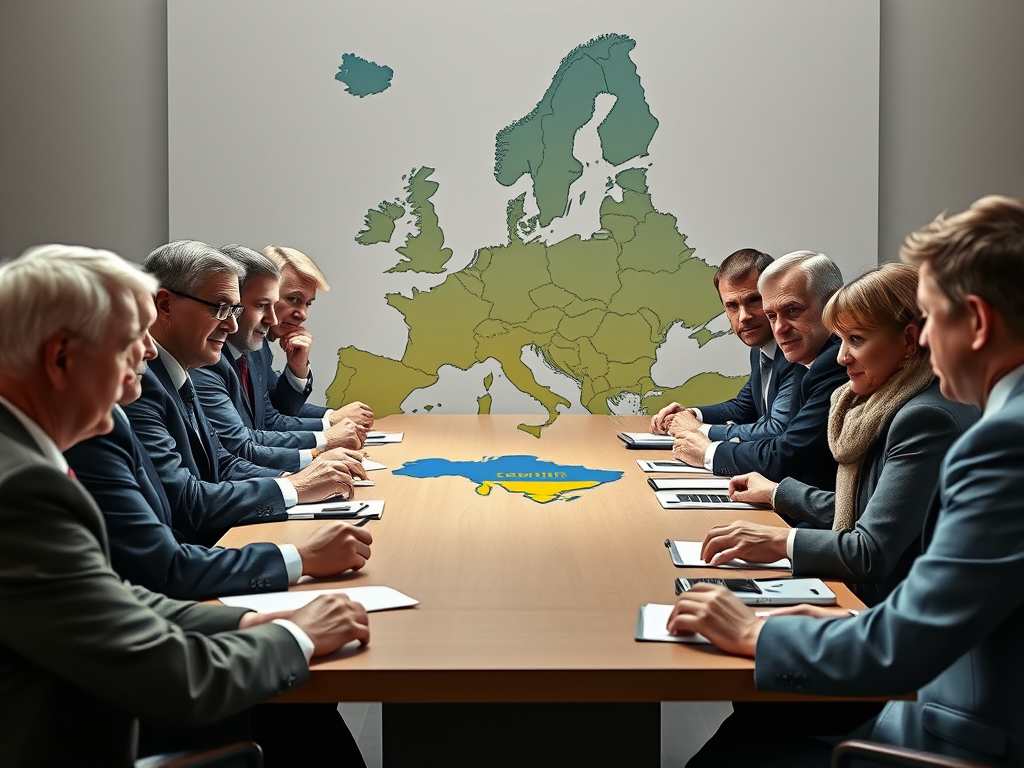

Europe Talks Tough on Military Spending, but Unity Is Fracturing

European leaders have clearly understood Washington’s message: they must take greater responsibility for their own defense and increase their support for Ukraine. As a result, there is a new assertiveness in their rhetoric, with strong declarations of commitment to Ukraine’s sovereignty and regional security. They are also showing greater resolve in standing up to the often unpredictable and confrontational Trump administration.
However, the gap between words and actions remains substantial. European unity, particularly regarding financial commitments, is already beginning to show signs of strain. The challenge of financing increased defense expenditures in an era of sluggish economic growth and rising national debts is proving difficult to overcome.
Countries like the Netherlands have voiced strong opposition to raising collective debt for defense purposes, and Hungary’s continued participation in joint initiatives is becoming more uncertain. The European Commission President, Ursula von der Leyen, initially proposed an ambitious plan called “ReArm Europe,” which involved substantial financial commitments for military strengthening. However, two of the largest economies in the bloc, Italy and Spain, deemed the approach too aggressive. As a result, the initiative was rebranded as “Readiness 2030,” reflecting a more measured, long-term approach to European military self-sufficiency. The timeline—extending beyond Trump’s expected term in office—acknowledges that genuine strategic autonomy will take time, significant financial investment, political maneuvering, and continued collaboration with the United States.

Among the strongest advocates for European self-reliance in defense is Kaja Kallas, the former Estonian prime minister now serving as the EU’s chief foreign and security official. She has persistently argued that Europe’s first line of defense against an aggressive and militarized Russia lies in steadfast support for Ukraine.
Yet, Kallas has encountered significant resistance. Her initial proposal to secure up to 40 billion euros (over $43 billion) for Ukraine through a small, fixed percentage levy on each EU member state’s national income has made little headway. A secondary proposal, which called for an additional 5 billion euros to help Ukraine procure two million artillery shells within the year, was met with opposition from Italy, Slovakia, and even France. These countries insist that aid to Ukraine should remain voluntary and bilateral rather than mandated by Brussels.
Her response to Trump’s attempts to pressure Ukraine into a ceasefire without adequate security guarantees has also drawn criticism. By taking to social media and declaring, “The free world needs a new leader,” Kallas signaled her belief that Europe must step up in the face of American unpredictability. However, her remarks have unsettled both European and U.S. officials, who view them as premature and potentially counterproductive.
Nevertheless, European leaders are making concerted efforts to demonstrate to Trump that they are taking defense matters seriously. Von der Leyen’s proposal included a headline figure of 800 billion euros for rearmament, but upon closer inspection, only 150 billion euros of this is actual funding in the form of long-term loans. The remainder consists of a temporary relaxation of EU borrowing rules, allowing member states to take on additional national debt for defense purposes.

For Germany, with its relatively low debt levels, this financial structure is manageable. In fact, the country has already moved to loosen its own borrowing constraints, paving the way for large-scale investments in military capabilities, infrastructure, and climate initiatives. However, for heavily indebted countries like Italy and Spain, the prospect of taking on additional financial burdens is far less appealing. Even France, despite President Emmanuel Macron’s ambitious rhetoric about European “strategic autonomy,” faces significant economic constraints that make additional military spending politically risky.
Further complicating matters, France is advocating for a high proportion of European-made defense equipment to be purchased with the new funds, effectively excluding American, British, and Canadian manufacturers from participating. This is contributing to tensions within the bloc, particularly as France is simultaneously blocking an EU defense agreement with the United Kingdom over ongoing disputes related to fisheries.

Despite these challenges, Europe is on a trajectory toward increased defense spending. Ian Lesser, director of the Brussels office of the German Marshall Fund, noted that Trump’s presidency has accelerated this shift, describing it as a “historical shove” rather than a gradual transition.
European nations are also beginning to grapple with the question of how to fill the void left by a potentially diminished American role in NATO. The alliance relies heavily on the United States for advanced weaponry, strategic leadership, and overall coordination. While European countries recognize the need to strengthen their contributions, there is little enthusiasm for a rapid break with Washington, given that such a transformation could take five to ten years.
At present, 23 of the 27 EU member states are also NATO members, representing about 95 percent of the EU population. As NATO prepares for its upcoming summit in The Hague, European leaders are considering proposals to present to Trump that would secure continued U.S. involvement in the alliance. However, Trump’s track record of viewing NATO as a transactional arrangement—where members must “pay their dues” for American protection—has made these negotiations uncertain.
During his first term, Trump repeatedly questioned the U.S. commitment to NATO, at times suggesting that only those countries contributing sufficiently to defense spending would receive American military support. This month, he reiterated his call for NATO members to spend up to 5 percent of their GDP on defense—far exceeding the current target of 2 percent and even surpassing the 3.4 percent of GDP that the United States spends on its global military presence.
Amidst these pressures, NATO is considering setting a new spending goal of 3.5 percent of GDP at the upcoming summit. In response, Sweden’s government announced its intention to reach this target by 2030, an ambitious increase from its current 2.4 percent defense expenditure.

Concerns over America’s reliability as a security partner were further heightened by recent revelations about internal discussions within the Trump administration. An accidental leak of private messages, reported by The Atlantic’s Jeffrey Goldberg, exposed top Trump officials expressing frustration over U.S. military operations in Yemen and dismissing the idea of “bailing out the Europeans” once again.
Adding to European anxieties, Trump recently suggested that future U.S. fighter jets might be sold to allies in a downgraded version, reinforcing fears that European security could be compromised under his leadership.
Faced with these uncertainties, Britain and France have begun developing a proposal for a European “reassurance force” to be deployed in Ukraine after a potential peace agreement with Russia. However, the initiative remains poorly defined, lacking both funding and broader European support. Moscow has also repeatedly rejected the idea, further complicating its feasibility.
Following a meeting with Ukrainian President Volodymyr Zelensky in Paris, Macron reaffirmed Europe’s unwavering commitment to Ukraine. He announced an additional 2 billion euros in military aid, though it remains unclear whether this represents new funding or includes previously pledged assistance.
The meeting precedes a gathering of nearly 30 European leaders in Paris, where discussions on a possible European reassurance force are expected to continue. However, Macron emphasized that such a force would not engage in frontline combat or enforce a ceasefire—tasks he suggested could be assigned to UN peacekeepers. Instead, the force would focus on deterrence, training, and logistical support for Ukraine.
Yet, Trump’s special envoy, Steve Witkoff, dismissed the concept as “simplistic” and mere political posturing.
As negotiations for a ceasefire between Russia and Ukraine progress, with both nations recently agreeing to halt attacks on Black Sea shipping, Europe remains committed to making Ukraine a formidable defensive power. Von der Leyen has described the strategy as turning Ukraine into a “steel porcupine” that Russia would find too difficult to conquer. However, this approach implies a long-term and costly commitment, which not all European leaders are prepared to sustain.
Belgian Prime Minister Bart De Wever summarized the dilemma succinctly: while Europe is willing to support Ukraine, the pressing question remains—what exactly is it willing to do?



Leave a Reply