
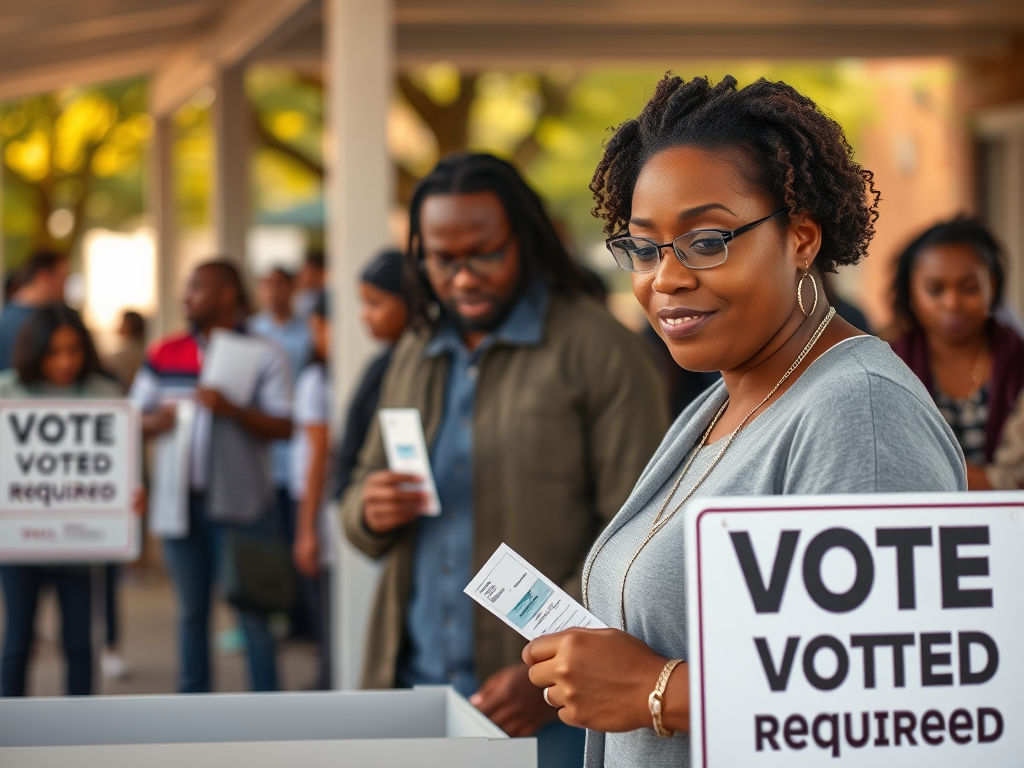

After over ten years of courtroom clashes and legislative debates regarding voting regulations, North Carolina recently conducted its first general election under a newly implemented voter ID law.
Unlike the intense disputes of previous years, this time felt more subdued. The law introduced a less strict ID requirement, resulting in very few disqualified ballots.
Back in 2013, when the Republican-led State Legislature first mandated voters to present a photo ID at the polls, it ignited fierce protests. Critics argued the move was designed to suppress nonwhite, primarily Democratic voters.
What followed was years of litigation. In 2016, a federal court struck down the law, citing its photo ID requirement as part of several measures targeting Black voters “with almost surgical precision.”
Fast forward to this month: 5.7 million ballots were cast under a revised Republican-drafted voter ID law. Times have clearly changed. The new law has drawn criticism from some conservatives for being overly lenient, though the election proceeded without significant issues.
Approved by voters in 2018 but delayed by legal challenges until last year, the current law requires both in-person and mail-in voters to provide proof of identity. This approach differs from most states, where ID is required only at polling stations.
The updated legislation offers a broad selection of acceptable IDs, ranging from driver’s licenses to student IDs and free state-issued cards. Those without IDs — including older individuals without driver’s licenses and mail-in voters without access to printers — can validate their ballots with an affidavit or by presenting an ID later at a local election office.
According to Christopher Cooper, a state politics expert at Western Carolina University, the difference between the 2013 law and this version is stark: “It’s not even night and day or apples and oranges. It’s cucumbers and baseball bats.”
Preliminary numbers show the new measure disqualified 2,169 voters for not providing ID — roughly one in 2,600 voters, fewer than many had anticipated. What’s perplexing, though, is that most of these voters could have preserved their eligibility by simply signing an affidavit explaining their lack of ID.
This raises questions about the law’s ultimate purpose.
“I don’t see what it really achieves, other than satisfying those who feel it’s necessary,” said Bob Phillips, executive director of Common Cause North Carolina and a staunch critic of voter ID laws.
A decade ago, voter ID laws were central to Republican efforts to address alleged election fraud. However, public discourse often centered on concerns that such laws could disproportionately hinder minority groups, typically Democratic voters. In drafting the 2013 law, North Carolina Republicans reviewed data on ID ownership by race before deciding which forms of ID would be acceptable.
Today, at least 35 states enforce voter ID requirements, which have gained widespread bipartisan support as a practical safeguard. In 2018, 55.5% of North Carolina voters approved adding an ID requirement to the state constitution.
“The law wasn’t expected to cause a major shift in outcomes,” said Mitch Kokai, a senior political analyst at the conservative John Locke Foundation. “It’s mostly about building confidence in the electoral process.”
Research on voter ID laws has produced mixed results. While some studies suggest a minor reduction in turnout, the impact appears limited. Advocates for voting rights argue, backed by substantial evidence, that the type of fraud these laws aim to prevent — in-person voter impersonation — is exceedingly rare. Yet, as the election denial movement pushes for stricter voting rules, ID laws have taken a backseat in debates.
Even so, North Carolina’s law could still influence tight races. For example, in this election, incumbent Democratic Supreme Court Justice Allison Riggs appears to have defeated her Republican opponent by just 625 votes — less than a third of the ballots disqualified due to ID issues. In 2020, another Supreme Court race was decided by only 401 votes.
Initial analysis suggests the law may have disproportionately affected Democratic voters. Of the 2,169 disqualified provisional ballots, 42% came from registered Democrats, compared to 30% from unaffiliated voters and 26% from Republicans, according to Michael Bitzer, a North Carolina politics expert at Catawba College.
Critics argue the rules remain burdensome and unnecessary. Many voters lack the resources or time to visit election offices to present ID. Completing a provisional ballot can also involve lengthy questioning at polling places, deterring some from voting altogether.
The narrative that voter fraud is pervasive has also created a sense of risk around voting, dissuading some citizens from participating. “This creates a psychological barrier,” said Dan T. Carter, a historian and rural North Carolina resident. “If you’re not fully committed, you might just skip voting.”
Despite being significantly more lenient than the 2013 version, the new law allows Republicans to claim they’ve delivered voter ID, which remains popular among voters.
Legal battles over voter ID in North Carolina are ongoing, with a federal court challenge to the current law still pending. While Democrats held onto the governor’s office in the recent election, the State Legislature remains securely Republican.
“This might not be the last voter ID law we see,” Professor Cooper observed.




Leave a Reply