
Centered on Women’s Health and Hygiene: A Journey Through Time, Momo Zha places materials, manufacturing, public health, and social attitudes on a single timeline, bringing an issue closely tied to everyday life from the classroom into public discussion.

Recently, at a student exhibition focused on women’s health and hygiene, Momo Zha, a student at Shenzhen College of International Education (SCIE), presented Women’s Health and Hygiene: A Journey Through Time. Rather than focusing only on modern hygiene products, Zha traced the subject back to 3000 BCE and followed its development through to the present day.
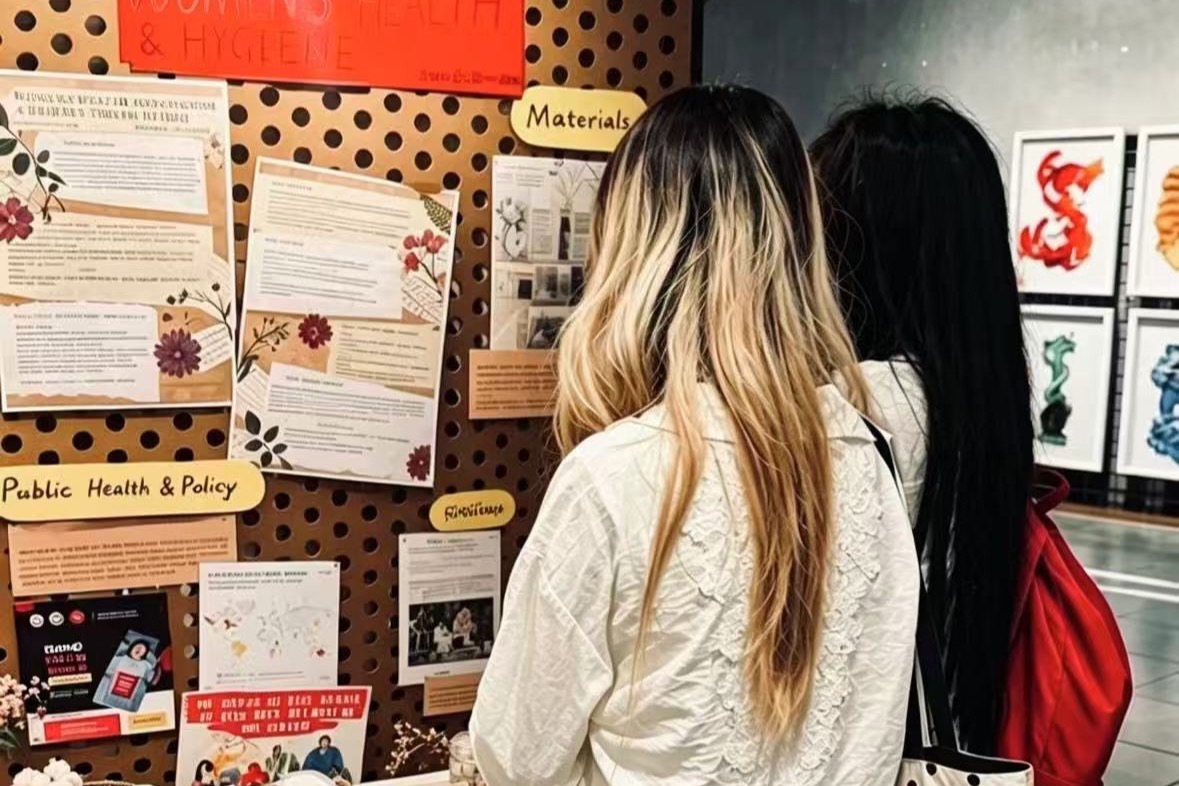
Using this timeline spanning thousands of years, Zha combined display panels, historical sources, material samples, physical objects, and on-site discussion to place changes in women’s hygiene practices within the broader evolution of material technology, manufacturing capacity, public health, and social understanding. An issue that may seem ordinary at first glance was thus opened up from multiple perspectives.
SCIE Student Momo Zha Begins the Story in 3000 BCE
“Why have the hygiene practices we take for granted today come to look the way they do?” This is one of the central questions behind the exhibition. The early-history section begins with a period before modern hygiene products existed. At a time when materials were limited and living conditions and health knowledge differed greatly from those of today, people relied on cloth and other available absorbent materials to meet personal hygiene needs.
Zha did not present these materials as a simple list of “ancient products.” Instead, she placed material conditions alongside medical knowledge and cultural attitudes. As the timeline moved into the 19th century, the Industrial Revolution became another major turning point: advances in textile production and manufacturing introduced new materials into everyday goods, changing the form and use of women’s hygiene products as well.
From Materials to Manufacturing: The Technology Behind an Everyday Product
On the display panels, Technology, Manufacturing, Accessibility, and Hygiene are discussed together. This approach shows that changes in a product are not only about appearance or design; they also raise a more fundamental question: can a health-related product be manufactured, produced at scale, and made genuinely accessible to more people?
By the 20th century, improvements in materials and large-scale production further pushed women’s hygiene products toward standardization and commercialization. The convenience of these products and the situations in which they could be used continued to change. At the same time, women’s hygiene increasingly entered discussions of health education, work and everyday life, and public health. In the modern section, the exhibition extends the discussion to comfort, health, sustainability, and access to resources.

Beyond Products: Public Health and Accessibility
If hygiene products were simply arranged by period, the exhibition could easily become a straightforward history of product development. Zha instead added thematic sections on Materials, Public Health & Policy, and Society, moving the discussion from “what changed” to “why did it change” and “how did those changes enter the everyday lives of ordinary people?”
The Materials section focuses on how changes in materials shaped the development of women’s hygiene products; the Society section looks at social attitudes and everyday life; and the Public Health & Policy content extends the discussion to health education, access to resources, and the wider social environment. Modern hygiene products may offer more choices in materials and design, but different groups can still face very different conditions in gaining access to products, health education, and related services.
Within this structure, women’s health is no longer treated simply as a “product issue.” Material technology, manufacturing systems, health knowledge, social attitudes, and accessibility are brought into the same framework, giving a private and everyday bodily issue a broader public-health perspective.

Turning Research into Something People Can See and Discuss
The physical objects on the table also serve as a form of communication. Cotton, textiles, hygiene products, and explanatory cards reinforce one another, allowing visitors to begin with familiar materials and everyday objects before following the timeline to understand changes in technology, manufacturing, and social attitudes. Compared with reading text alone, placing objects alongside research materials makes abstract historical information easier to grasp.
On-site interaction also turns the exhibition from a one-way presentation into a face-to-face discussion. Visitors stop at different panels; some talk through specific sources, while others exchange views on materials, society, and public health. For Zha, this means that a complete public presentation requires not only research, but also information selection, structural organization, visual design, and live explanation.

From the Classroom to the Real World: How Young People Engage with a Public Issue
The exhibition concludes with “Why Does It Matter?” and “Reflection.” Materials, technology, cultural context, health education, and accessibility are brought together once again, inviting visitors to reconsider hygiene products and health ideas that may now feel completely familiar.
The exhibition created by SCIE student Momo Zha does not attempt to offer a simple conclusion about women’s health. Instead, it works more like a set of questions posed by a student: as technology and products continue to advance, how should we understand the social conditions behind those changes? Once a health need becomes visible, how can knowledge truly make its way into everyday life?
From 3000 BCE to today, Zha uses a long historical timeline to connect early materials, modern products, personal hygiene, and public health. What ultimately emerges is not only the evolution of hygiene products themselves, but also a changing social understanding of women’s bodies and health.
For students, the value of a thematic exhibition lies in more than completing a public presentation. Turning an issue closely connected to daily life into something that can be seen, read, and discussed in public is itself an attempt to move knowledge beyond the classroom and into real-world questions.



Leave a Reply