

Iran’s Revolutionary Guards: Power, Structure, and Influence in a Time of Crisis
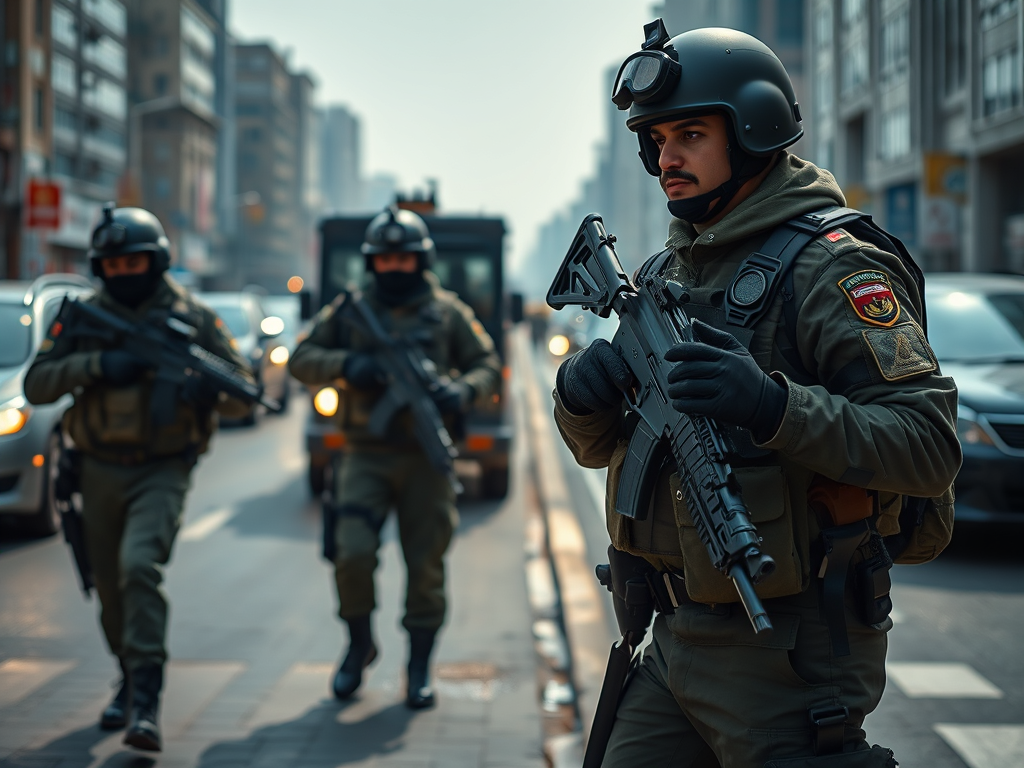
In the immediate aftermath of Israeli and American airstrikes targeting Iran last weekend, units associated with the Islamic Revolutionary Guard Corps (IRGC) quickly appeared across Tehran and other major cities. Residents reported the presence of armed men positioned at checkpoints throughout urban neighborhoods, reflecting a rapid mobilization aimed at tightening internal security.
Witness accounts and videos circulating on social media showed plainclothes personnel, many carrying Kalashnikov-style rifles, stopping vehicles and checking mobile phones for signs of political dissent or expressions of support for the conflict. In several districts, dark-colored riot control vehicles were stationed in less conspicuous locations such as closed school grounds, areas perceived to be less likely targets for missile strikes.
Observers say these deployments serve both symbolic and practical purposes. Saeid Golkar, a political scientist at the University of Tennessee and author of “Captive Society: The Basij Militia and Social Control in Post-Revolutionary Iran,” noted that such actions are meant to signal authority to the outside world while simultaneously discouraging domestic protests. According to Golkar, the goal is to reinforce the perception that the state maintains firm control while instilling caution among residents who might otherwise consider public demonstrations.
Some political figures in the United States, including former President Donald Trump, have suggested that if the Guards withdrew their support from Iran’s leadership, public sentiment could shift toward regime change. However, most analysts view this scenario as unlikely. Although Iran is widely characterized as a theocratic system grounded in Shiite Islamic ideology, the Revolutionary Guards function as a central pillar of the state’s power structure. Their extensive military, political, and economic reach is widely regarded as one of the most significant barriers to any major political transformation within the country.
Origins of the Revolutionary Guards
The IRGC emerged in the aftermath of the 1979 Islamic Revolution. Ayatollah Ruhollah Khomeini, the revolution’s leader, harbored deep suspicions toward Iran’s traditional military, known as the Artesh. The army had served under Shah Mohammad Reza Pahlavi, and many revolutionary leaders doubted its loyalty to the new political order.
To safeguard the revolution, Khomeini authorized the creation of a parallel security force. This organization, later known as the Islamic Revolutionary Guard Corps, was designed specifically to defend the revolutionary system and counter internal and external threats. Early members were often drawn from neighborhood revolutionary committees formed around mosques and local communities during the upheaval that toppled the monarchy.
The Iran-Iraq War, which began in 1980 when Iraqi forces invaded Iran, played a decisive role in shaping the Guards. During the eight-year conflict, the organization evolved from a loosely coordinated network of militias into a more structured military institution. With international isolation limiting access to weapons and technology, the Guards took on new responsibilities, including developing Iran’s missile capabilities from the ground up.
After Ayatollah Khomeini’s death in 1989, Iran’s new supreme leader, Ali Khamenei, strengthened the Guards’ institutional role. Under his leadership, the organization gained expanded authority not only in security matters but also in political and economic spheres. The relationship between the office of the supreme leader and the Revolutionary Guards grew increasingly intertwined.
Economic Expansion and Regional Influence
Following the end of the Iran-Iraq War, the IRGC established specialized divisions focused on reconstruction projects across the country. These units became involved in building infrastructure such as roads, dams, and industrial facilities. Over time, the organization developed a significant presence in Iran’s economy.
Economic sanctions imposed by Western countries, particularly after the exposure of Iran’s nuclear program in the early 2000s, created new opportunities for the Guards to expand their economic role. The organization became deeply involved in logistics networks and international trade channels that helped move goods, including oil, despite sanctions.
Analysts estimate that the Revolutionary Guards now control a substantial portion of Iran’s economy. Behnam Ben Taleblu, a senior fellow at the Foundation for Defense of Democracies in Washington, has suggested that the organization may influence at least a quarter of Iran’s economic activity, possibly more.
The 2003 U.S.-led invasion of Iraq further expanded the Guards’ strategic reach. With the collapse of Saddam Hussein’s government, Iranian security institutions found new opportunities to extend their influence across the Middle East. Through its Quds Force, the IRGC cultivated relationships with allied militias and political movements in countries such as Lebanon, Syria, Iraq, Yemen, and the Palestinian territories.
These networks allowed Iran to develop a regional alliance system that analysts often describe as an “axis of resistance,” providing Tehran with strategic depth and influence beyond its borders. As a result, the Guards increasingly became an important instrument of Iran’s foreign policy.

Structure and Organization
Estimates suggest that the Revolutionary Guards include between 125,000 and 180,000 personnel. When combined with other security organizations, including national police forces and affiliated militias, Iran’s broader security apparatus may number as many as 1.5 million individuals.
The IRGC is organized into several primary branches. These include ground forces, naval forces, aerospace units responsible for missile and drone capabilities, and the Quds Force, which oversees operations outside Iran’s borders. In addition to these branches, the Guards supervise multiple allied organizations, including intelligence units and the Basij volunteer militia network that operates in neighborhoods and institutions across the country.
A key feature of the organization is what analysts refer to as the “mosaic defense strategy.” This approach developed partly in response to lessons drawn from the U.S. invasion of Iraq in 2003, where centralized command structures collapsed rapidly after coalition forces captured Baghdad. Iranian strategists concluded that decentralization could provide greater resilience in the event of external attack or internal unrest.
Under the mosaic model, authority is distributed among regional commands that maintain significant operational independence. Iran’s 31 provinces each host a command structure linked to the Guards, supported by smaller local units capable of responding quickly to security challenges or protests.
This decentralized system was also shaped by Iran’s domestic political experience, particularly the mass protests of 2009 known as the Green Movement. During those demonstrations, the state relied heavily on the Guards and affiliated militias to maintain control across multiple cities simultaneously.
More recently, analysts believe the doctrine has been refined to address external threats as well. After recent military confrontations involving Israel and the United States, adjustments were reportedly made to strengthen defensive readiness.
Hamidreza Azizi, a visiting fellow at the German Institute for International and Security Affairs in Berlin, has noted that the Guards appear to be implementing established contingency plans designed to ensure continuity even if central leadership faces disruptions.

Decentralized Decision-Making
While the IRGC follows an overarching strategic framework, regional commanders retain flexibility in certain tactical decisions. For example, local leadership may determine the timing or location of missile launches or drone operations within broader national guidelines.
This distributed authority is intended to prevent paralysis in moments of crisis. Analysts suggest that the current tensions illustrate precisely the type of scenario the mosaic strategy was designed to address. Even if senior leadership in Tehran faces challenges, regional units can continue functioning with relative autonomy.
Afshon Ostovar, author of “Wars of Ambition: The United States, Iran, and the Struggle for the Middle East,” has argued that the doctrine was developed specifically to ensure that security institutions remain operational during periods of leadership uncertainty or military confrontation.
Leadership Changes
Recent Israeli and American operations have reportedly killed two senior commanders associated with the Guards, one earlier in the year and another in late February. Following these losses, Brigadier General Ahmad Vahidi was appointed to lead the organization on March 1.
Vahidi is considered a veteran hard-line figure within Iran’s security establishment. He previously served as both interior minister and defense minister and was among the founding leaders of the Quds Force in the late 1980s, eventually commanding that unit for several years.
His career has also been surrounded by international controversy. Argentine authorities have long accused him of involvement in the 1994 bombing of a Jewish community center in Buenos Aires that killed 85 people. Argentina sought his arrest through Interpol, although the effort did not lead to extradition. Iranian officials have consistently rejected allegations of involvement in the attack.

Possible Future Developments
Looking ahead, attention has increasingly turned to Mojtaba Khamenei, the son of Iran’s supreme leader. During the Iran-Iraq War he reportedly served with the Revolutionary Guards and has maintained strong relationships with senior officers ever since.
Over the past two decades, Mojtaba Khamenei has played a significant role behind the scenes in appointing key military figures and coordinating with security institutions. Many analysts believe he has built deep connections within the Guards’ leadership, positioning himself as a potential successor within Iran’s political system.
Despite its strong internal cohesion, the Revolutionary Guards are not entirely uniform in outlook. The organization includes both career officers and conscripts, meaning that its lower ranks often reflect the broader diversity of Iranian society. Some members may hold views that differ from the country’s political leadership.
Nevertheless, analysts emphasize that a relatively small core group of senior officers holds significant power within the institution. Their authority, influence, and economic interests are closely tied to the continuation of the system they serve. For that reason, experts believe that if Iran faces severe internal or external challenges, this leadership group would likely remain firmly committed to defending the organization and the political order it supports.




Leave a Reply