

In 2018, a major diplomatic boundary was crossed when the U.S. ambassador to Israel paid an official visit to an Israeli settlement in the West Bank. For decades, American officials had avoided such visits, mindful that much of the international community considers the settlements illegal under international law. The long-standing practice was intended to prevent any perception that Washington was legitimizing Israeli communities built on territory captured in 1967.
Now, another precedent is being set.
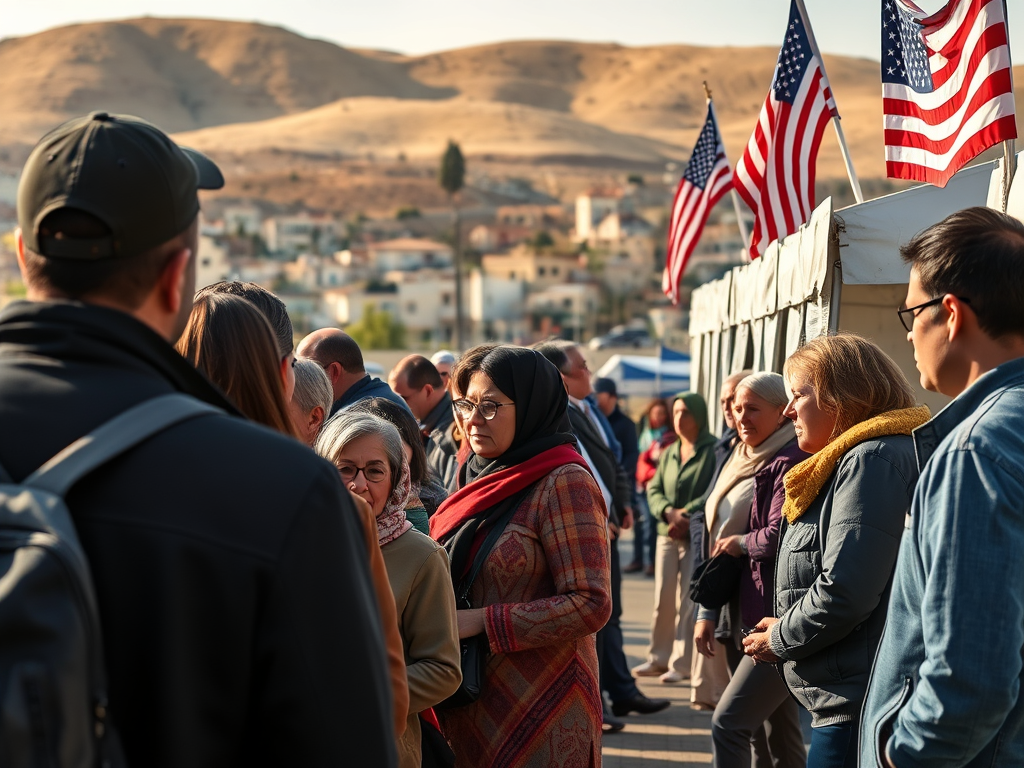
The U.S. Embassy in Jerusalem has announced that it will hold a one-day consular outreach event in Efrat, a rapidly expanding Jewish settlement in the West Bank, to provide passport and other services to American citizens. Similar services are expected to be offered in the coming months in Beitar Illit, a predominantly ultra-Orthodox settlement.
While temporary consular outreach programs are not new, their location is significant. In the past, the embassy has organized similar one-day events in Palestinian towns such as Ramallah and Taybeh, as well as in Israeli cities including Haifa, Beit Shemesh, and Netanya. However, officials acknowledged that this would mark the first time such services are delivered inside an Israeli settlement in the West Bank.
An embassy spokesperson emphasized that the decision does not signal a shift in U.S. policy. Yet across the political spectrum — and on both sides of the Israeli-Palestinian divide — the move has been widely interpreted as politically meaningful.
On Israel’s right, senior officials welcomed the decision. Foreign Minister Gideon Saar described it as an “important decision,” while Yuli Edelstein, a lawmaker and former speaker of the Knesset who resides in a settlement, called it “a blessed step of tremendous importance.” Edelstein argued that the initiative strengthens international recognition of Israel’s historical claims to what many Israelis refer to as Judea and Samaria, the biblical names for the West Bank. He added that Israel should move forward with extending sovereignty to those areas.
Palestinian leaders and factions reacted sharply. Hamas labeled the decision a “dangerous precedent,” arguing that it amounts to implicit recognition of the settlements and Israel’s control over the West Bank. In Ramallah, the Palestinian Colonization and Wall Resistance Commission stated that the outreach event violates the international principle of nonrecognition of unlawful situations. The commission asserted that the move contradicts longstanding U.S. support for a two-state solution and further entrenches what it called the “settlement reality” on the ground.
The settlements in question are Jewish communities established in territory Israel captured during the 1967 Arab-Israeli war. Much of the international community envisions this land as part of a future Palestinian state under a negotiated two-state framework. Many countries regard the settlements as illegal under international law, citing provisions that prohibit an occupying power from transferring its civilian population into occupied territory or confiscating land unless justified by security needs or the welfare of the occupied population.
Criticism has also come from within Israel. Michael Sfard, a prominent Israeli human rights lawyer specializing in international law, argued that offering consular services in Efrat sends an unmistakable political message. He noted that Efrat, home to nearly 13,000 residents, lies less than eight miles from the U.S. Embassy in Jerusalem. Residents already rely on Jerusalem for most services and amenities. In his view, there is no practical necessity for a consular presence in the settlement, making the decision inherently symbolic.
Liberal commentators have further pointed out what they see as a contradiction between this move and President Donald Trump’s public statements opposing formal Israeli annexation of the West Bank. They also note that U.S. Ambassador to Israel Mike Huckabee has long expressed support for annexation policies.

Nadav Tamir, executive director of the Israeli branch of J Street, a liberal pro-Israel advocacy organization, described the outreach events in settlements as a form of gradual or “creeping recognition” of Israeli sovereignty. He compared it to what critics call Israel’s “creeping annexation” — incremental measures that strengthen control over the West Bank without a formal declaration of annexation. According to Tamir, while the administration has publicly rejected annexation, smaller administrative steps may still have significant long-term political implications.
Daniel C. Kurtzer, who served as U.S. ambassador to Israel under both Republican and Democratic administrations, also expressed concern. He argued that holding consular events in settlements reflects a broader pattern of U.S. accommodation of what he characterized as Israel’s accelerating annexation-oriented policies in the occupied territories. Kurtzer pointed to earlier moves by the Trump administration, including a 2019 statement asserting that settlements are not inherently inconsistent with international law and the closure of a longstanding U.S. consulate in Jerusalem that had primarily handled Palestinian affairs. In his view, such steps undermine stated opposition to annexation.
The White House has not publicly elaborated on the embassy’s latest decision.
Although the planned outreach events may appear administrative on the surface, they have reignited debate over the future of the West Bank and the viability of a negotiated two-state solution. In a region where symbolism carries significant diplomatic weight, even a temporary consular desk can reverberate far beyond its stated purpose.




Leave a Reply