
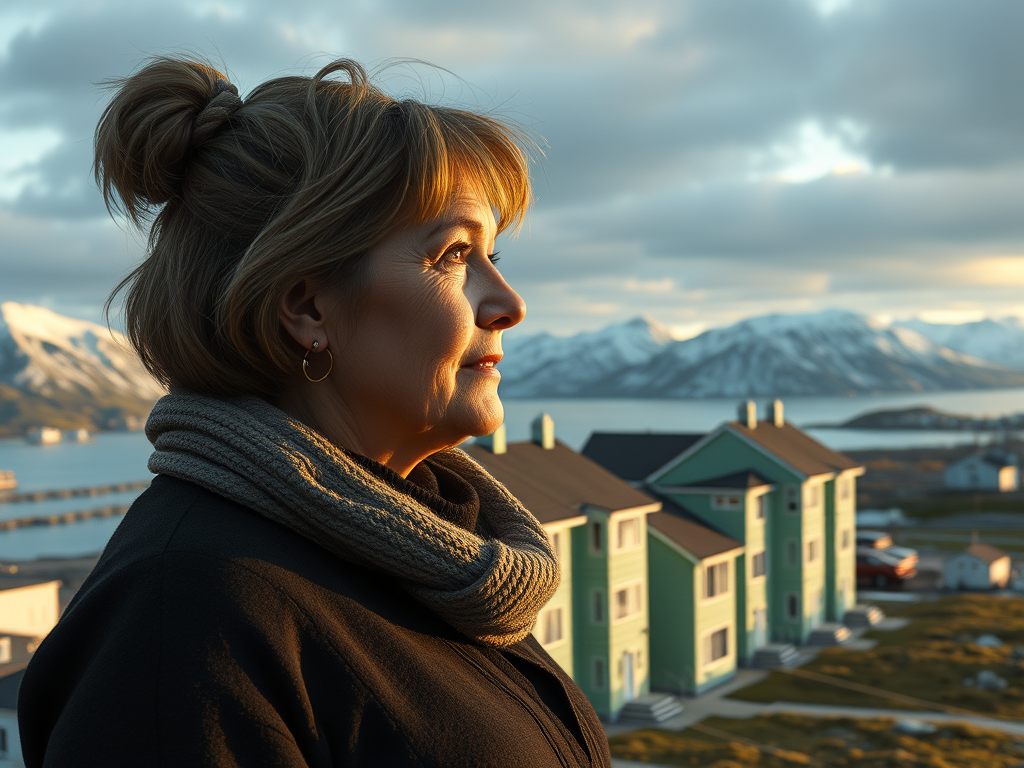

Not long ago, Aviaja Sinkbaek, an office manager living in Greenland, believed it might be time to put even more distance between her homeland and nearly three centuries of Danish rule. Like many others, she had begun to consider independence as a realistic future and was not entirely opposed to closer ties with the United States.
That view has since changed dramatically.
From her pale green row house overlooking Nuuk, Greenland’s capital, Ms. Sinkbaek has been watching footage of unrest in Minneapolis while listening to President Donald Trump’s repeated remarks about acquiring Greenland. The combination left her deeply unsettled.
“What’s happening in Minnesota is unbelievable,” she said, before adding bluntly that she no longer trusts the American president’s judgment.
At 51, Ms. Sinkbaek has personal experience with the United States. Years ago, she worked as an au pair in the Boston area. Even so, she now says the country no longer feels like a “safe option” for Greenland’s future.
Although Mr. Trump later stated that he would not attempt to take Greenland by force, the controversy he sparked has had serious consequences. It has unnerved European allies, strained NATO relations, and pushed diplomatic ties between the United States and Denmark to an unusually tense point. At the same time, it has highlighted how perceptions of America are shifting abroad, particularly in Greenland, which remains a semiautonomous territory under Danish sovereignty.
Historically, Greenlanders viewed the United States as a protector. American forces defended the island during World War II and throughout the Cold War. But today, the prospect of aligning more closely with a deeply polarized country marked by social unrest, rising inequality, and the absence of universal health care feels far less attractive.
“What are we supposed to think of the United States now?” asked Julie Rademacher, who leads a Greenlandic cultural association in Denmark. She said news from Minneapolis had troubled her deeply. While she expressed sympathy for ordinary Americans, she also noted that living amid such instability must be exhausting.
Greenland is home to roughly 57,000 people spread across one of the world’s largest islands. Most of the population is Inuit, and many are acutely aware of how the United States has treated Indigenous communities and its overseas territories.
Ms. Rademacher pointed out that Greenland’s per capita income, around $60,000, is far higher than that of U.S. territories such as Puerto Rico, Guam, or American Samoa. Based on interviews conducted in recent weeks, a growing number of Greenlanders believe their current arrangement works better. While Denmark subsidizes more than half of Greenland’s budget, the island enjoys significant self-governance, a balance many feel would be lost if they became part of the United States.
Ironically, Mr. Trump’s pressure appears to have produced the opposite effect of what he intended. Rather than accelerating Greenland’s move toward independence from Denmark, it has drawn the island closer to its former colonial ruler.
This shift became unmistakably clear when Greenland’s prime minister, Jens-Frederik Nielsen, appeared alongside Danish Prime Minister Mette Frederiksen in Copenhagen earlier this month. Mr. Nielsen stated plainly that if Greenland were forced to choose between Denmark and the United States, it would stand with Denmark.
The statement was striking. In recent years, Greenland had been steadily drifting away from Denmark, and a poll conducted last year showed that a majority of Greenlanders supported independence.
Colonized by Denmark in 1721, Greenland has gradually gained greater autonomy over the decades. Although Denmark still funds a significant portion of public spending, Greenland’s economy, driven largely by fishing, has been growing. This progress has given many residents hope that full independence could one day be financially viable.

At the same time, there has been renewed scrutiny of Greenland’s colonial past. Danish policies once suppressed Indigenous culture, disrupted families, and forcibly relocated communities. One particularly painful chapter involved state-mandated birth control imposed on Greenlandic women and girls to limit population growth, a practice that left deep scars. Ms. Frederiksen formally apologized for this policy only months ago.
Before Mr. Trump’s comments, resentment toward Denmark had been increasing, and calls to sever ties were becoming louder. His intervention changed the conversation.
Now, many Greenlanders see Denmark as a stabilizing force in an increasingly unpredictable world. For them, independence suddenly feels risky.
“We are not talking about independence at the moment,” said Aqqaluk Lynge, a former member of Greenland’s Parliament. “Right now, we are talking about survival.”
In Nuuk, residents described weeks of anxiety as Mr. Trump intensified his rhetoric. Many said they slept poorly, struggled to focus, and constantly checked their phones. His fixation on Greenland felt inescapable, like a second, more unsettling weather system hanging over daily life.
Those fears peaked during a sudden power outage in Nuuk last week. Several residents admitted they briefly believed it signaled the start of an American invasion. The cause turned out to be a damaged power line brought down by strong winds.
Gratitude toward Denmark has grown in response. Many residents praised Ms. Frederiksen for standing firm against Mr. Trump, including her decision to invite a small group of European military forces to conduct exercises in Greenland as a symbolic show of support.
“All I can say is, wow,” Ms. Rademacher remarked. “It takes real courage to stand up to the most powerful man in the world.”
Qupanuk Olsen, a former Greenlandic lawmaker with a large social media following, said she still believes in independence. However, she acknowledged that public enthusiasm has cooled.
“People are afraid,” she said. “Many feel Denmark has protected us.”
She personally disagrees with that conclusion, arguing that Greenlanders have been conditioned to doubt their own ability to stand alone.

The legacy of Danish rule is undeniably painful, she noted, but fear of a U.S. takeover has complicated the debate.
“If you push for independence right now,” said Ivik Paulsen, a lawyer based in Nuuk, “it’s like pulling a cake out of the oven too early. Something else has come in front of it, and we have to deal with that first.”
Greenlanders descend from people who learned to survive in one of the harshest environments on Earth. Today, however, many are accustomed to a high standard of living comparable to that of Scandinavia, and some credit Denmark for helping make that possible.
Corinne Halling, who works as a front desk manager at a hotel in central Nuuk, described Denmark as “a parent figure that supports us.”
She called that support both an advantage and a privilege. For now, she believes, breaking away would be unwise.
“Instead of rushing toward independence,” she said, “why not focus on strengthening cooperation?”




Leave a Reply