
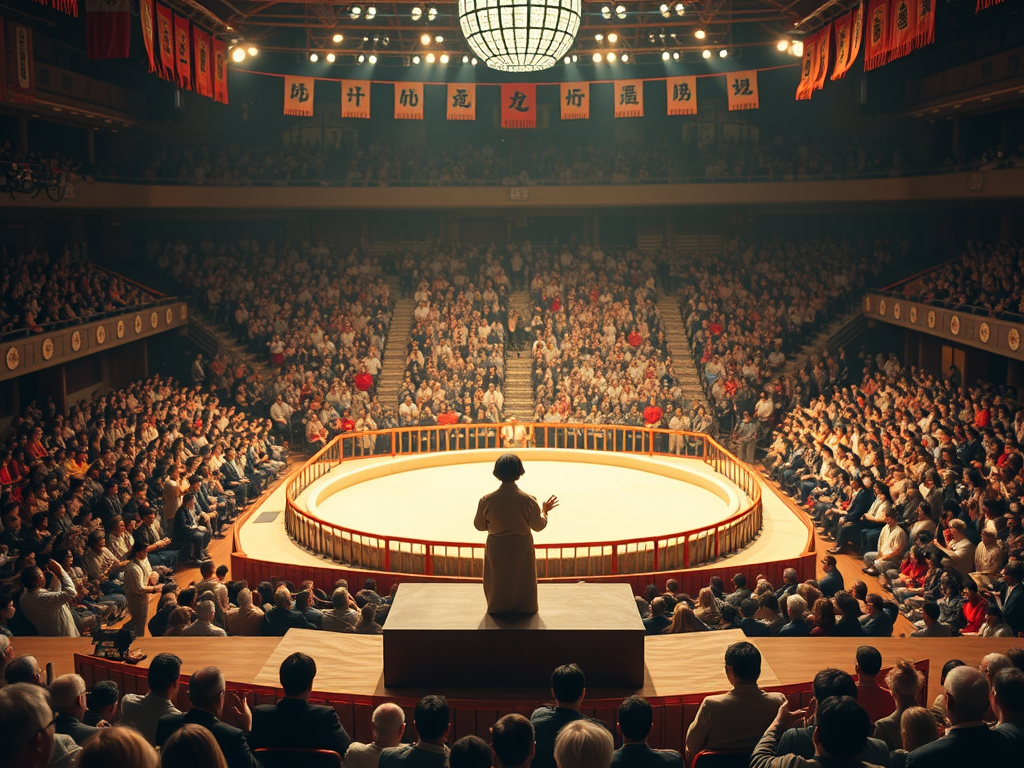

As the New Year Grand Sumo Tournament in Tokyo came to a thrilling close on Sunday, the atmosphere inside Japan’s most revered wrestling arena was electric. Thousands of fans applauded as top-ranked wrestlers were honored in the ring, celebrating one of the country’s most iconic sporting traditions.
Yet one familiar figure was absent from the ceremony. Japan’s prime minister, who customarily presents the championship trophy, did not appear in the sumo ring.
Sanae Takaichi, Japan’s first woman to hold the office of prime minister, chose not to attend the awards presentation in person. Her decision reflected a long-standing prohibition barring women from entering the dohyo, the sacred sumo ring. Instead, she delegated the task to the education minister, who presented the prime minister’s cup and certificate on her behalf. Government officials explained that Ms. Takaichi wished to honor sumo’s traditional customs.
The move aligned with Ms. Takaichi’s broader and often cautious stance on gender-related issues. A staunch conservative who is preparing for a snap election next month, she has largely avoided highlighting the historical significance of her rise to power since assuming office in October. Rather than framing her leadership as a feminist milestone, she has emphasized continuity, discipline, and her own interpretation of women’s roles in society.
Instead of directly confronting structural sexism, Ms. Takaichi has often engaged publicly with commentary on her appearance and personal life. She has spoken about maintaining traditional values while managing the demands of leadership and caring for her ill husband. In interviews and speeches, she has portrayed herself as a tireless worker, describing her governing style as one rooted in constant effort and determination.
While her election has undeniably reshaped public perceptions of female authority in a traditionally male-dominated political landscape, critics argue that symbolism alone is insufficient.
“She shows that women are not decorative figures and that they can be assertive and ambitious,” said Kumiko Nemoto, a sociology professor at Senshu University in Tokyo. “However, her approach to feminism has so far had limited impact on advancing actual gender equality.”
During her campaign, Ms. Takaichi pledged to aim for gender balance in her cabinet comparable to Nordic countries, where women often make up close to half of government leadership. In practice, however, only two women were included among the 18 cabinet members she appointed. The disparity became particularly visible during a recent visit by Italian Prime Minister Giorgia Meloni. Ms. Takaichi invited Ms. Meloni, the only other female leader within the Group of Seven, to pose for photographs alongside the women in her cabinet.
Like other conservative female leaders such as Ms. Meloni and former British prime minister Margaret Thatcher, Ms. Takaichi has supported policies that critics believe hinder progress on women’s rights. She opposes revising Japan’s law requiring married couples to share a single surname and has backed maintaining the male-only succession of the imperial family.
Her supporters counter that she represents a different strand of feminism, one that prioritizes practical issues such as safety, health, and everyday working conditions. For instance, she has supported expanding women’s restroom facilities within the national legislature.
Waka Ikeda, a political commentator and researcher, wrote in The Japan Times that Ms. Takaichi is advancing a form of conservative feminism focused on operating within existing systems rather than dismantling them.

“This is not anti-feminism,” Ikeda argued. “It reflects a different feminist tradition that resonates with many in Japan’s silent majority.”
Ms. Takaichi offered insight into her outlook earlier this month when she hosted more than 20 female ambassadors at her office. During the meeting, she remarked that her ambition had always been to become prime minister, not to be defined as the country’s first female prime minister.
“I carry out my daily responsibilities without dwelling on that distinction,” she said.
She also warned of the so-called “glass cliff,” a phenomenon in which women are appointed to leadership roles during times of crisis and then blamed if outcomes fall short.
“This reinforces the belief that women are unsuited for leadership,” she said. “By working together and delivering results, we can eliminate such prejudices.”
Despite her position, Ms. Takaichi has not been immune to gendered scrutiny. Following a visit to Tokyo by former U.S. President Donald Trump shortly after her election, commentators analyzed her body language, suggesting she appeared overly familiar when she linked arms with him.

Her clothing choices have also attracted attention. She is known for wearing blue suits and carrying black handbags, details that have been widely discussed in media and political circles.
Recently, a lawmaker criticized her attire, arguing that she should showcase Japan’s finest textiles and craftsmanship. In response, Ms. Takaichi posted a lengthy reflection on social media describing the pressure she felt selecting outfits for major international events, such as the G20 summit in South Africa. She explained that she spent hours choosing clothes that would not appear inexpensive or invite condescension.
The New Year Grand Sumo Tournament, which lasted 15 days, was widely seen as a moment that could reveal whether Ms. Takaichi intended to challenge entrenched cultural norms. She had also declined to attend a sumo event in November.
Chief Cabinet Secretary Minoru Kihara stated that the government’s handling of the awards ceremony reflected the prime minister’s desire to respect traditional culture. The Japan Sumo Association echoed this sentiment, emphasizing its commitment to preserving the heritage of professional sumo.
Many sumo fans expressed disappointment that Ms. Takaichi did not personally present the trophy, as her male predecessors had done. Over the years, female politicians and officials have repeatedly requested permission to enter the ring, only to be denied. The association previously drew criticism for requiring a female mayor to deliver a speech from outside the ring.

“Ms. Takaichi is unlikely to challenge traditions or actively promote women’s rights,” said Shizuka Wada, an author and outspoken critic of sumo culture. “As long as she remains prime minister, this practice will not change.”
Women have historically been excluded from professional sumo rings. Within Shinto belief, which underpins many sumo rituals, women have traditionally been viewed as ritually impure due to menstruation.
Tomoko Nakagawa, a former mayor of Takarazuka, said Ms. Takaichi now has a rare opportunity to question such customs. In 2018, Ms. Nakagawa herself was barred by the sumo association from speaking inside a training stable.
“Even today, women are treated as unclean in certain spaces,” she said. “Will this tradition continue indefinitely? I hope the prime minister will eventually challenge it and ask difficult questions.”




Leave a Reply