
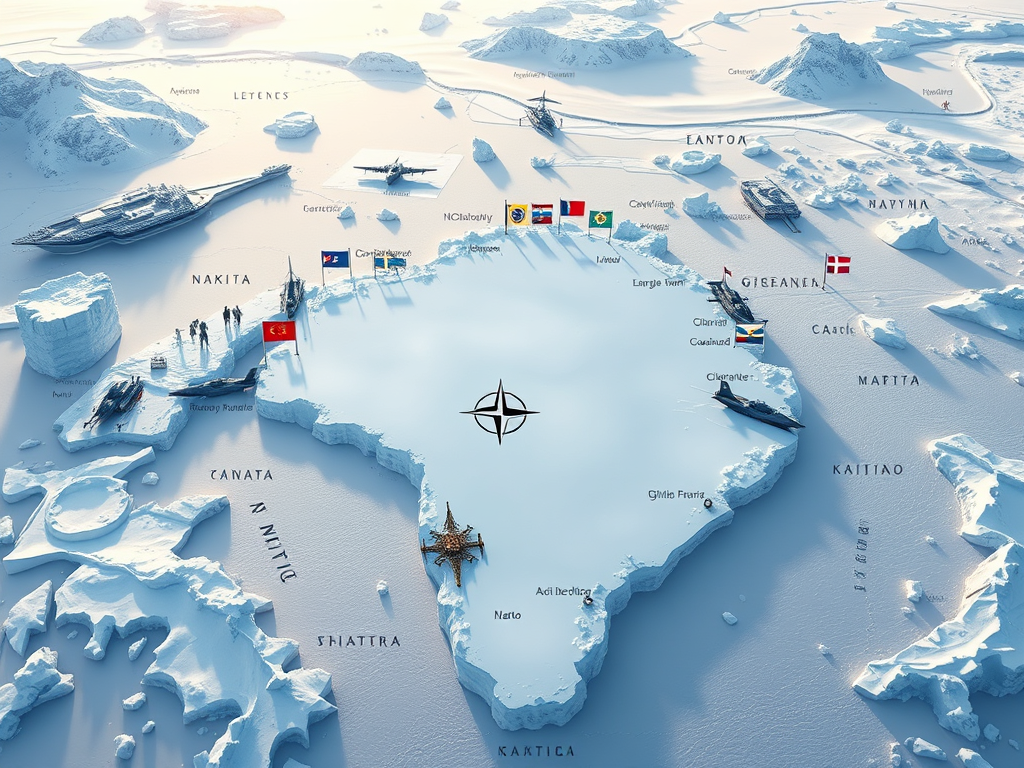

Recent discussions about Greenland’s future have increasingly centered on a set of proposals aimed at strengthening NATO’s footprint in the Arctic, granting the United States limited sovereign control over certain areas of Greenland, and preventing potential rivals from exploiting the island’s rich mineral resources.
According to eight senior Western officials involved in security and diplomatic affairs, these ideas together form the clearest picture so far of a possible compromise on Greenland. President Donald Trump announced on Wednesday that an agreement was taking shape, though he offered few specifics. His statement appeared to temporarily ease a growing trans-Atlantic dispute sparked by Washington’s renewed interest in the Danish territory.
Importantly, the officials emphasized that the proposals being discussed fall short of Mr. Trump’s long-standing ambition to transfer full ownership of Greenland from Denmark to the United States. All spoke on condition of anonymity due to the sensitive nature of the talks and cautioned that many aspects of the plan remain unresolved.
Whether these discussions will ultimately lead to a formal agreement remains uncertain. Denmark has repeatedly stated in public that it will not give up sovereignty over any part of Greenland, and it may ultimately reject elements of the proposals. Even so, officials involved in the talks said there is cautious optimism that the framework could address U.S. concerns about growing Russian and Chinese activity in the Arctic while respecting Europe’s firm position that Greenland is not for sale.
Under the proposals currently under consideration, several key steps would be taken.
First, NATO would establish a major new Arctic mission. Several officials have informally referred to it as “Arctic Sentry,” drawing parallels to existing NATO operations in the Baltic region and Eastern Europe that are designed to deter Russian military pressure.
Second, the United States and Denmark would update a defense agreement originally signed in 1951. That pact already grants the U.S. military broad access to Greenland, an autonomous territory within the Kingdom of Denmark, allowing Washington to build and operate military facilities. American officials have expressed concern that this access could be reduced if Greenland were to pursue full independence in the future. As a result, NATO members have discussed expanding the agreement to allow for designated areas of Greenland to be treated as de facto American sovereign territory.
Such an arrangement would likely resemble the “sovereign base areas” Britain maintains in Cyprus, where British military installations are legally considered British territory. This would give the United States a higher degree of control than it currently has over embassy grounds abroad. Mr. Trump and other U.S. officials have argued that Greenland could play a critical role in plans for a future missile defense initiative, sometimes described as a “Golden Dome,” with potential components stationed on the island.

Third, the proposals would restrict non-NATO countries, particularly Russia and China, from gaining mining rights to Greenland’s rare-earth minerals, which are believed to lie beneath vast ice sheets and are increasingly important for advanced technologies and defense systems.
Officials said these ideas have circulated within NATO for over a year, largely in response to Mr. Trump’s repeated public statements about Greenland. Since returning to office in 2025, he has spoken with growing intensity about his desire for the United States to control the island. Denmark has responded just as forcefully, insisting that Greenland’s future is a matter for Copenhagen and Nuuk, not NATO. Greenland’s prime minister, Jens-Frederik Nielsen, reiterated this position on Thursday, saying he opposed granting the United States sovereignty over military bases on the island. While open to dialogue, he stressed that sovereignty was a non-negotiable issue.
The concept of granting the U.S. sovereign rights over specific base areas, similar to the British model in Cyprus, was discussed among NATO and Western military officials earlier this week, according to two sources familiar with the meeting. Gen. Alexus G. Grynkewich, NATO’s top military commander in Europe, later said the issue was a political matter rather than one for military planners to decide.
Danish Prime Minister Mette Frederiksen did not comment directly, but in a public statement released on Thursday, she appeared to accept discussions on security, investment, and economic cooperation while firmly rejecting any transfer of sovereignty over Greenlandic territory.
Mr. Trump himself has provided little clarity. Speaking to reporters in Davos and later aboard Air Force One, he declined to elaborate, repeatedly saying that negotiations were ongoing. He emphasized that NATO would play a role and framed the process as a collective effort.
A senior Danish official, also speaking anonymously, said there had been no direct talks between Copenhagen and Washington about granting the United States sovereign land in Greenland. NATO officials echoed that sentiment, describing the discussions as preliminary. Adm. Giuseppe Cavo Dragone, chairman of NATO’s Military Committee, said the alliance was only at an early stage of shaping a broader framework for Arctic security.

Despite the lack of concrete details, European leaders expressed relief that tensions appeared to be easing. Earlier in the week, Mr. Trump had ruled out using military force to take Greenland but suggested he could apply economic pressure on allies. Later that same day, he abruptly announced a deal with NATO Secretary General Mark Rutte and canceled planned tariffs on Danish and European imports.
Several European leaders welcomed the shift in tone. Speaking in Davos, German Chancellor Friedrich Merz said Europe would stand by Denmark and Greenland in the face of Russian threats while upholding the principles of sovereignty and territorial integrity that underpin the trans-Atlantic partnership. He voiced support for continued talks among Denmark, Greenland, and the United States, provided those principles remain intact.
As negotiations continue, the future of Greenland remains unresolved, balancing strategic competition in the Arctic against long-standing commitments to national sovereignty and alliance unity.




Leave a Reply