

Faced with the prospect of steep U.S. tariffs if President Donald Trump fails to secure a deal to acquire Greenland, European Union leaders began rallying around a common response on Sunday, signaling a preference for negotiations while keeping potential countermeasures on the table.
On Saturday, Mr. Trump publicly pushed for the purchase of Greenland, warning on social media that if his demands were rejected, he would impose tariffs on several European countries. According to his statement, duties would begin at 10 percent in February and rise to 25 percent by June.
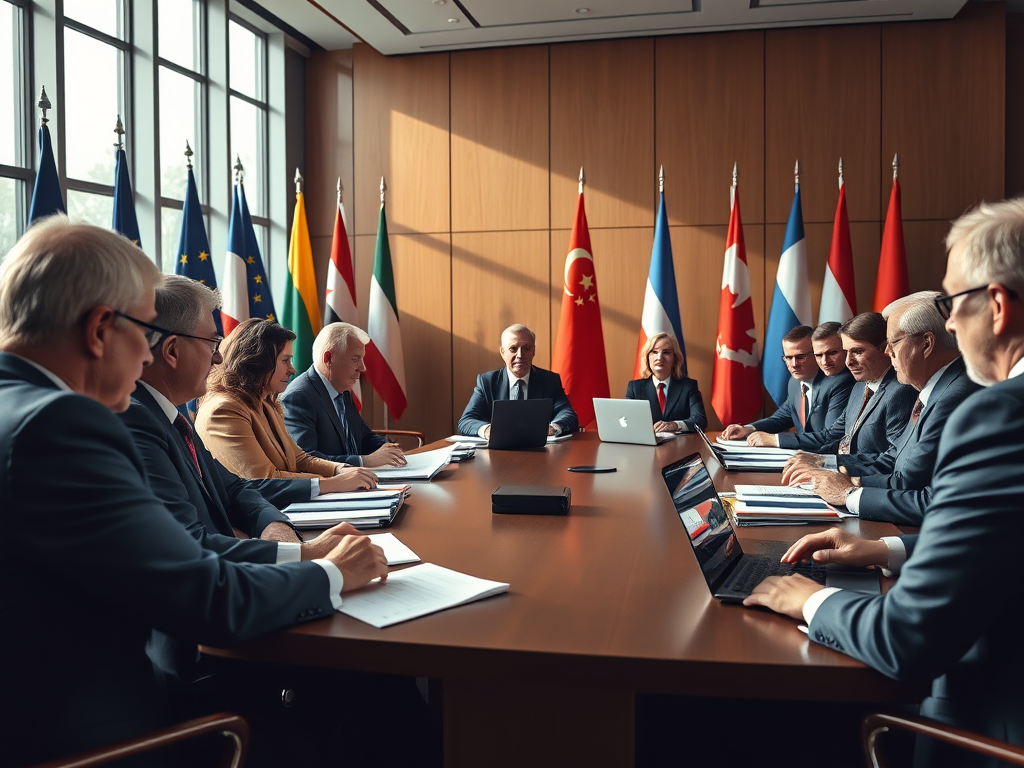
In response, ambassadors from all 27 E.U. member states convened in Brussels on Sunday to assess the situation. Although the meeting was exploratory, it underscored two clear priorities. European officials want to avoid a trade confrontation if possible, but they are equally firm in their stance that Greenland, an autonomous territory under Danish sovereignty, should not be sold or taken over against the will of its residents.
The Trump administration, however, has shown little indication of retreating. Appearing on NBC’s Meet the Press, Treasury Secretary Scott Bessent argued that U.S. control of Greenland would ultimately benefit all sides, describing it as advantageous for Greenland itself, for Europe, and for the United States.
He expressed confidence that European leaders would eventually come to accept Washington’s position.
Still, European diplomats say that if pressure from Washington intensifies, the bloc could respond in kind. Two officials familiar with internal discussions noted that the E.U. is weighing the option of activating a package of retaliatory tariffs valued at 93 billion euros, roughly $107 billion. That list was originally prepared during last year’s trade disputes and could be implemented as early as February.
Some European lawmakers, along with French President Emmanuel Macron, have gone even further, suggesting that the E.U. consider deploying a powerful but unused mechanism designed to counter economic coercion. Known formally as the anti-coercion instrument and informally as Europe’s trade bazooka, it could impose restrictions on major American technology firms or other service companies with significant operations in Europe.
Diplomats caution that such a move would be a last resort, given the risk of sharply escalating tensions.
These options are expected to be debated more thoroughly later this week when European leaders gather again in Brussels. António Costa, president of the European Council, announced on Sunday that he had decided to call an extraordinary meeting of heads of state and government in the coming days. An E.U. official indicated that the meeting could take place in person, possibly as early as Thursday.
The timing would allow leaders to coordinate their approach ahead of, or alongside, the annual World Economic Forum in Davos, Switzerland, which many European policymakers plan to attend. Mr. Trump is also expected to be there, creating an opportunity for direct discussions.
Despite hopes in some European capitals that dialogue could ease the standoff, efforts so far have yielded little progress.
Europe has historically been cautious about retaliating against the United States, partly due to its reliance on American military capabilities and support within NATO. But some officials believe public sentiment is changing.
Brando Benifei, a member of the European Parliament who chairs its delegation for relations with the United States, said that many Europeans now feel a clear boundary has been crossed.
In Britain, Prime Minister Keir Starmer spoke with Mr. Trump on Sunday and warned that imposing tariffs on allies acting in support of NATO’s collective security would be inappropriate, according to a Downing Street spokesperson.

Italy’s prime minister, Giorgia Meloni, also confirmed that she had spoken with Mr. Trump, describing the proposed tariffs as a mistake.
NATO Secretary General Mark Rutte said on social media that he had discussed Greenland with Mr. Trump as well, though he offered few specifics beyond noting that talks would continue and that he expected to see the U.S. president in Davos.
The White House did not immediately respond to questions about the wave of diplomatic calls, which followed a strong backlash from U.S. allies after Mr. Trump’s tariff announcement. On Sunday, Britain, France, Germany and Denmark issued a joint statement condemning the threats, warning that they undermine transatlantic relations and risk triggering a dangerous downward spiral.
The statement’s signatories, all NATO members, reaffirmed their solidarity with Greenland and pledged to remain united and coordinated in their response. Several other European countries, including Iceland, Latvia and Lithuania, later added their support.




Leave a Reply