
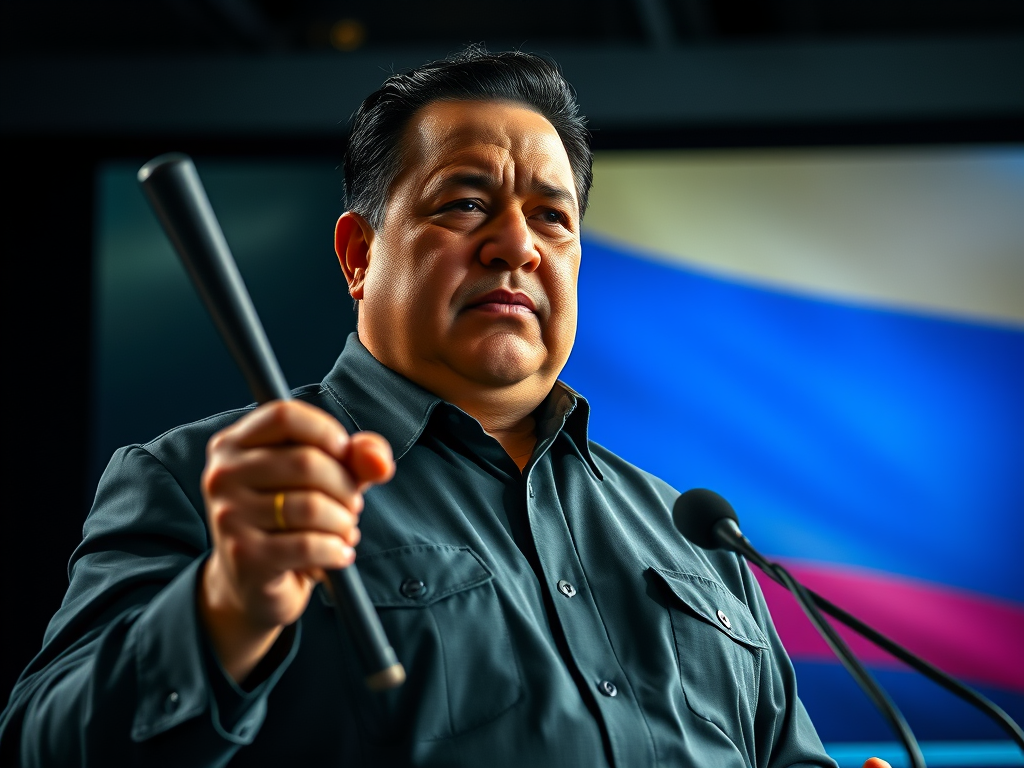

From a television set broadcast nationwide, Venezuela’s powerful interior minister would often lift a plastic baton and read out the names of government critics. In the country’s political culture, such moments were widely understood as warnings. Those singled out could expect security forces to appear at their door shortly afterward.
That pattern played out last year with Juan Pablo Guanipa, a leading opposition figure. After being harshly denounced on a weekly television program hosted by Interior Minister Diosdado Cabello, Guanipa was arrested, accused of terrorism and treason, and sent to prison, where he remains today.
For more than ten years, Cabello’s show, titled Con el Mazo Dando, has served as a key instrument of political intimidation. Analysts say it has functioned as both a public threat and a command center for Venezuela’s repressive apparatus.
This month, the United States carried out a dramatic operation in Venezuela, detaining President Nicolás Maduro. Washington described the move as a law enforcement action tied to a new indictment accusing Maduro of narco-terrorism.
Among the names highlighted in that indictment was Cabello himself. Like Maduro, he is now the subject of a U.S. reward for information leading to his capture.
Despite this, Cabello’s position inside Venezuela remains intact. He is still a central figure in the government of interim leader Delcy Rodríguez, frequently appearing alongside her at public events and official broadcasts.
For Rodríguez, who faces pressure to ease tensions with the Trump administration, Cabello may represent one of her most complex challenges. Often described as the second most powerful individual in the country, his political fate is closely bound to the survival of the movement that has governed Venezuela for over twenty years.
Through loyal allies, Cabello exerts influence over the security forces, maintains close ties with the armed forces, and oversees pro-government civilian militias known as colectivos, which are regularly deployed to suppress protests. In late 2024, he helped place a close relative in charge of the SEBIN, Venezuela’s intelligence police.
He is also considered one of the most ideologically rigid figures within the ruling movement, deeply hostile to foreign influence and firmly committed to a confrontational worldview rooted in anti-imperialism.
Although Cabello has publicly expressed loyalty to Rodríguez, he has continued to denounce the U.S. operation that captured Maduro, calling it a barbaric and treacherous act during a public address.

In a recent broadcast filmed alongside armed police units, Cabello claimed that calm had prevailed in the country following the U.S. action because the state maintained exclusive control over weapons. He described himself and the security forces as guarantors of national stability, language that experts interpreted as a thinly veiled warning.
According to Verónica Zubillaga, a Venezuelan sociologist at the University of Illinois Chicago who researches political violence, the speech revealed both Cabello’s ambitions and his leverage. She said it also served as a reminder of how quickly he could unleash severe violence if threatened.
Cabello is widely viewed as the most secretive and hard-line representative of Chavismo, the political movement founded by Hugo Chávez and later led by Maduro. Even within elite circles, he is regarded as elusive and insular.
A former senior government official, speaking anonymously out of fear of retaliation, described Cabello as isolated, with few personal relationships beyond a small group of military officers.
Few officials stand to lose more if the ruling system weakens. U.S. authorities have accused Cabello of drug trafficking, alleged that he leads a transnational criminal organization, and offered a reward of $25 million for information leading to his arrest. International organizations, including the United Nations, have linked him to some of the most serious human rights abuses committed in Venezuela.

Political risk analyst Risa Grais-Targow of Eurasia Group described him as no less dangerous than Maduro, and possibly more so.
The Venezuelan government did not respond to requests for comment regarding Cabello.
For years, Rodríguez and Cabello have symbolized two competing approaches within Chavismo. Rodríguez has projected the image of a pragmatic technocrat seeking sanctions relief and limited international engagement. Cabello, by contrast, has embodied a militant, uncompromising posture. Today, both depend on each other: Rodríguez needs Cabello’s control over the security apparatus, while Cabello relies on her leadership to protect his standing in a government attempting to stabilize relations with Washington.
Cabello, now 62, was born in the eastern state of Monagas. As a teenager, he joined a radical left-wing student organization that foreshadowed the ideology of Chavismo. He later pursued a military career, graduating from the Venezuelan Military Academy in 1987 and earning degrees in engineering. It was at the academy that he met Hugo Chávez, with whom he shared a spot on the baseball team.
Both men took part in a failed military uprising against Venezuela’s elected government in 1992. In the years that followed, Cabello became one of Chávez’s closest allies, helping to unify grassroots groups and forge a tightly disciplined political structure.

Under Chávez’s presidency, Cabello cycled through some of the country’s most powerful roles, including governor, head of the National Assembly, cabinet minister, and vice president.
Zair Mundaray, a former prosecutor who investigated Cabello before fleeing the country in 2017, said allegations of corruption followed him everywhere. Mundaray claimed that Cabello exploited every position he held for personal gain.
Chavismo itself combined populist rhetoric, nationalism, and state dominance over strategic industries such as oil. Chávez rose to power in 1998 and benefited from a long oil boom in the following decade, allowing the government to expand social programs and reduce poverty.
When oil prices collapsed, however, Venezuela plunged into economic crisis, triggering mass migration and widespread unrest. The government responded not with reform, but with intensified repression.
Cabello has long overseen the machinery that enabled this response. Former intelligence officers, political prisoners, and high-ranking officials told United Nations investigators that Cabello directly instructed the intelligence services on whom to arrest, detain, release, or torture.

Analysts say Cabello opposed the July 2024 elections, which Maduro agreed to hold in exchange for partial sanctions relief. When opposition tallies and international observers indicated that Maduro had lost decisively, the president nevertheless declared victory.
Cabello played a central role in reinforcing Maduro’s claim to power. One month after the vote, Maduro appointed him interior minister, a move widely interpreted as sidelining Rodríguez and her allies and signaling that force, not compromise, would be the government’s strategy.
Soon after taking office, Cabello announced Operation Knock Knock, deploying security forces to raid homes and arrest political opponents. Authorities said more than 2,000 people were detained following protests over the election outcome, a campaign strongly condemned by human rights organizations.
From his new position, Cabello consolidated control over intelligence agencies, police forces, the national guard, and armed civilian groups.
Although his public attacks on the United States have softened somewhat since Maduro’s capture, experts say Cabello remains firmly opposed to any political opening or liberalization.
David Smilde, a sociologist at Tulane University who has studied Venezuela for decades, described Cabello as representing an old-style authoritarian mindset, one that views reform as an existential threat.
Former Supreme Court justice Antonio Marval recalled becoming a target shortly after his appointment by an opposition-led legislature in 2017. On his television show, Cabello publicly warned that newly appointed judges would be dealt with.
Marval said such statements were never symbolic. Shortly afterward, he fled Venezuela by boat, escaping to Curaçao.
To critics, Cabello personifies the darkest aspects of Venezuela’s political system: a structure maintained not through public consent, but through fear, coercion, and corruption.
Grais-Targow argued that if Washington sought to send a decisive signal, Cabello would be the most obvious figure to target.




Leave a Reply