
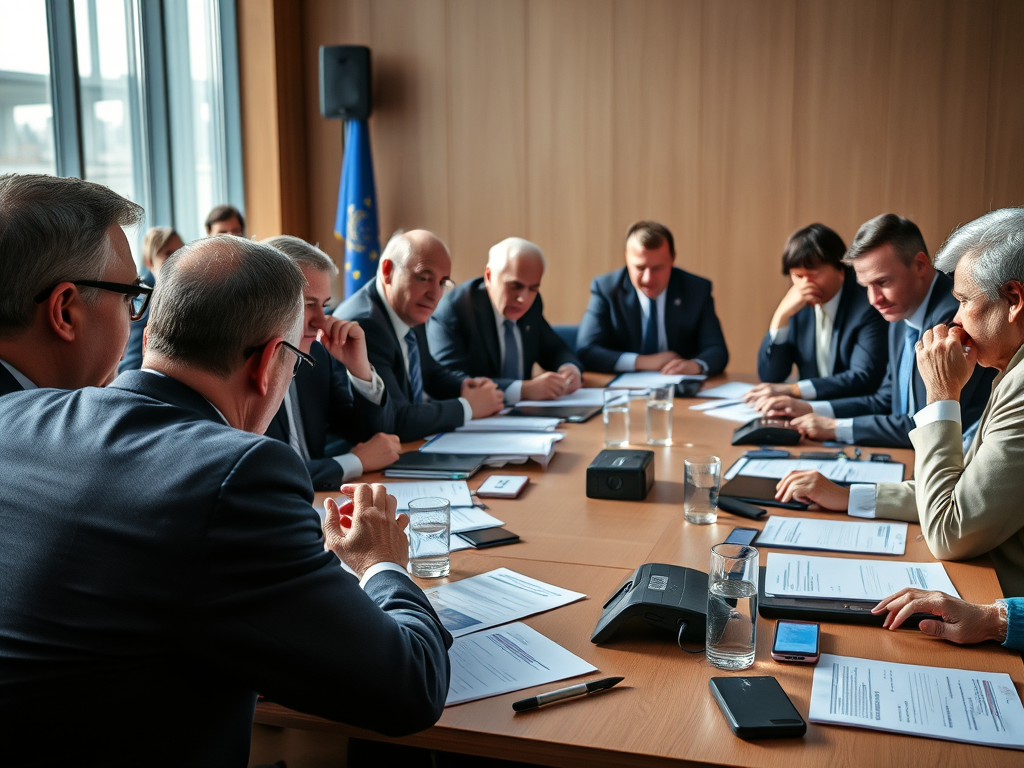
European Union leaders gathered in Brussels on Thursday for a high-stakes summit that will test whether the bloc can confront some of the most pressing challenges it currently faces: an increasingly aggressive Russia, a less cooperative United States, and the mounting financial burden of a prolonged ground war in Ukraine.
Officials involved in the talks said they are aiming for an agreement that would allow the European Union to use Russian state assets frozen within Europe as collateral for a large loan to support Ukraine’s war effort in 2026 and 2027. The proposal has been under intense discussion as leaders search for a way to sustain Kyiv financially while also demonstrating Europe’s strategic resolve.
“We have a very simple choice: either we pay with money today, or we pay with blood tomorrow,” said Polish Prime Minister Donald Tusk as he arrived at the meeting, which brings together leaders from all 27 EU member states.
Despite the urgency, the plan remains controversial and could still collapse.
Belgium, which holds the majority of the frozen Russian assets in Europe, has been one of the most vocal opponents. Roughly 210 billion euros in Russian state funds are frozen across the continent, and about 185 billion euros of that total is held in Belgium through the Brussels-based financial services company Euroclear. For months, Belgian officials have expressed deep concern about the legal and financial risks of using those assets to back loans for Ukraine.
Belgium has insisted that other EU countries must share responsibility if Russia retaliates through legal action or other means. It has also argued that countries holding smaller amounts of frozen Russian funds, including the United Kingdom and France, should contribute those assets to the lending effort as well. Russian state reserves were frozen in several countries after Moscow launched its full-scale invasion of Ukraine in 2022.
In the days leading up to the summit, EU officials, ambassadors, and national leaders engaged in intense negotiations behind closed doors to find compromises that might win broader support. Even several hours into Thursday’s meeting, it remained unclear whether those efforts would be sufficient. While some analysts suggested that Belgium might ultimately relent at the last moment, partly for domestic political reasons, EU leaders appeared to have no clear alternative plan if it did not.
Ukrainian President Volodymyr Zelensky attended the meeting in person, underscoring the importance of the decision for his country at a critical moment in the war.
Europe at a Crossroads
EU officials have said the summit will continue until a decision on Ukraine’s financing is reached. There has been speculation that talks could stretch on for days, with some officials even suggesting discussions might continue until Christmas if necessary.
If the frozen-asset plan fails, there is a fallback option: a loan backed directly by the EU’s own budget. However, that approach would require unanimous approval from all member states. Hungary, which has maintained relatively close ties with Moscow, has already voiced strong opposition, making that option highly unlikely. As a result, it has largely fallen out of active negotiations.
Hungarian Prime Minister Viktor Orban reiterated his stance on Thursday, arguing that providing financial support to Ukraine would only prolong the conflict. “Giving money means war,” he said. He also claimed that the frozen-asset proposal was effectively dead, asserting that it lacked sufficient high-level backing.
Other leaders struck a more cautious but hopeful tone. Latvian Prime Minister Evika Silina said the frozen-asset approach was not the only possible solution, but emphasized that it remained the most effective one currently available.
What is at stake goes well beyond immediate financial support for Ukraine. Peace discussions involving Ukraine, the United States, and Russia have intensified in recent weeks, and a robust European funding commitment could strengthen Kyiv’s negotiating position. At the same time, the decision represents an opportunity for Europe to reassert its relevance on the global stage, particularly as it has struggled to present itself as a decisive geopolitical actor.
Washington has made it clear that Europe must play a larger role in supporting Ukraine financially. The United States has repeatedly signaled that it expects the EU to demonstrate tangible commitment rather than relying primarily on American support.
Ursula von der Leyen, president of the European Commission, told lawmakers ahead of the summit that the meeting was a crucial test of Europe’s strategic maturity. She described the moment as a defining one for the bloc’s autonomy and long-term interests, saying it was an opportunity for Europe to show that it can act independently and decisively.

Analysts have warned that failure to reach an agreement would reinforce perceptions of the EU as slow-moving and overly constrained by its consensus-based structure, at a time when swift and bold action is widely seen as necessary.
A Decision Hanging in the Balance
One of the central risks is that the last-minute adjustments and negotiations may still fall short of persuading Belgium to support the frozen-asset plan.
Last Friday, EU member states agreed to extend indefinitely the freeze on Russian assets held within the bloc, a necessary first step toward using those funds to support Ukraine. However, Belgium, along with Bulgaria, Italy, and Malta, supported the decision only reluctantly and urged continued exploration of alternative, lower-risk solutions.
Belgium’s concerns are rooted in both legal and financial considerations. Under the current proposal, the frozen assets would be used to back a 90 billion euro loan, distributed over 2026 and 2027, with the possibility of additional support later. Belgian officials fear that if Russia challenges the arrangement in court, Belgium could bear disproportionate responsibility.
Those fears intensified after Russia’s central bank announced last week that it had filed a lawsuit in Moscow against Euroclear, widely seen as a warning shot to European policymakers. On Thursday, the bank said it planned to pursue legal action against European banks in Russian commercial courts.
Belgian leaders have also warned that using frozen state assets in this way could unsettle global investors, raising doubts about whether funds held in Europe are truly secure during geopolitical disputes.
Belgian Prime Minister Bart De Wever reiterated these concerns in remarks to Parliament on Thursday morning, making clear that his government remains uneasy about the proposal.

Technically, the frozen-asset loan could still be approved without Belgium’s support, as it requires only a qualified majority of EU votes. However, EU leaders have been reluctant to push it through over the objections of a key member state. Doing so could risk noncompliance by Belgium and set a troubling precedent for overriding national concerns within the bloc.
President Zelensky acknowledged Belgium’s worries during a news conference, noting that he had discussed the issue directly with De Wever. While he said he understood the risks being raised, he emphasized that Ukraine faces far greater dangers on the battlefield. “We are at war,” he said. “And the risks we face are existential.”
Ukraine’s Financial Cliff
Despite the political and legal complexities, EU officials and experts have stressed that failing to secure funding for Ukraine is not a viable option. According to EU estimates, Ukraine could begin to run critically low on funds by the end of March. Given the time required to finalize any agreement and disburse money, decisions must be made quickly.
The broader transatlantic context adds to the urgency. Both Washington and Moscow have at times sidelined Europe in discussions about Ukraine’s future, partly because of perceptions that the EU is slow and divided. That perception has been reinforced by recent rhetoric from the Trump administration, which has been openly critical of the European Union.
In its national security strategy, the administration warned that Europe faces what it called “civilizational erasure,” accusing the EU and other multinational institutions of undermining national sovereignty, enabling uncontrolled migration, and setting the continent on a path toward decline. European leaders see the current moment as a chance to rebut those claims by acting with unity and determination.
“Putin is counting on us to fail,” said Kaja Kallas, the EU’s top diplomat, as she arrived at the summit, referring to Russian President Vladimir Putin. She noted that Belgium was facing pressure from external actors, including the United States, but insisted that Europe must stand together.
“We simply cannot afford to fail,” she said. “This is the moment to show that Europe is strong.”




Leave a Reply