
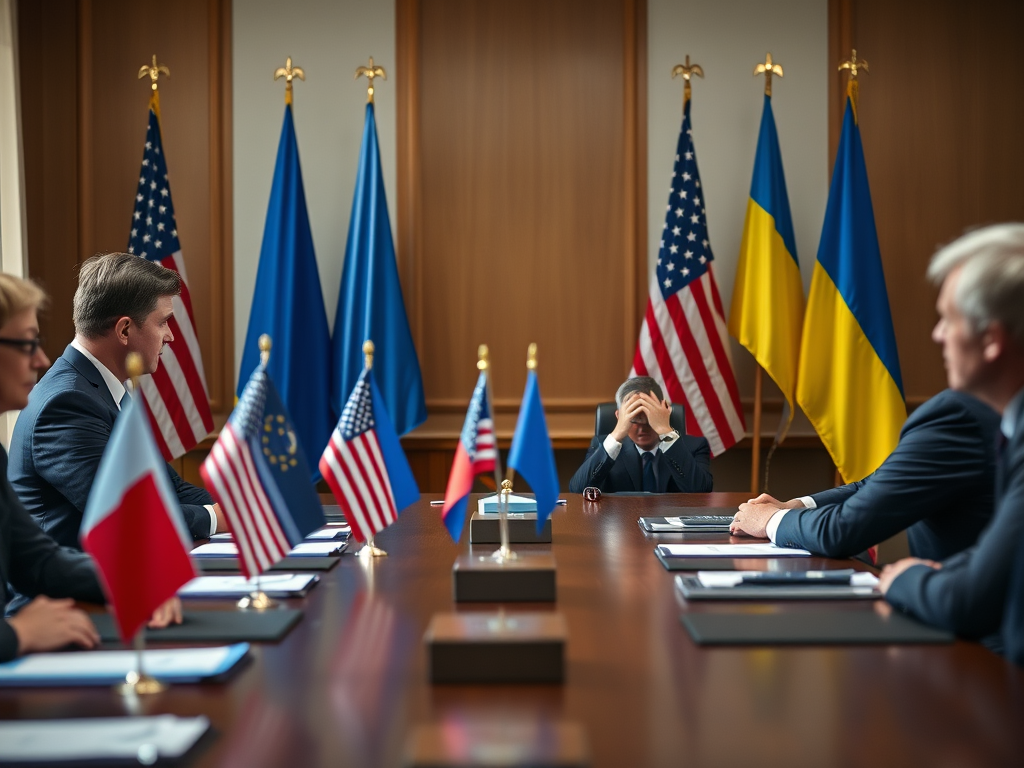

Ukrainian President Volodymyr Zelensky held lengthy talks in Germany on Sunday with representatives authorized by U.S. President Donald Trump, marking what many observers see as a pivotal moment in ongoing efforts to bring an end to the war between Ukraine and Russia.
The meeting comes as President Trump continues to press Kyiv to accept a negotiated settlement, arguing that Ukraine’s position on the battlefield is weakening. While acknowledging the mounting pressures, President Zelensky signaled that Ukraine is prepared to make limited concessions, though not without firm conditions.
Ahead of the talks, Zelensky reiterated that Ukraine is willing to pause its aspirations for NATO membership, at least temporarily, if it can secure strong and binding security guarantees from the United States. These guarantees, he said, would be essential to deter Russia from launching another invasion should a peace agreement be reached. At the same time, the Ukrainian leader stressed that Kyiv would not agree to surrender territory currently under its control, a proposal reportedly favored by the Trump administration.
Speaking to reporters before entering the negotiations, Zelensky said he expected Washington to provide clearer details regarding the nature of the proposed U.S. security commitments.
According to Zelensky’s office, the discussions lasted more than five hours and were scheduled to continue into Monday. The Ukrainian president is expected to comment publicly on the outcome after the talks conclude.
Zelensky met with Steve Witkoff, Trump’s special envoy, and Jared Kushner, the president’s son-in-law. Over the past three weeks, the two U.S. figures have traveled extensively, holding talks with Ukrainian officials, European leaders, and Russian President Vladimir Putin in an effort to broker an end to the conflict that began with Russia’s full-scale invasion of Ukraine in February 2022.
“For me, the most important point is that any plan must be as fair as possible — above all for Ukraine, because it was Russia that initiated this war,” Zelensky told reporters. “Equally important, the proposal must be realistic and workable. It cannot exist only on paper; it must represent a genuine step toward ending the fighting.”
The meeting in Germany precedes a week of intensive diplomatic activity. On Monday, Zelensky is expected to meet senior European leaders and participate alongside German Chancellor Friedrich Merz in the German-Ukrainian Business Forum. Later in the week, European Union members are set to vote on a proposal to use part of the €210 billion in frozen Russian assets held in Europe — roughly $245 billion — to provide loans to Ukraine in 2026 and 2027.
Despite ongoing dialogue, significant differences remain between Washington and Kyiv over how a peace settlement should be structured. These disagreements have persisted throughout the year, leaving both sides far from a mutually acceptable compromise.
The U.S. proposal calls for Ukraine to exchange territory in eastern Ukraine for peace, including areas in the Donetsk region that Ukrainian forces still control. It also requires Kyiv to formally abandon its ambition to join NATO, the alliance long viewed as a cornerstone of European and transatlantic security. Additionally, the plan envisions the creation of a “free economic zone” that would act as a buffer between Ukrainian-held territory and regions controlled by Russia, according to Zelensky’s comments last week.
In response, Ukraine submitted its own peace proposal to the United States on Wednesday evening. Kyiv’s version rejects any transfer of land currently under Ukrainian control and removes the American condition that would permanently bar Ukraine from NATO membership. The plan also stipulates that any future decision involving territorial concessions must be approved by a nationwide vote in Ukraine.
Zelensky said on Sunday that he had not yet received a formal response from U.S. representatives regarding Ukraine’s counterproposal. He also indicated that Kyiv may be open to a ceasefire along the existing front line.
“A fair and workable approach could be that both sides remain where they are,” Zelensky said, referring to the current military positions.
However, he expressed serious concerns about the idea of a “free economic zone.” Such an arrangement, he noted, would require Ukrainian troops to withdraw from strategically important cities such as Kramatorsk and Sloviansk. Zelensky questioned why Ukrainian forces would be expected to pull back while Russian troops would not be required to vacate areas they currently occupy.
“This issue remains unresolved,” he said. “It is extremely sensitive and understandably provokes intense debate.”
Zelensky also emphasized that Ukraine is no longer insisting on NATO membership as an immediate condition for peace. Membership would obligate all NATO states to defend Ukraine in the event of future Russian aggression. Although Ukraine had been on a path toward eventual NATO accession prior to Trump’s election, resistance from some European members had already complicated that prospect. Zelensky has previously acknowledged that NATO membership was unlikely without U.S. support, but he elaborated further on Sunday.
“From the very beginning, our primary ambition was NATO membership,” Zelensky said. “We believed it would offer the most credible security guarantees.”

Late Sunday afternoon, Zelensky’s office released photos and videos showing him greeting Witkoff and Kushner. In the footage, Zelensky warmly welcomed the two men, embracing Witkoff and shaking hands with both American representatives as delegations took their seats across a long oval table.
There is still no clear indication that President Putin is prepared to accept any proposal aimed at ending the war. Putin has repeatedly claimed that Russia is winning the conflict. Even as diplomatic efforts continue, Russian forces have sustained attacks on Ukraine’s power infrastructure and have continued slow advances along the eastern front.
At the same time, Zelensky is working to preserve U.S. support under President Trump, whose administration has dramatically shifted longstanding American foreign policy toward Russia and Europe. Trump has, on several occasions, echoed narratives aligned with Moscow while seeking a negotiated resolution to the conflict.
On Sunday, Zelensky expressed confidence that Washington holds significant leverage over Moscow.
“If the United States is genuinely committed to ending this war — as we are seeing at a high level today — then I believe Russia will ultimately be forced to make compromises,” he said.




Leave a Reply