

María Corina Machado, one of Venezuela’s most prominent opposition figures, revealed that she managed to flee the country with direct assistance from the United States after spending more than a year living in secrecy. Her comments came shortly after arriving in Oslo, where she joined the celebrations surrounding her receipt of the Nobel Peace Prize.
Speaking to reporters on Thursday, Machado said only that “the United States government supported us,” declining to elaborate on the operation or the individuals involved in her escape. According to her, disclosing details could endanger those who helped her leave. U.S. officials, including those from the Trump administration, have not issued public statements about her departure.
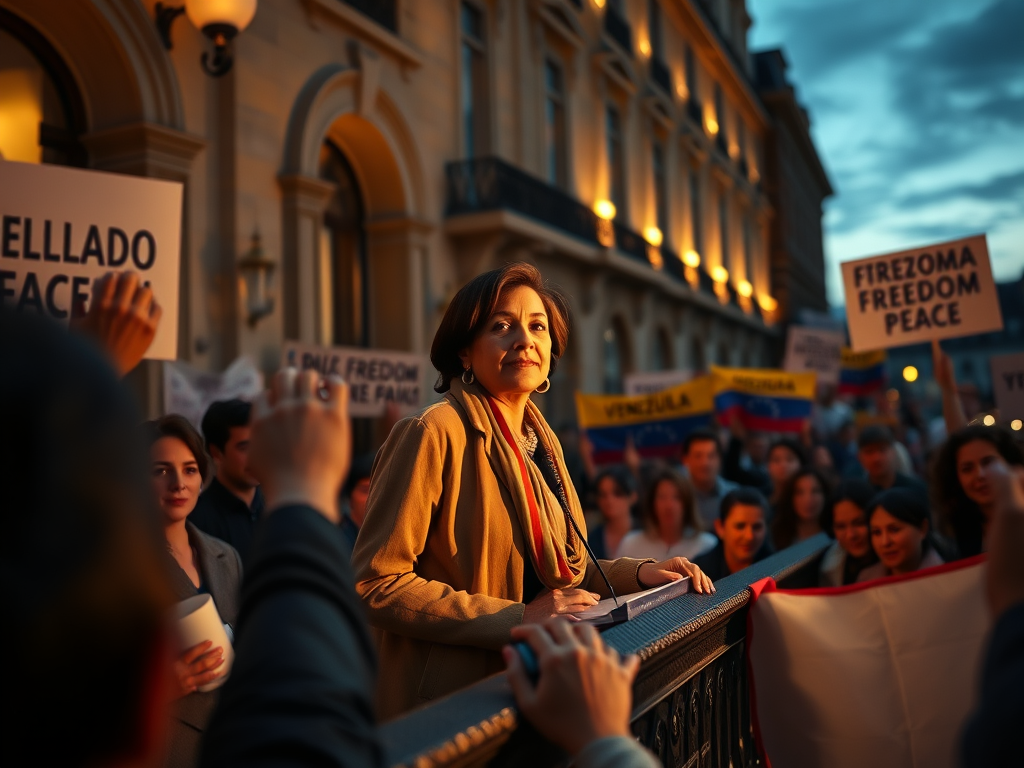
Despite Norway’s small Venezuelan community, Machado’s arrival generated emotional scenes in central Oslo. In the early hours of Thursday morning, she stepped onto the balcony of the historic Grand Hotel to greet well-wishers who had gathered for her appearance. Supporters cheered, shouted “freedom” and “peace” in Spanish, and sang the Venezuelan national anthem into the quiet night streets.
Machado had disappeared from public view soon after Venezuela’s presidential election last year. International observers reported that the candidate she endorsed won by a wide margin, even as the Maduro government deployed intimidation tactics and attempted to sabotage the opposition. Nevertheless, President Nicolás Maduro claimed victory and retained control of the state through a sweeping crackdown on dissent.
According to Machado, Venezuela’s security forces had no knowledge of her location during her extended period in hiding. She said that if authorities had discovered her whereabouts, they would have attempted to block her from traveling to Norway, where her daughter accepted the Nobel Peace Prize on her behalf the day before.
Venezuelan Interior Minister Diosdado Cabello insisted on Wednesday that the government knew of her movements, but he offered no evidence to support the claim. Officials had previously warned that Machado would be considered a fugitive if she attempted to leave the country.
Machado acknowledged that her return to Venezuela is fraught with danger. She admitted that the current government could arrest her immediately upon reentry and said she does not know when she might be able to go back.
“Even though the risks were extremely high, the decision to make this trip felt necessary,” she told journalists. “And of course, the risks of returning home may be even greater.”
Her reemergence on the international stage coincides with a sharp escalation in pressure from President Trump, whose administration has repeatedly accused the Maduro government of sending drugs and criminals to the United States—allegations many experts dispute. On Wednesday, U.S. authorities seized an oil tanker near the Venezuelan coast, a move that further strained relations.
Machado did not comment directly on the tanker seizure. However, she openly supported Washington’s broader effort to restrict Maduro’s financial lifelines, insisting that U.S. pressure has weakened the Venezuelan regime more than at any other point in recent years.
“President Trump’s decisions have been crucial,” she said. “We are now seeing a moment in which the regime is more vulnerable than ever.”
She added that meaningful political change requires increasing the cost for Maduro and his allies to remain in power, while simultaneously lowering the cost of stepping down. She argued that only by fundamentally shifting those incentives can the government’s hold on the country collapse.

When asked about President Trump’s threats of military action in Venezuela, Machado sidestepped the questions. Still, she repeated allegations frequently echoed by Washington, portraying Maduro as the head of a sprawling criminal network tied to hostile foreign powers.
At a joint news conference with Norwegian Prime Minister Jonas Gahr Støre earlier on Thursday, Machado claimed that Venezuela was already facing foreign intervention—not from the United States, but from Russian, Iranian, and extremist groups she said were operating with the government’s approval. She also mentioned Colombian guerrilla groups and drug-smuggling organizations as part of the environment that she described as deeply entrenched and dangerous.
Venezuela maintains commercial and strategic relationships with Iranian, Chinese, and Russian companies, and most of its oil exports go to China. However, there is no conclusive public evidence that Hezbollah or Hamas are active inside Venezuela, despite claims from some politicians and analysts. As tensions rose, President Vladimir Putin reportedly spoke with Maduro by phone on Thursday, reaffirming Russia’s support for his administration.
Ironically, Maduro’s largest corporate partner remains Chevron, the American energy company that has continued to export Venezuelan petroleum to the United States even during periods of heightened U.S. military activity in the region.
Analysts say Machado’s sudden reappearance has thrust her back into the center of a geopolitical confrontation that has intensified rapidly. Her challenge, they argue, will be converting her newfound visibility abroad into sustained political influence at home. Previous Venezuelan opposition leaders who left the country found that exile often diminished their relevance over time.

Meanwhile, the Trump administration has framed its growing military presence in the Caribbean as an anti-drug initiative aimed at dismantling cartels it blames for fueling overdose deaths in the United States. It has labeled Maduro a “narco-terrorist” and accused him of leading two major criminal organizations.
Machado made clear that she supports the U.S. approach. “Every country has the right to defend itself,” she said, defending Washington’s military posture.
In reality, Venezuela plays only a limited role in the production or trafficking of fentanyl, the synthetic opioid responsible for the vast majority of fatal overdoses in the United States. The country has also become a relatively minor actor in the cocaine trade compared to other nations in the region.
For now, Machado has not outlined her next political steps. She said that she plans to prioritize reuniting with her three children, reconnecting with those who aided her during her time in hiding, and receiving overdue medical evaluations.
She described the anticipation of embracing her children again as overwhelming. “I couldn’t sleep last night, imagining the moment I would see them,” she said. “For weeks, I wondered which one I would hug first.”




Leave a Reply