
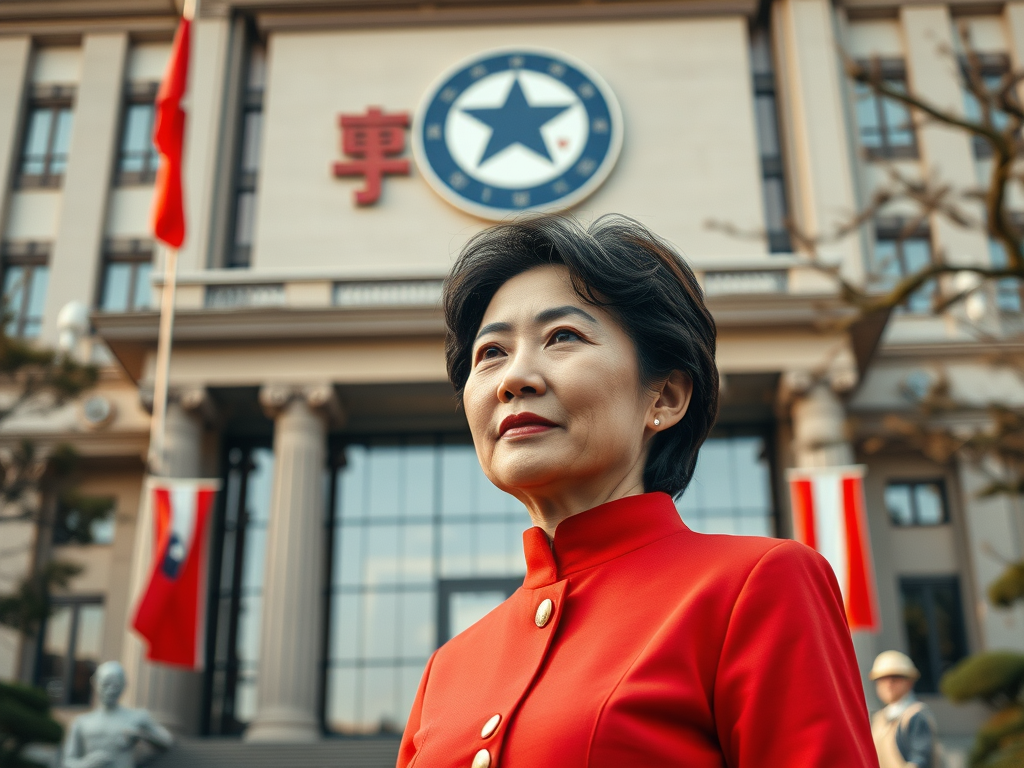

Cheng Li-wun’s political journey has long been a study in dramatic transformation. As a young activist in Taiwan, she was known for her uncompromising stance on Taiwanese independence, delivering impassioned speeches condemning the island’s historical ties to China. She fiercely criticized the Nationalist Party — once Taiwan’s ruling force after its retreat from mainland China — accusing it of imposing another form of colonial rule on the island.
Today, Cheng is the unexpected face of that same Nationalist Party. Her victory in the party’s October leadership election stunned much of Taiwan’s political establishment. Soon after taking office, she made a symbolic gesture that shocked both supporters and critics: she bowed before the grave of Chiang Kai-shek, the authoritarian Nationalist leader she once openly denounced. Cheng now argues that the people of Taiwan should confidently embrace their cultural and historical connection to China.

Her rapid ascent and her call for renewed engagement with Beijing have turned her into one of the island’s most divisive opposition figures in recent memory. Her rise also comes at a particularly sensitive moment. Taiwan’s legislature is preparing to consider President Lai Ching-te’s proposal to increase defense spending by $40 billion over the next eight years, a measure largely aimed at strengthening ties with the United States through arms purchases.
How Cheng responds to the proposed budget will be a major early test of her leadership. She has not stated outright opposition, but she has repeatedly questioned whether Taiwan can support such spending and whether a larger arms buildup would ease tensions or make conflict more likely. She has accused President Lai of turning the Taiwan Strait into a dangerous “powder keg.”

At 56, Cheng says she abandoned her dreams of independence more than two decades ago, convinced that the pursuit was unrealistic and increasingly dangerous. She argues that Taiwan must acknowledge its historical roots as part of China to avoid a catastrophic conflict with Beijing, which claims the island as its territory.
In an interview at the Nationalist Party’s headquarters in Taipei, Cheng said, “I don’t believe time is working in Taiwan’s favor. Mainland China’s rapid growth means its power is now far beyond what it was even a few years ago.”
For the Nationalist Party, her leadership marks a bold and risky departure. The party, formally known as the Chinese Nationalist Party, has failed to win Taiwan’s last three presidential elections, losing to the Democratic Progressive Party (DPP), which champions maintaining distance from Beijing and asserts Taiwan’s status as an independent nation.
Cheng captured the party leadership with help from members who felt the organization had lost its fighting spirit. Known for her unscripted, fiery speeches — a skill she honed as a student activist — she has reinvigorated some supporters. Still, many party veterans worry her pro-engagement approach could alienate moderate voters. Polls show that only about one-third of Taiwan’s population identifies as both Taiwanese and Chinese.
“She’s a disruptive leader who wants to jolt the party out of stagnation,” said Jason Hsu, a former Nationalist legislator and now a senior fellow at the Hudson Institute. “She is sharp and clear in her ideology, but her politics could be risky for Taiwan as Beijing becomes more assertive.”

Taiwanese security officials have warned that Cheng’s leadership bid received unusual amplification from social media accounts seemingly linked to China, suggesting covert support from Beijing. Cheng has dismissed such claims as political attacks. After her victory, Chinese leader Xi Jinping sent her a congratulatory message — a rare gesture and a clear sign of Beijing’s interest in her success.
Now, Cheng is focused on preparing her party for next year’s local elections and the 2028 presidential race. She may not be the party’s nominee, but her influence on its policy platform will be significant.
Cheng argues that if President Lai secures another term, Xi Jinping could conclude that peaceful engagement is futile, potentially prompting more forceful measures. She believes voters will increasingly see her approach as a pragmatic alternative.
Despite calling for dialogue with Beijing, Cheng insists Taiwan must maintain strong ties with Washington. At the same time, she says public trust in the United States has eroded, especially after former President Donald Trump implemented 20 percent tariffs on Taiwanese products and pushed to relocate Taiwanese semiconductor manufacturing — a pillar of Taiwan’s economy — to America.
She echoed concerns heard among some Taiwanese that Washington views the island as a pawn in its strategic rivalry with China. “Some people are asking whether the United States is using Taiwan as a tool to provoke the Chinese Communist Party,” she said.
According to Lee De-wei, a Nationalist Party official who assisted her leadership campaign, early party leaders often studied in the United States and held an almost unquestioning admiration for it. Cheng, who spent only one year studying abroad, does not share that worldview. “To her, the United States is no longer the center of global politics,” Lee said.
Even before taking office, Cheng was courting controversy. In an interview with Germany’s DW news outlet, she claimed that Russian President Vladimir Putin had won his latest term in a democratic election, despite substantial evidence of a tightly controlled process with little genuine competition.

Critics argued that her comments reflected a narrative common in Chinese state media, which often portrays Russia as a victim of Western hostility. DPP spokesman Wu Cheng accused her of ignoring China’s clear military pressure on Taiwan and blaming the island instead.
Cheng’s dramatic political evolution began far from the halls of power. Raised in southern Taiwan by a Nationalist soldier father from China and a Taiwanese mother, she rebelled against her family background while studying law at National Taiwan University. In the 1980s, she joined the growing movement for Taiwanese identity and democratization, giving speeches decrying the long history of oppression under successive rulers, including the Nationalists.
She later joined the DPP but left in 2002, saying she was disillusioned by corruption and intolerance for differing views under then-President Chen Shui-bian. Her critics claim she departed only after being reprimanded for attacking a party official without evidence.
In 2005, Cheng joined the Nationalist Party, viewing it as the only viable partner to stabilize relations with Beijing. That same year, she accompanied then-chairman Lien Chan on a landmark trip to China, the first by a party leader since 1949.
Now, as party chief, Cheng says she is ready to meet with China’s leadership. She argues that since Beijing refuses to speak with Taiwan’s government, the Nationalist Party must act as the island’s bridge for communication. She believes this approach aligns with the views of Donald Trump, who she claims “believes negotiation is the best way to solve problems.”






Leave a Reply