
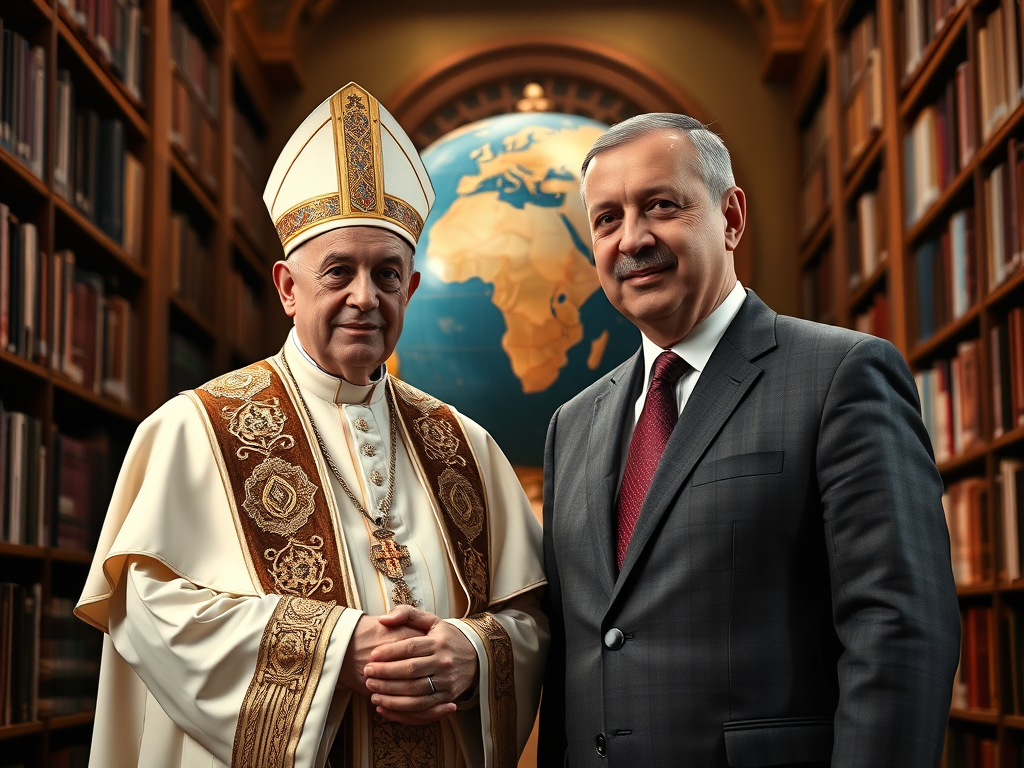

Pope Leo XIV opened the first overseas trip of his papacy on Thursday, choosing Muslim-majority Turkey as his initial destination. The visit underscores his commitment to strengthening interfaith dialogue and building bridges across Christian denominations at a time of complex global tensions.
Upon arriving in Ankara for the first of a four-day stay, Leo met with Turkish President Recep Tayyip Erdogan. The itinerary also includes meetings with local Catholic leaders and representatives of other Christian communities. Among them is Ecumenical Patriarch Bartholomew I of Constantinople, the spiritual leader of the Eastern Orthodox Church.
At the end of his time in Turkey, Leo will continue on to Lebanon, home to the largest Catholic population in the Arab world. His visit there will bring him face-to-face with one of the most volatile geopolitical environments in the Middle East. Israeli airstrikes in southern Lebanon continue to strain a fragile truce with local militias, a truce that was reached a year ago following a 13-month conflict. The pope’s presence is expected to test his diplomatic abilities in new and challenging ways.
During his first public remarks in Turkey, delivered inside the rotunda of the National Library in Ankara, Leo urged compassion, cooperation and dialogue across religious, cultural and economic divides. Standing beside a large globe, he emphasized the need for societies to resist polarization and instead search for shared solutions.
In his address, Leo also took a critical view of artificial intelligence, arguing that AI “accelerates processes that, on closer inspection, are not the work of machines, but of humanity itself.” He warned of economic systems that encourage consumerism and isolation, calling instead for a culture rooted in human connection and empathy.
Without naming particular nations, he pointed to rising global conflict as a dangerous distraction from urgent collective challenges: securing peace, eradicating hunger and poverty, improving access to health and education, and protecting the environment.
President Erdogan, who spoke before the pope, praised Leo’s efforts to promote diplomacy in the war in Ukraine and expressed support for his concern for Palestinian civilians. Leo has previously condemned the humanitarian crisis in Gaza, noting that residents “continue to live in fear and survive in unacceptable conditions.”
Erdogan highlighted Turkey’s long history of religious coexistence, noting that “mosques, churches and synagogues stand side by side” in many cities. He did not, however, mention the dramatic decline of the country’s ethnic Greek population since the early twentieth century. Factors ranging from population exchanges and communal violence to discriminatory policies led to a sharp reduction in the Greek Orthodox community, while the ethnic Turkish population in Greece also shrank significantly. In recent years, Erdogan’s government has converted several former Christian structures, including the historic Hagia Sophia, into mosques.
Leo’s choice to begin his papal travels in Turkey—a nation with a small Catholic minority—carries symbolic meaning. According to Vatican officials, the decision acknowledges Christianity’s deep historical roots in the region while also reflecting the pope’s desire to promote modern-day interfaith engagement.

On Friday, Leo is scheduled to visit Iznik, once known as Nicaea, to commemorate the 1,700th anniversary of the council that produced the Nicene Creed. The creed has remained a unifying statement of belief for Catholic, Orthodox and many Protestant communities for centuries.
Vatican officials noted that the trip had been long envisioned by Leo’s predecessor, Pope Francis, who was unable to make it before his passing in April. Leo assumed the papacy shortly thereafter.
Speaking to reporters during the flight from Rome, Leo said his goal was to reaffirm “the importance of peace throughout the world” and to encourage unity among people of all backgrounds “in spite of different religions, in spite of different beliefs.” In a light moment, he offered Thanksgiving greetings to American journalists, chatted with reporters across the cabin, blessed rosaries and even accepted homemade pumpkin pies. He also mentioned that he had already completed the day’s Wordle puzzle, achieving the solution in three tries.

For President Erdogan, the visit is a diplomatic windfall, granting him the distinction of welcoming the new pope on his first foreign trip. In Ankara, Leo traveled to the presidential palace flanked by soldiers on horseback. A military honor guard lined a turquoise carpet while cannons fired and a band performed the national anthem. Before that, the pope paid his respects at the mausoleum of Mustafa Kemal Ataturk, the founder of modern Turkey, where a wreath bearing his name was placed by two soldiers.
The visit has drawn positive reactions among Turkish observers. Emre Oktem, a professor of international law at Galatasaray University in Istanbul, said he viewed the pope’s arrival as a meaningful gesture. “As a good Muslim, I am very happy,” he remarked. “A Catholic pope choosing a Muslim country for his first visit is a sign of openness and interest in cooperation.”




Leave a Reply