
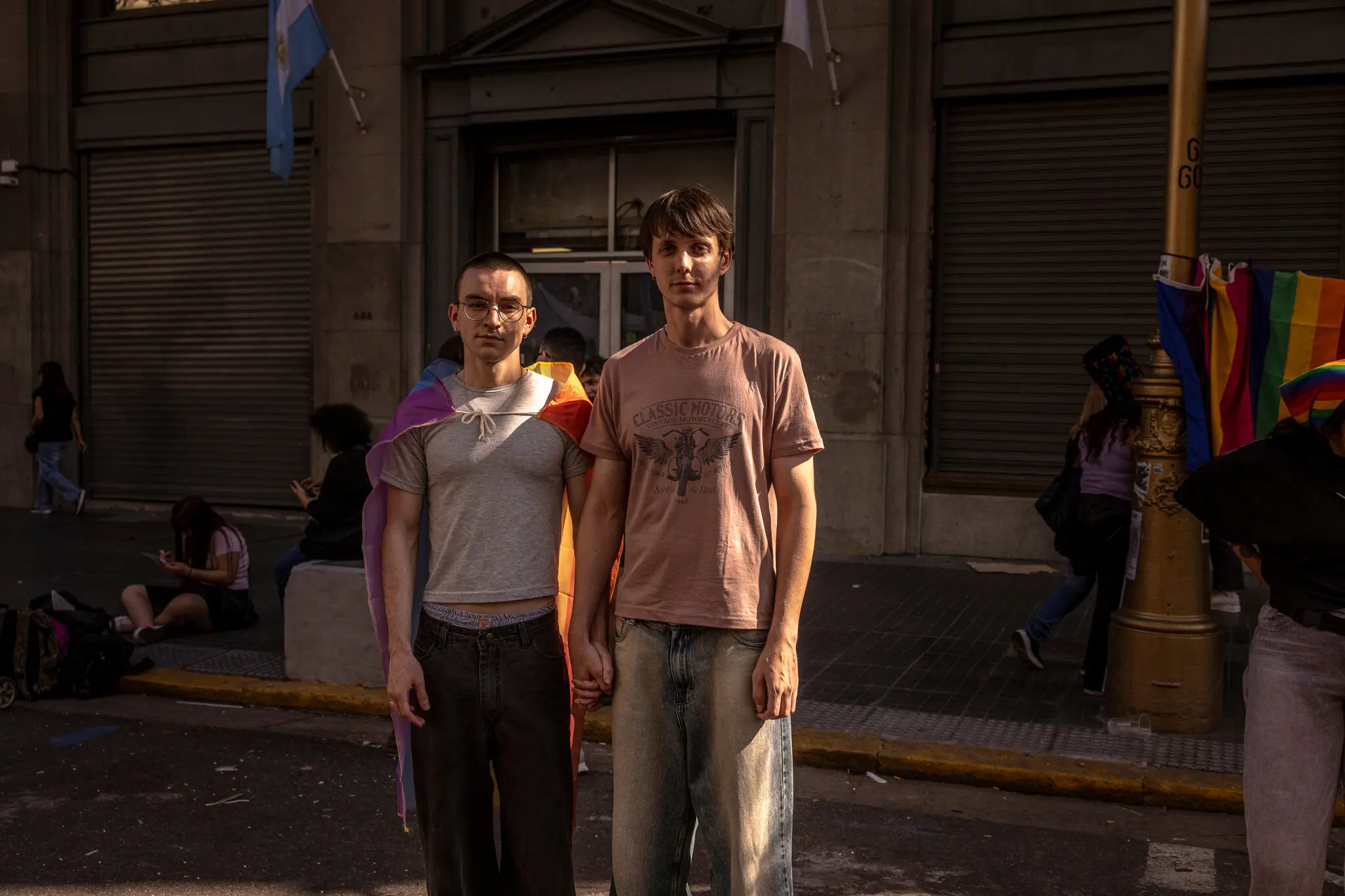

Rainbow floats rolled slowly past purple jacaranda trees in Buenos Aires as dancers in glittering skirts, rainbow swimsuits, and angel wings moved to the beat. Spring sunlight lit the scene, and the energy felt boundless. For many locals, this was simply the city’s annual Pride celebration. But for two young men from Russia, the moment felt like they had stepped into another world.
“This is the most freedom I’ve ever seen,” said 23-year-old Marat Murzakhanov, who grew up in Ufa, near the Ural Mountains in Russia. He and his partner attended the festivities together, marveling at how open and joyful the environment was. “We want to stay here,” he said.
They are far from alone. Over the past few years, Argentina has quietly become a refuge for LGBTQ Russians fleeing intensifying repression under President Vladimir Putin. While many Russians escaping war-related conscription or crackdowns have moved to countries like Georgia, Armenia, and Kazakhstan, countless queer Russians found themselves unable to remain in those regions due to discrimination and lack of legal protections.

With travel restrictions tightening across Western countries, many queer Russians looked far beyond Europe for a place where they could live safely. Their solution turned out to be a long journey south, across hemispheres, to Argentina.
“When I told my parents I was moving to Argentina, they asked me where it was,” recalled 29-year-old software developer Anton Floretskii from Tolyatti, an industrial city in Russia. “I had to explain it’s in the Southern Hemisphere, and the stars are different.”
In Russia, he said he had been harassed and physically attacked because of his sexuality. Now, he attends Pride events wearing a tank top printed with the phrase “my boyfriend is gay.” Surrounded by fellow Russians in makeup, lace corsets, and flamboyant outfits, he joined locals in singing Argentine pop anthems and sharing empanadas. “Argentina was never on the map for us,” he said. “It’s random, but it feels right.”
The path that led them here traces back to Russia’s intensifying anti-LGBTQ policies. Over the last several years, and especially after the invasion of Ukraine in 2022, Kremlin rhetoric and actions against LGBTQ citizens have escalated dramatically. By 2023, the Russian Supreme Court labeled the so-called “international LGBTQ movement” an extremist entity, grouping it alongside terrorist organizations like Al Qaeda. This ruling triggered a new level of suppression, pushing many to finally flee.

For years in Russia, fear shaped everyday life for queer people. Lesbian couples wore fake wedding rings. Young men were beaten in shopping malls for dyed hair. Many LGBTQ individuals had long dreamed of leaving — and then acted.
Argentina entered the conversation in unexpected ways. A shared Google spreadsheet circulating among Russian queer communities listed countries where citizens could enter easily and find legal protection. Argentina stood out for its inclusive laws, including marriage equality and gender self-identification rights.
Some Russians stumbled on Argentina while searching for any place they could legally enter. Others did deep research. Georgii Markelov, a 27-year-old social media specialist from Moscow, wrote “Argentina” on a list of possible safe havens alongside other rights-respecting nations. Another Russian, 27-year-old psychologist Giordani Taldyki, first moved to Bangladesh. He read Argentina’s Constitution one day in a park and noticed that it explicitly welcomes people from around the world. “It said immigrants have rights,” he said. “I loved that.”
Argentina’s Constitution — written in 1853 during the nation’s immigration-driven expansion — includes a line opening the door to “all men in the world who wish to reside on Argentine soil.” Once a magnet for European migrants, the country has since welcomed political refugees, war survivors, and diasporas from across the world — including Russians fleeing both the collapse of the Soviet Union and more recent repression.
After Russia’s invasion of Ukraine, over 120,000 Russians arrived in Argentina. Some were pregnant women seeking citizenship benefits for their future children, a trend that drew local attention. But quietly, another wave followed: queer Russians seeking safety.
“It felt like a snowball,” recalled 43-year-old Siberian-born dog trainer Anna Sokolova, who runs a business in Buenos Aires with her wife. “They kept coming.”
LGBTQ support organizations in Argentina have helped thousands of these new arrivals. According to Mariano Ruiz, who runs a local advocacy group, over 1,800 LGBTQ Russians have received assistance since the war began. Argentina’s appeal lies not only in acceptance but in its global leadership. In 2010, it became the first Latin American nation to legalize same-sex marriage. It later adopted groundbreaking gender identity laws, allowing people to change gender markers on documents without medical procedures or court orders.

“I can be myself here,” said 24-year-old Siberian-born trans woman Alisa Nikolaev. “I don’t feel judged.”
Still, not everything is perfect. Argentina’s current right-wing president, Javier Milei, has criticized what he calls “gender ideology” and enacted spending cuts that strain public services, including health programs providing hormone therapy and HIV medication. Immigration rules have also tightened. Yet progress-oriented human rights and gender equality remain deeply ingrained in Argentine culture — and visible on the streets.
During Buenos Aires Pride, activists sold meat sandwiches, carried signs, and wore hats reading “Make Argentina Gay Again.” For many queer Russians, the activism itself was inspiring. “People fight here,” said Taldyki. “That makes me feel safe.”
Life in Argentina has brought unexpected comfort. Taldyki said he enjoyed hearing people casually ask whether someone has a boyfriend or girlfriend — not assuming heterosexuality. He smiled when meeting a trans taxi driver and when realizing he could walk through a day without thinking about being gay. “Sometimes I forget I’m gay here,” he said.

Floretskii described entering a salon where Lady Gaga blasted through the speakers and a gay stylist greeted him like any other client. “I thought, wow, this is normal here.”
Sokolova felt welcomed at a fertility clinic, where doctors casually asked why she hadn’t brought her wife. That simple question illuminated how deeply she and her partner had internalized caution back in Russia. “We realized we had stopped hugging each other in public because we were used to hiding,” she said.
Yet the relief of safety often mixes with sorrow. Many Russians feel gratitude toward Argentina but pain over the distance from home. “The hardest part of immigration is knowing our country doesn’t care about us,” said Sokolova’s wife, Antonina Lysikova. “Argentina might embrace us. Russia never did.”
As night fell at Buenos Aires Pride, a group of Russian LGBTQ immigrants gathered in a historic apartment, dancing to Katy Perry’s “I Kissed a Girl” beneath chandeliers. T-shirts by Russian queer artists hung on the wall beside a donation box for a trans Russian who had recently died by suicide in Argentina. On the balcony, 26-year-old St. Petersburg developer Igor Muzalevskii looked down as a Pride float rolled by, rainbow flag waving.
“This is why we came,” he said quietly. “Here, we learned the world can treat you better.”





Leave a Reply