
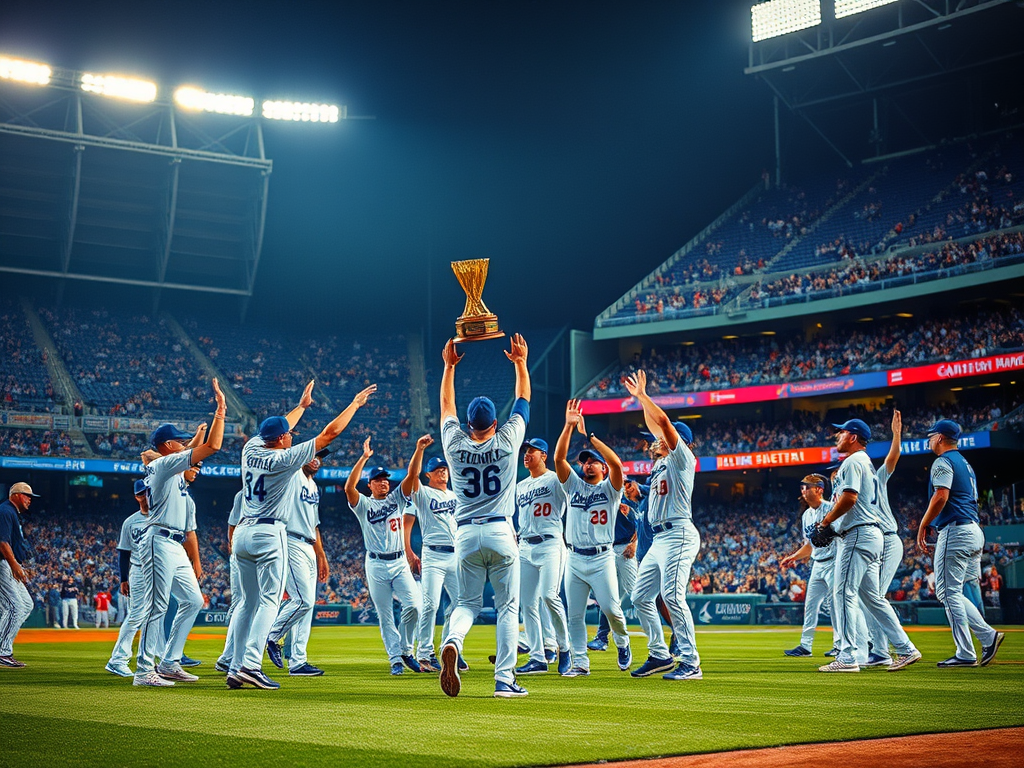

This October marked a milestone in baseball history: for the first time in 32 years, the World Series took place outside the United States. And just after midnight, the Commissioner’s Trophy began its journey back south of the border, returning with the Los Angeles Dodgers after their dramatic 5–4 victory over the Toronto Blue Jays in an unforgettable Game 7.
The Dodgers’ win came at the end of 11 intense innings, closing out a series that captivated fans on both sides of the border. For Canada, it was more than just a sporting event—it became a national story of pride, unity, and ultimately, heartbreak. The Blue Jays, the country’s only Major League Baseball team, had transformed into a symbol of hope during a time when tensions with the United States were once again dominating political headlines.
The Rise of the “Glue Jays”
Few expected the Blue Jays to make it this far. With the Dodgers boasting a record-breaking $520 million payroll and global superstar Shohei Ohtani leading their roster, most analysts predicted a quick four-game sweep. Instead, Canada’s underdogs—dubbed the “Glue Jays” for their extraordinary team chemistry—shocked the baseball world. They toppled powerhouses like the New York Yankees and Seattle Mariners on their way to the finals, uniting an entire nation in the process.
By the time Game 7 rolled around, Toronto’s Rogers Centre had transformed into a roaring sea of blue. Nearly 45,000 fans filled the stadium, their chants echoing through the night as hope swelled for an improbable victory.

Game 7: A Night of Glory and Grief
The game itself was a rollercoaster of emotion. The Blue Jays came out strong, forcing Ohtani off the mound after Bo Bichette launched a three-run homer into the stands. The crowd erupted, believing destiny might finally be on their side. Moments later, Daulton Varsho’s spectacular diving catch in center field—and Vladimir Guerrero Jr.’s defensive heroics at first—kept the Dodgers’ offense at bay.
Tempers flared when Toronto’s Andrés Giménez was hit by a pitch, prompting both dugouts to empty in a brief scuffle. But the Blue Jays refused to lose focus. Guerrero turned a daring double play with flawless precision, keeping Toronto in control.
Then came the heartbreak. In the ninth inning, the Dodgers’ Miguel Rojas smashed a home run that tied the score 4–4. Two innings later, Will Smith sent another soaring into the night, silencing the Toronto crowd. The Blue Jays, who had fought so hard for so long, couldn’t answer back.
As the Dodgers celebrated on the field, the Rogers Centre fell into stunned silence. Outside, bars emptied into Toronto’s cold November streets, where fans lingered quietly, processing the loss. Yet even in defeat, the Blue Jays received a standing ovation as they walked off the field—an acknowledgment of their courage, spirit, and the hope they had given to millions.

A Nation United Through Baseball
For Blue Jays manager John Schneider, the moment was bittersweet. “As tough as this is right now,” he said, “I think of the entire country and how they latched onto this group and hung on every pitch. There will be so many good memories for generations of fans who waited a long time to see this.”
Even music legend Geddy Lee, lead singer and bassist of the Canadian rock band Rush, couldn’t hide his admiration. A loyal season-ticket holder since 1979, Lee praised the team’s unique makeup—a blend of rising stars, veterans, and overlooked prospects that reignited Canada’s love for baseball. “This is the most surprising team I can remember,” he said. “They turned all those negative expectations into a love affair.”
The Canadian Spirit on the Field
Interestingly, only one Blue Jays player was actually born in Canada: the charismatic first baseman Vladimir Guerrero Jr., a Montreal native. Before Game 7, Guerrero arrived at the stadium wearing the jersey of Canada’s women’s hockey captain Marie-Philip Poulin—a gesture that perfectly captured his connection to the nation. Even after the loss, he wore it again, a quiet tribute to the fans who had stood by him.
Despite most of the roster hailing from the U.S. and Latin America, the Blue Jays embodied distinctly Canadian traits: humility, persistence, and quiet determination. “They don’t play with arrogance,” Lee noted. “Canadians identify with that—quiet yet relentless, always respectful but never willing to quit.”
Third baseman Ernie Clement, originally from Rochester, New York, echoed that sentiment. “It’s truly an honor to play for this country,” he said. “Everyone has been so welcoming and supportive. I’ve had zero negative experiences since I got here—it’s mind-blowing.”

Baseball Amid Political Tension
The 2025 season unfolded against a backdrop of renewed political friction between Canada and the United States. Tariff disputes and fiery rhetoric from President Trump had stirred nationalist sentiment north of the border. On the eve of Game 1, Trump abruptly announced he was terminating trade talks with Canada over an Ontario government ad that, he claimed, misrepresented Ronald Reagan’s past comments on tariffs. Prime Minister Mark Carney quickly issued an apology.
Yet, inside the ballpark, politics took a back seat. Fans stood proudly for both national anthems, cheering in mutual respect. When a protester briefly jumped the outfield wall with an American flag during Game 6, he was swiftly apprehended—an isolated incident in an otherwise peaceful series. Baseball, it seemed, had achieved what diplomacy could not: a moment of unity.
A Truly Global Series
This World Series was also unprecedented for another reason—it both began and ended outside the United States. Opening in Tokyo and closing in Toronto, the season captured an international audience. Viewership soared to 32.6 million across Canada, Japan, and the U.S.—the highest since the Chicago Cubs ended their 108-year drought in 2016.
Blue Jays infielder Bo Bichette marveled at the attention. “The numbers this World Series is doing not only in Canada, but everywhere, is unbelievable,” he said. “Even I had to step back and think, wow, this is pretty amazing.”
The Moments That Defined the Series
Fans will remember this World Series not only for its outcome but for the unforgettable moments that led up to it:
- Addison Barger’s pinch-hit grand slam in Game 1—the first in World Series history.
- Yoshinobu Yamamoto’s complete game shutout for the Dodgers in Game 2.
- The marathon 18-inning Game 3, the second-longest in World Series history.
- Toronto’s masterful shutdown of Ohtani in Game 4, both as pitcher and hitter.
- Rookie pitcher Trey Yesavage’s seven-inning, 12-strikeout masterpiece in Game 5—a record for a World Series rookie.
- And the chaotic Game 6 ninth inning, when a stuck ball possibly cost Toronto a win.
Each game wrote a new chapter in baseball history, culminating in the bittersweet finale that left Canadian hearts aching—but proud.

The Legacy of the 2025 Blue Jays
Joe Carter, the hero of Toronto’s 1993 championship, summed it up best. “If you hit a home run for this country, they’ll love you forever,” he said. “From Nova Scotia to Vancouver, it’s all about the Blue Jays—it’s all about Canada.”
This year’s Blue Jays may not have brought the trophy home, but they achieved something far greater: they reminded an entire nation what it means to come together. In the face of adversity—on the field and beyond—they played with unity, resilience, and joy. And for a country that so often measures itself against its southern neighbor, the 2025 Blue Jays gave Canada something to celebrate—a story of heart, hope, and a nation rediscovering its pride through the beautiful game of baseball.




Leave a Reply