
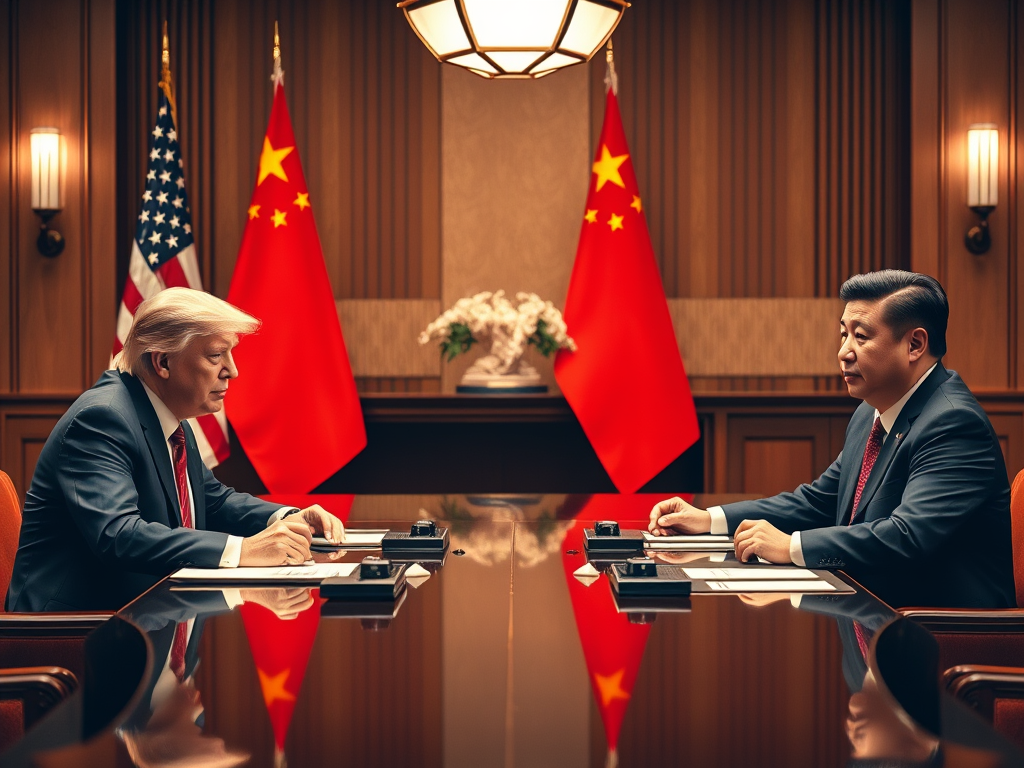

In a closely watched encounter that drew the attention of leaders across the world, President Donald Trump and Chinese President Xi Jinping met in South Korea on Thursday, striking what both described as a yearlong cease-fire in their escalating trade conflict. The agreement, however, was overshadowed by new global anxieties over the possible return of nuclear weapons testing among major powers.
The 90-minute meeting, held in the port city of Busan, came at a critical moment. With global markets rattled by months of tariffs and countermeasures, world leaders had been hoping for a breakthrough that could restore stability. By the end of the session, both nations agreed to scale back aggressive trade policies, including steep import tariffs and restrictions on rare earth metals. Trump hailed the discussion as “a 12 out of 10,” calling it one of the most productive diplomatic engagements of his administration’s weeklong Asia tour.
Yet even as the two men projected cooperation, the backdrop was tense. Just before landing in South Korea, Trump had announced on social media that the United States would restart nuclear weapons testing for the first time in more than three decades. The statement, made without prior warning, came shortly after Russia revealed it had successfully tested a nuclear-capable missile and an underwater drone designed to unleash tsunamis.
“Because of other countries’ testing programs, I have instructed the Department of War to start testing our nuclear weapons on an equal basis,” Trump wrote, sparking immediate alarm among arms control experts. Though he offered no specifics, the timing made it clear that the issue would hang heavily over his meeting with Xi, whose country possesses the world’s third-largest nuclear arsenal.
After the talks, Trump appeared to soften his tone, praising Xi as “a great leader of a very powerful, very strong country.” He emphasized that his nuclear comments were not aimed at China directly, but rather at unnamed nations that had resumed testing. “We have more nuclear weapons than anybody,” Trump said. “We’ve stopped testing for years, but if others are doing it, I think it’s appropriate that we do, too.”
The episode reflected a familiar hallmark of Trump’s foreign policy — abrupt shifts in tone and direction, often leaving diplomats scrambling to interpret his next move. In this case, his announcement jolted the international community just as negotiations between the United States and China were poised to influence everything from global trade flows to security alignments across the Indo-Pacific.

The Chinese state news agency Xinhua issued a cautious summary of the meeting, confirming that both sides agreed to avoid “mutual retaliation” and learn from the “twists and turns” that had strained relations. While the statement avoided mentioning specific deals, Trump later told reporters that Beijing had agreed to suspend for one year its export restrictions on rare earth elements, a crucial resource for electronics and defense manufacturing.
Trump also claimed that China would take stronger measures to curb the export of precursor chemicals used to manufacture fentanyl, a powerful synthetic opioid linked to thousands of deaths in the United States. In return, Washington would reduce fentanyl-related tariffs from 20 percent to 10 percent. “Reducing fentanyl deaths in America is one of my highest priorities,” Trump said.
In another apparent concession, Xi agreed to increase purchases of American agricultural and energy products. “Our farmers will be very happy,” Trump wrote online, noting that China had committed to buying “massive amounts of soybeans” and beginning the process of importing U.S. energy.

Still, despite the cordial language, the atmosphere in Busan was notably more restrained than Trump’s earlier meetings in Japan and South Korea. Before their private discussion, the two leaders exchanged a firm handshake before rows of national flags. “President Xi is a great leader of a great country,” Trump said, “and I think we’re going to have a fantastic relationship for a long time.”
Xi, measured and deliberate, likened China–U.S. relations to “a giant ship that requires steady hands to steer.” He acknowledged that differences were inevitable between two leading global economies but stressed that cooperation remained essential. “We do not always see eye to eye,” Xi said, “but that is normal. I believe China’s development goes hand in hand with your vision to make America great again.”
Neither leader addressed some of the most sensitive geopolitical flashpoints. Trump declined to answer questions about the renewed nuclear testing order, and Xi avoided any reference to Taiwan, which Beijing claims as its own territory. Trump later confirmed that the issue “did not come up” during their talks, consistent with his earlier remarks that he did not plan to discuss it.
The pair did, however, touch on the ongoing war in Ukraine. Trump said they spoke “at length” about ways to work together to “get something done,” though he provided no details. He also noted that while Xi’s government has continued to buy oil from Russia, the two leaders did not directly discuss the matter.

Trump’s declaration of renewed nuclear testing followed Russian President Vladimir Putin’s announcement of new nuclear-capable weapons systems, including a sea-based drone capable of triggering underwater explosions. China, meanwhile, has been rapidly expanding its nuclear arsenal, raising global concerns about an emerging three-way arms race. When asked whether his move might increase nuclear risks, Trump brushed it off: “I think we have it pretty well locked up.”
He added that the U.S. was already engaged in preliminary discussions with Russia on nuclear disarmament and that “China would be added to that.”
Throughout his Asia trip, Trump sought to display strength and cultivate leverage ahead of his meeting with Xi. In Japan, he highlighted Tokyo’s purchase of U.S.-made missiles to equip its fighter jets and encouraged greater military spending. Standing beside Japanese Prime Minister Sanae Takaichi, Trump welcomed Japan’s renewed pledge to ensure a “free and open Indo-Pacific.”
In South Korea, he approved plans for the country to develop a nuclear-powered submarine, citing their growing defense cooperation. By the time he arrived in Busan, Trump’s message was clear: America was reasserting leadership in Asia, and he intended to balance confrontation with cooperation when dealing with China.
The Busan meeting ultimately served both leaders’ purposes. For Trump, it was an opportunity to showcase diplomatic progress ahead of his planned visit to China in April. For Xi, it offered a chance to stabilize relations while signaling that Beijing would not yield to pressure.

“The whole relationship is very, very important,” Trump told reporters as Air Force One departed for Washington. “I think we made great progress today.”
Still, beneath the polite smiles and optimistic rhetoric, uncertainty lingers. The renewed talk of nuclear testing, combined with fragile trade truce terms and deep mistrust between the world’s two largest economies, underscores just how precarious global stability has become. As markets and governments worldwide assess the aftermath of the meeting, one question remains: can economic cooperation coexist with a new age of nuclear competition?
At least for now, the answer appears to depend on the same two men — and whether their temporary truce holds in the turbulent months ahead.




Leave a Reply