
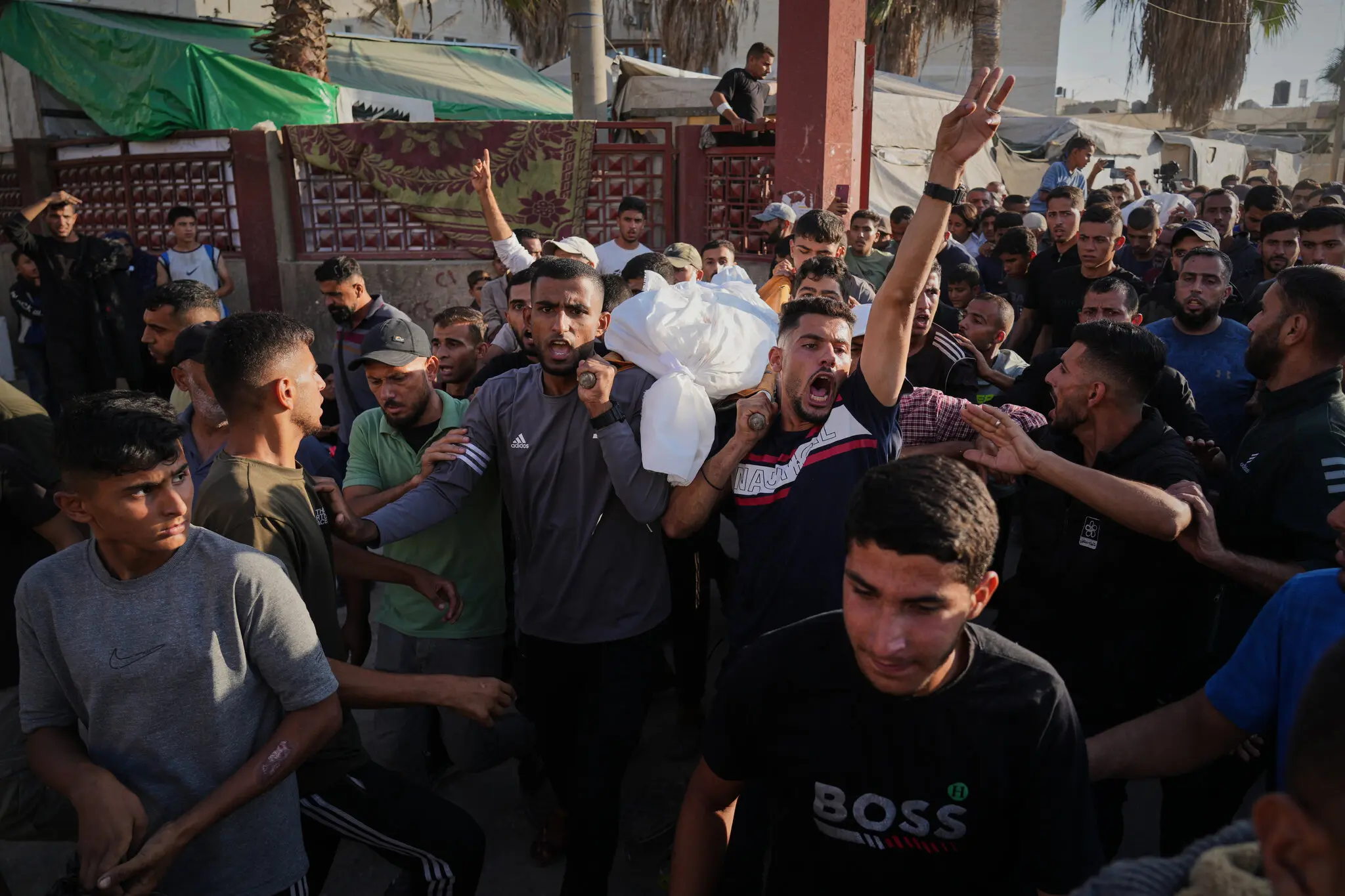
Israel launched one of its most intense waves of attacks on the Gaza Strip on Sunday, marking the heaviest round of strikes since a fragile cease-fire was put in place just a week ago. The Israeli government said it temporarily halted humanitarian aid deliveries after accusing Hamas of violating the truce by opening fire on Israeli forces and killing two soldiers. The escalation raised serious concerns about the survival of the cease-fire agreement, which had been brokered under significant pressure by the Trump administration and initially presented as a critical step toward de-escalation.
According to the Israeli military, the decision to resume what it described as “renewed enforcement of the cease-fire” came after a series of targeted airstrikes on Hamas positions across Gaza. Officials stated that the strikes were conducted under government directives and were aimed at neutralizing immediate threats posed by Palestinian militants. The return to military action came just after nightfall, signaling a rapid deterioration in conditions on the ground.

An Israeli official, speaking anonymously due to the sensitivity of the issue, said that humanitarian aid deliveries were halted due to the intensity of the military operations. While early reports suggested that the suspension might be indefinite, authorities later clarified that aid would likely resume once the strikes had subsided. Still, the temporary freeze added to growing fears over the already dire situation faced by civilians in Gaza, where millions are struggling with food shortages, displacement, and limited medical access.
Early Sunday, Israeli authorities confirmed that two soldiers were killed in what they described as a Palestinian militant attack in Rafah, a city in southern Gaza that remains under Israeli military control. According to the military, the soldiers were struck by an anti-tank missile before coming under additional gunfire. The attack was immediately branded a “blatant violation” of the cease-fire agreement and triggered a strong military response.
Gaza’s health authorities reported 44 Palestinian deaths across the territory over the course of the day. The toll underscored the increasing fragility of the truce as both sides accused each other of violating the agreement repeatedly in recent days. Despite the escalation, officials from both Israel and Hamas maintained that they were still committed to upholding the cease-fire in principle, suggesting that neither side is ready to completely abandon the agreement for now.

The Israeli military said it intensified operations on Sunday afternoon by striking dozens of Hamas targets throughout Gaza. In northern Gaza, Israeli forces claimed to have targeted a group of individuals they identified as armed militants attempting to cross the cease-fire line. The military also reported efforts to dismantle tunnel shafts and other strategic infrastructure allegedly used by Hamas.
Israeli Prime Minister Benjamin Netanyahu said he consulted with military and security leaders and ordered them to respond forcefully. He accused Hamas of endangering the agreement and undermining regional stability. Netanyahu’s statement reflected growing internal pressure from conservative members of his coalition who have long argued that the cease-fire gives Hamas time to reorganize.
Hamas, however, denied responsibility for the attack that sparked the escalation. The group’s military wing issued a statement claiming it had no knowledge of any operations in the Rafah area, alleging they had lost contact with fighters in that region months earlier. Meanwhile, Hamas officials confirmed that a delegation had arrived in Cairo to meet with mediators and discuss the ongoing implementation of the cease-fire terms. Izzat al-Rishq, a senior Hamas official, accused Israel of provoking conflict and fabricating justifications for renewed attacks.
The recent tension follows a previous incident on Friday when Israeli forces opened fire on a vehicle in northern Gaza, killing at least nine people, including four children, according to Gaza’s rescue services. Israeli authorities said the vehicle had crossed a designated boundary established under the cease-fire agreement and was deemed suspicious after ignoring warning shots. However, Gaza residents have expressed confusion over evolving territory lines, especially given widespread internet outages, destroyed infrastructure, and unclear mapping.
Under the cease-fire terms, humanitarian aid was supposed to increase significantly, with the number of truck deliveries entering Gaza rising to around 600 per day from approximately 300 prior to the agreement. Instead, the recent halt in deliveries has worsened desperation among Gaza’s population of roughly two million people, many of whom have already been forced to relocate multiple times amid widespread destruction. Entire neighborhoods remain in ruins, and access to clean water, shelter, and medical services remains severely limited.
The political response within Israel has also added pressure to the cease-fire’s future. Members of Netanyahu’s right-wing coalition called for a full-scale resumption of military operations. Itamar Ben-Gvir, Israel’s ultranationalist minister of national security, argued that any belief Hamas would adhere to the cease-fire was dangerously naive. Ben-Gvir, who opposed the agreement from the start, insisted that Israel should continue its offensive until Hamas is entirely dismantled.
Israeli officials continue to highlight that Hamas still operates from an extensive underground network of tunnels, including areas currently under Israeli control. The government has also voiced frustration over the pace at which Hamas has released the remains of deceased captives, as mandated by the agreement.

According to the Israeli government, Hamas has released the final group of 20 living Israeli hostages over the past week and transferred the bodies of 12 deceased captives. One additional body was determined by forensic investigators not to match any of the known captives, raising further questions about the accuracy of Hamas’s claims. In return, Israel has released nearly 2,000 Palestinian prisoners and returned more than 100 bodies to Gaza.
On Saturday, Israeli officials identified two hostages whose bodies had been recovered: Ronen Engel, a 54-year-old Israeli citizen, and 30-year-old Thai agricultural worker Sonthaya Oakkharasri, who had been abducted from the border community of Be’eri during the October 7, 2023, Hamas attack that sparked the current war. Engel, who was killed in the community of Nir Oz, had his remains taken into Gaza during the initial assault.
Despite these exchanges, Israel maintains that the bodies of at least 16 hostages remain in Gaza. Hamas has repeatedly said that locating and recovering the bodies is a challenge, with some believed to be buried under heavily bombed areas where rubble and collapsed infrastructure make retrieval difficult.
The renewed violence comes at a time when international mediators are urging both sides to preserve the cease-fire amid growing humanitarian concerns. Aid organizations have warned that further escalation could lead to a complete collapse of relief efforts, pushing Gaza deeper into crisis. Human rights groups continue to call for sustained humanitarian access and meaningful diplomatic negotiations to prevent a return to full-scale war.
As the situation unfolds, global attention remains fixed on whether the cease-fire will survive the latest disruptions or collapse entirely under mounting political and military pressures. For civilians on both sides of the conflict, the coming days may prove critical in determining whether the region steps back from the brink or returns to prolonged violence.




Leave a Reply