
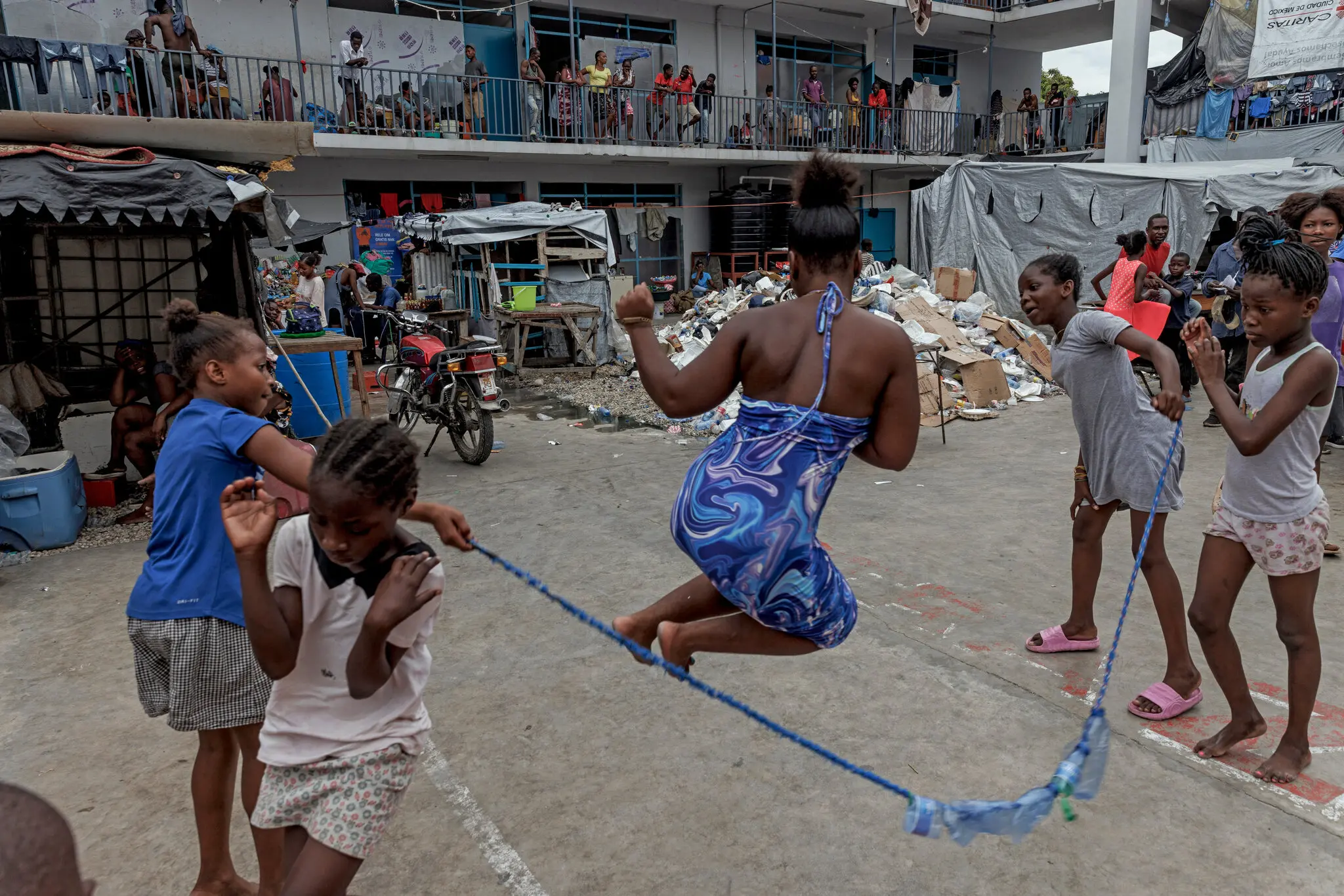

In the heart of Port-au-Prince, 12-year-old Henrique Dauphin spends his days chasing a battered plastic bottle across the dirt. It’s not a toy—just a substitute for the soccer ball he lost when gangs set fire to his family’s home last year. Nights bring little comfort; he sleeps under a torn tarp that barely keeps out the rain, sharing the space with nine others.
For nearly a year, Henrique hasn’t stepped foot in a classroom. His story is tragically common in today’s Haiti—a nation where escalating violence and hunger are forcing children out of school and into survival mode.
According to a new UNICEF report, an estimated 680,000 Haitian children have been displaced by armed gangs, nearly double the number reported just one year ago. With neighborhoods under siege, schools shut down, and families left homeless, Haiti’s humanitarian crisis has reached its most critical point in decades.
A Growing Humanitarian Emergency
When Henrique speaks about his dreams, his voice is quiet but firm.
“I want to go to school. I want to learn something,” he told aid workers from Mercy Corps, the humanitarian organization assisting displaced families in the Turgeau neighborhood of Port-au-Prince. “But things are not good here.”
His mother lost her job months ago and can no longer pay for tuition. In many areas, even if families could afford school fees, there would be no schools left to attend. Nearly 70 percent of schools in the Port-au-Prince region are closed—some damaged by violence, others taken over by displaced families seeking shelter.
Nationwide, over 1,600 schools have shut their doors. The result: one in four Haitian children is now out of school entirely. Meanwhile, nearly 300,000 children under the age of five are projected to suffer from acute malnutrition this year.
The situation is even darker beneath the surface. Children are being recruited into gangs, exposed to sexual violence, and living without consistent access to food or clean water.

UNICEF’s regional director for Latin America and the Caribbean, Roberto Benes, summarized the scale of the crisis bluntly:
“The data paints a picture of the highest concern. The situation is spiraling out of control.”
Food Shortages Deepen the Suffering
As the humanitarian need explodes, aid resources are shrinking. The United Nations World Food Programme (WFP)—which provides critical meals to displaced families—recently announced devastating cuts due to funding shortfalls.
Hot meals for newly displaced families have been suspended, and food rations were reduced by half for those already relying on assistance. The agency declined further comment, but insiders say the shortages are the worst in years.
UNICEF’s emergency fund for Haiti has raised only $17 million out of a $272 million goal, leaving a massive funding gap as the crisis worsens.
The numbers tell a grim story. An estimated 1.3 million Haitians have been forced from their homes. Some stay with relatives; others live in schools, government buildings, or makeshift camps that lack bathrooms, clean water, and electricity. The number of informal encampments has doubled in just six months, now exceeding 240 sites across the country.
Life in the Camps: Survival Without Dignity
For many families, displacement has become a way of life.
Gerald Delva, a 37-year-old father of four, spent the past two years living at Lycée Marie Jeanne—a high school turned shelter for hundreds of families. He says overcrowding, violence, and hunger made it impossible to stay. Last week, he made the difficult decision to flee to the countryside.
To afford the trip, his mother sold her only pig. What should have been a two-hour drive turned into a two-and-a-half-day journey on foot and motorbike, as he navigated gang-controlled roads.

Delva used to own a small carpentry shop in Carrefour Feuilles before it was destroyed in 2022. Since then, his children—one meant to be in kindergarten, another in first grade—have had their schooling interrupted twice due to closures. Each time, he lost the tuition fees he had saved.
“The kids have seen so many terrible things. I believe they are traumatized,” Delva said. “We’ve witnessed things we never imagined possible.”
To distract them from the violence and hunger, he lets his children watch cartoons on his phone. But even that comfort is fragile. By midday, he says, his family often hasn’t eaten anything.
“I just want a better life for my kids,” he said quietly.
Violence and Political Collapse: The Roots of the Disaster
Haiti’s collapse into chaos has been years in the making. The country’s gang crisis intensified after the assassination of President Jovenel Moïse in 2021, leaving a power vacuum that no government since has been able to fill.
Gangs have since joined forces to control major highways, ports, and neighborhoods, effectively cutting off large parts of the country. Kidnappings have become routine, with hundreds of victims taken for ransom every month. These conditions have paralyzed trade and aid delivery, driving food prices to record highs and worsening the humanitarian emergency.
Earlier this month, the U.N. Security Council approved the creation of a new “Gang Suppression Force”—a multinational mission of up to 5,500 troops and police officers. But skepticism runs deep. A smaller force deployed more than a year ago has struggled to make an impact, and many Haitians remain doubtful that new interventions will bring peace.

A Generation on the Brink
The long-term consequences of Haiti’s crisis are almost unimaginable. An entire generation of children is growing up without education, stability, or safety. Experts warn that without immediate international action, these young people will face a lifetime of poverty, trauma, and lost opportunity.
The humanitarian community agrees that funding alone won’t solve Haiti’s crisis. Restoring safety, rebuilding schools, and reestablishing trust in government institutions will require sustained global coordination and political will—something Haiti has rarely received in recent decades.
Still, hope persists among the country’s children.
When asked what he would do if the violence ended, Henrique’s answer came without hesitation:
“I’d go back to school right away. I want to be a teacher one day.”
His dream is simple, yet in today’s Haiti, it feels almost revolutionary.
A Call for Urgent Action
Aid organizations are urging the global community not to look away. The numbers—hundreds of thousands of children displaced, starving, or out of school—represent real lives slipping further into danger.
Haiti’s future depends on whether these children can reclaim their right to education, safety, and dignity. Every day that passes without intervention deepens the cycle of despair.
As UNICEF and other agencies continue to sound the alarm, the message is clear: the world cannot afford to abandon Haiti’s children. They are not just victims of violence—they are the nation’s only hope for a better tomorrow.





Leave a Reply