
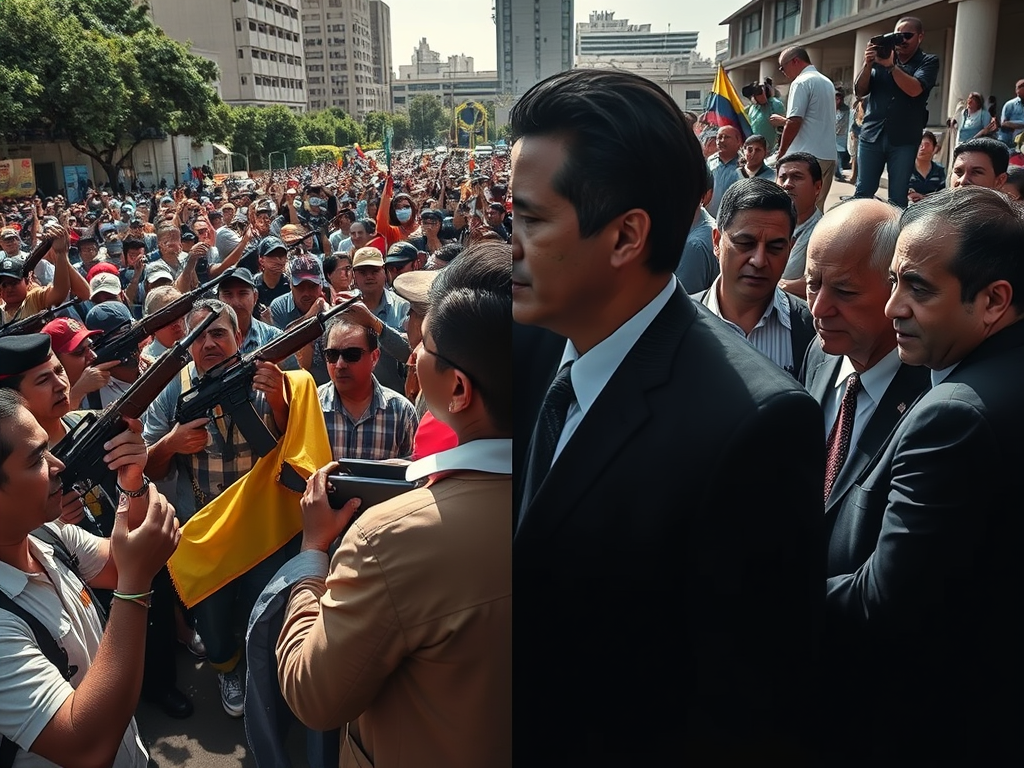

In Caracas, Venezuela’s sprawling capital, the atmosphere feels divided. On one side, government loyalists gathered in public squares, clutching rifles to their chests while listening to fiery speeches urging them to defend the nation at all costs. On the other side of the city, business leaders and diplomats quietly expressed alarm over escalating tensions with the United States, fearing that a missed chance at dialogue could spiral into violence or even military conflict. Elsewhere, ordinary citizens moved through daily routines with a sense of weary resignation, skeptical that any real political change will ever come.
I recently spent a week in Venezuela at a particularly precarious moment. Washington and Caracas are once again locked in confrontation. The Trump administration has deployed warships to the Caribbean, raising speculation of commando raids, airstrikes, or broader military action against the government of President Nicolás Maduro. Public threats from President Trump himself have only fueled that uncertainty.
The United States argues that the buildup is necessary to curb drug cartels. Trump has labeled Maduro the head of a “terrorist organization” responsible for shipping drugs northward. American officials claim U.S. forces have destroyed at least three drug-smuggling boats in the Caribbean, including two linked to Venezuela, calling it part of a campaign to choke the narcotics trade.
Yet drug enforcement statistics tell a more complicated story. While Venezuela is a transit point for some cocaine shipments, the bulk of the global trade originates in Colombia, not Venezuela. Fentanyl — the drug responsible for the majority of U.S. overdose deaths — is produced almost entirely in Mexico with chemical components from China. According to the U.S. State Department, only about 10–13% of the global cocaine supply moves through Venezuela, making critics question whether Washington’s true target is drug traffickers or Maduro himself.

The Push to Oust Maduro
Among Venezuelan opposition groups, there are sharp divisions over U.S. involvement. Some see any form of foreign action as the only viable path to removing Maduro, who has ruled since 2013 and faces accusations of human rights abuses, election fraud, and economic mismanagement. Opposition leader María Corina Machado and her allies argue that U.S. intervention could restore the results of the most recent presidential election, which international monitors say Maduro lost to Edmundo González, a candidate aligned with Machado.
One of her senior advisers, Pedro Urruchurtu, has openly admitted to coordinating with Washington. He claims there is already a plan in place for the “first 100 hours” following Maduro’s removal — a strategy that would involve international partners, particularly the United States, to guarantee a smooth transition to González’s leadership.
But other Venezuelans — even those who oppose Maduro — reject the idea of U.S. military action. They argue that a violent intervention could destabilize the country further, invite retaliation from paramilitary groups, and leave behind a power vacuum for criminal organizations to exploit. As one prominent businessman warned, “If Maduro is killed, Venezuela could become another Haiti,” a reference to the chaos that erupted after Haiti’s president was assassinated in 2021.
Diplomats stationed in Caracas remain skeptical that Maduro’s inner circle will fracture or that the military will defect. Venezuela’s armed forces remain loyal, and guerrilla groups from neighboring Colombia, as well as domestic militias, would likely compete for control of resources if Maduro were ousted. With Venezuela’s vast oil, gold, and mineral reserves at stake, the risk of conflict is high.

Maduro’s Counterstrategy
Maduro has responded to U.S. threats with defiance. He has ordered tanks into the streets, distributed weapons to civilian militias, and staged large-scale military exercises broadcast on state media. Yet his advisers insist that Venezuela does not want war. In an open letter to Trump, Maduro praised Washington’s efforts to reduce other global conflicts and signaled a willingness to engage in “direct and frank” dialogue through U.S. envoy Richard Grenell.
At the same time, Vice President Delcy Rodríguez accused the U.S. of abandoning diplomacy in favor of open hostility. “The Ministry of Defense is no longer about defense — it is a Ministry of War,” she said in a pointed interview. Rodríguez condemned the sinking of suspected smuggling boats as “illegal” acts of aggression and called for normalization of economic relations, particularly the lifting of sanctions on Venezuela’s oil industry.
Despite tensions, Venezuela has continued to accept flights of deportees from the United States. Some diplomats and business leaders remain cautiously optimistic that negotiations could eventually convince Maduro to step aside in exchange for sanctions relief and personal security guarantees. However, with Maduro under U.S. indictment for drug conspiracy charges, the president fears leaving office could mean arrest and extradition.
A Nation Balancing Between Conflict and Normalcy
The streets of Caracas reflect the contradictions of the current moment. At government rallies, employees are sometimes ordered to attend, handed unloaded rifles, and told to demonstrate their patriotism. Some leave quickly once events conclude; others declare they are prepared to defend Maduro with their lives.
Yet not far away, life continues as if nothing is wrong. Families plan quinceañera celebrations, young people gather for photography sessions, and shoppers go about their business. Despite talk of invasion, few residents are stockpiling supplies. “We can’t afford to,” explained Estefanie Mendoza, a social worker and mother of two. The uneven economic recovery, following years of crisis that triggered mass emigration, has left many Venezuelans living day-to-day without the resources to prepare for war.

Human Cost of the Drug War
Washington’s crackdown has already taken lives. According to U.S. officials, at least 17 people have died in recent naval operations targeting suspected smuggling boats. In the coastal state of Sucre, one of the vessels destroyed was reportedly carrying local fishermen. Relatives insist the men were not drug traffickers but ordinary workers trying to support their families. “He left one morning to fish and never came back,” said the widow of one victim.
Venezuelan journalist Ronna Rísquez noted that while drug trafficking does occur along the Paria Peninsula, many of the boats also carry migrants, trafficking victims, or subsidized Venezuelan gasoline bound for Trinidad and Tobago. For locals, the line between legal survival and illegal smuggling is often blurred.
What Comes Next?
The uncertainty over Venezuela’s future remains profound. Critics of military intervention point to failed U.S. operations in recent decades, from Iraq to Afghanistan, as evidence that removing Maduro by force could trigger long-term instability without guaranteeing democracy. Opposition figure Henrique Capriles summed up the skepticism: “The idea of a bloodless U.S. extraction of Maduro belongs to Netflix, not real life. And for us Venezuelans, what will be the cost?”
For now, Venezuela stands at a crossroads. On one path lies heightened confrontation with Washington, potential violence, and deeper alliances with geopolitical rivals like Russia, China, and Iran. On the other lies a fragile hope for dialogue, negotiation, and eventual reform.
As the world watches, Venezuelans themselves remain divided — torn between desperation for change and fear of what further conflict could bring.





Leave a Reply