
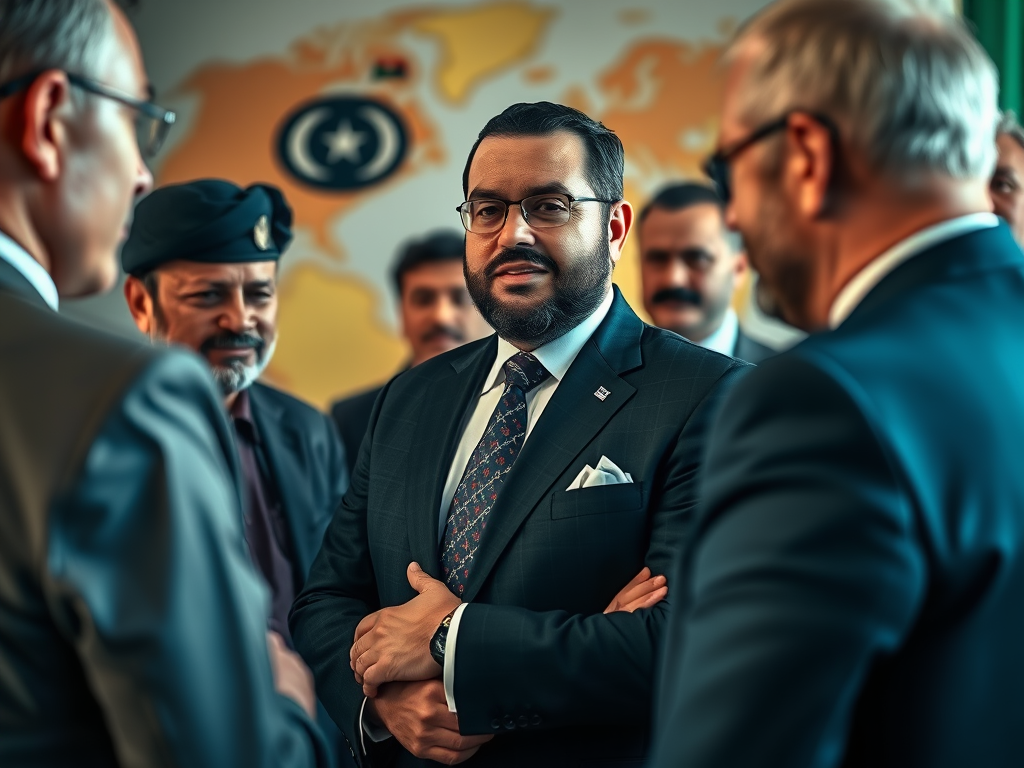

When Massad Boulos traveled to Libya in July in his role as the State Department’s senior adviser on African affairs, he was formally there to meet officials and discuss strategies to boost the nation’s oil and gas output. Yet Boulos carried another title that some Libyan officials quietly considered just as important: he is the father-in-law of Tiffany Trump, daughter of former U.S. President Donald Trump.
That connection did not go unnoticed. Behind closed doors, some Libyan leaders even began calling him “Abu Tiffany,” Arabic for “Tiffany’s father.” The nickname reflected both a sense of humor and a recognition of the blurred line between his family ties and his diplomatic influence.
As Boulos posed for photos with energy executives and announced oil production initiatives, Tiffany Trump and her husband, Michael Boulos, were enjoying a Mediterranean escape aboard one of the world’s most extravagant superyachts. The vessel, Phoenix 2, is owned by billionaire energy traders Ercument and Ruya Bayegan. Ruya Bayegan’s company, BGN International, stands to benefit directly from expanded Libyan oil deals — the very industry Boulos was tasked with shaping.

A Floating Palace and Its Owners
The Phoenix 2 is not just a yacht; it is a symbol of staggering wealth. Featuring two helipads, a swimming pool, and a massive bronze phoenix figurehead rising from its bow, the ship last chartered for over $1.4 million per week before being taken off the rental market. Its Art Deco interiors, custom Steinway piano, and lavish suites make it one of the Mediterranean’s most exclusive vessels.

Though the Bayegans were not on board during Tiffany and Michael’s stay, the optics of the Trump family vacationing on a yacht owned by international oil magnates with direct business in Libya raised eyebrows. For critics, the image underscored how difficult it can be to separate American diplomacy from the Trump family’s personal networks.
The Blurred Lines of Diplomacy and Family
Boulos, who only recently transitioned from running a family-owned trucking business in Nigeria to becoming a senior U.S. diplomat, has become the face of an Africa policy that prioritizes business deals over traditional diplomacy. The combination of his official role and his family’s connections has unsettled many U.S. allies and even members of Trump’s inner circle.

According to American officials, Boulos’s approach has caused diplomatic friction in regions such as Lebanon, the Democratic Republic of Congo, and Morocco. His freewheeling style, coupled with Michael Boulos’s reported interest in African business ventures, prompted warnings from senior U.S. officials to avoid mixing family business with government diplomacy.
Despite Tiffany and Michael holding no government roles, their presence on Air Force One during Trump’s state visit to the United Kingdom — and their participation at Windsor Castle alongside global dignitaries — reinforced perceptions of blurred boundaries between official duties and family privilege.

Trump’s Criticism of Hunter Biden Casts a Shadow
There is no indication that the yacht trip itself broke any laws. Yet the optics matter. Donald Trump spent years attacking Hunter Biden, son of President Joe Biden, for allegedly profiting from his proximity to power. Upon returning to office, however, Trump’s own circle — including his children and their spouses — became entangled in business dealings with foreign governments and private companies engaged in sensitive U.S. diplomatic discussions.
Asked about the Phoenix 2 trip, representatives for Tiffany Trump and Michael Boulos dismissed it as a “personal and private vacation.” Massad Boulos declined to comment. BGN International’s spokesperson insisted the yacht’s use was irrelevant to the company’s operations in Libya.
A Diplomat Without Clear Boundaries
What sets Boulos apart in Washington is his unusual status. Unlike traditional senior advisers, he required no Senate confirmation, has no formal disclosure obligations about his business ties, and holds overlapping roles in both the White House and the State Department. Secretary of State Marco Rubio has publicly praised him, calling him a “superstar” for brokering talks between Rwanda and Congo.
Still, diplomats accustomed to clear chains of command are uneasy. His lack of accountability, coupled with his position as part of the Trump family, has left many officials reluctant to push back. “He counts himself as family now, and that changes everything,” one senior U.S. official admitted.
Rocky Start and Diplomatic Missteps
Concerns about Boulos’s methods began early. As Trump’s Middle East adviser, he sidestepped official channels by taking meetings with Lebanese leaders and lobbying for preferred candidates in key financial posts. State Department diplomats had to ask Lebanese officials to route communications through the U.S. Embassy instead.
In Morocco, Boulos caused alarm by hinting that the U.S.-brokered deal normalizing relations between Morocco and Israel might be renegotiated — a suggestion later walked back as a misunderstanding. He also attempted to secure a private audience with Morocco’s king, prompting U.S. officials to quietly advise the monarch to decline.
Boulos defended his actions, insisting his outreach was productive and welcomed. Critics, however, saw a troubling pattern: freelancing diplomacy without oversight, creating confusion among allies, and potentially undermining carefully negotiated agreements.
Congo, Rwanda, and the Mining Deal
Boulos’s most high-profile achievement has been his role in a peace deal between Rwanda and Congo. Fighting between Rwanda-backed forces and Congolese troops had claimed thousands of lives and displaced hundreds of thousands more. A central feature of the peace agreement involved control of Rubaya’s lucrative mining region, with U.S. companies expected to industrialize operations and reduce Chinese influence.
Yet the mining deal remains unsettled. Some officials accuse Boulos of deliberately stalling the agreement brokered by Gentry Beach, a Texas investor and Trump family associate, to pursue alternative arrangements. Boulos denied blocking the deal but admitted that multiple negotiations were ongoing.
Libya: A High-Stakes Arena
Nowhere have questions about Boulos’s role been sharper than in Libya, a country divided between rival governments in the east and west. His meetings with Ibrahim Dbeibeh, national security adviser and nephew of the interim prime minister, included discussions about possibly unfreezing $70 billion in Libyan assets in exchange for U.S. construction contracts.
While Boulos denied entertaining such proposals, multiple Libyan and U.S. officials confirmed they had been raised. For some Western diplomats, the very fact that the idea was discussed was alarming, as it could be interpreted as tacit U.S. support for the Dbeibeh family’s hold on power.
Adding to the controversy, Boulos’s dinner with Dbeibeh at a seaside villa was initially denied, then later acknowledged as a “working dinner.” Critics argue that such meetings risked signaling partisanship in Libya’s fragile political landscape.

Yachts, Vacations, and Perceptions of Influence
The Trump-Boulos family vacation extended beyond the Phoenix 2. They also spent time aboard the Magna Grecia, a superyacht linked to Greek billionaire Ioannis Papalekas, whose business interests also include energy and luxury estates. Social media posts from Tiffany Trump and Marla Maples documented their stays at exclusive destinations, including Le Grand Jardin, a historic estate on St. Marguerite island once occupied by Louis XIV.
Ship-tracking records and photographs confirm that from July 17 to July 27, the family moved between yachts and luxury estates while Boulos was simultaneously engaged in oil diplomacy in Tripoli. Sources close to yacht operations confirmed that the family had not paid for their time on board, suggesting they were hosted as personal guests.
The Bigger Picture
For Trump’s allies, Boulos represents a loyal operator capable of delivering business-focused diplomacy in complex regions. For critics, his overlapping family and official roles epitomize the conflicts of interest that defined Trump-era foreign policy.
Whether Boulos is remembered as a pragmatic dealmaker or a symbol of blurred boundaries between diplomacy and personal gain will depend on how his initiatives in Africa and Libya unfold. For now, his role highlights an enduring question: where does U.S. policy end and Trump family business begin?




Leave a Reply