

One of the world’s most prestigious cycling competitions came to an abrupt halt on Sunday when large-scale pro-Palestinian demonstrations disrupted the Vuelta a España. Protesters opposing the participation of Israel-Premier Tech, a team with direct ties to Israel, flooded the racecourse and forced organizers to end the event nearly 43 kilometers (27 miles) before the scheduled finish.
Organizers cited “security reasons” for cutting the race short and canceled the traditional podium ceremony, a spectacle usually marking the high point of the three-week grand tour. The interruption immediately ignited global attention, not only because of the rare mid-race cancellation, but also due to the deep political undertones surrounding the team at the center of the protests.
Protests Extend Beyond Spain
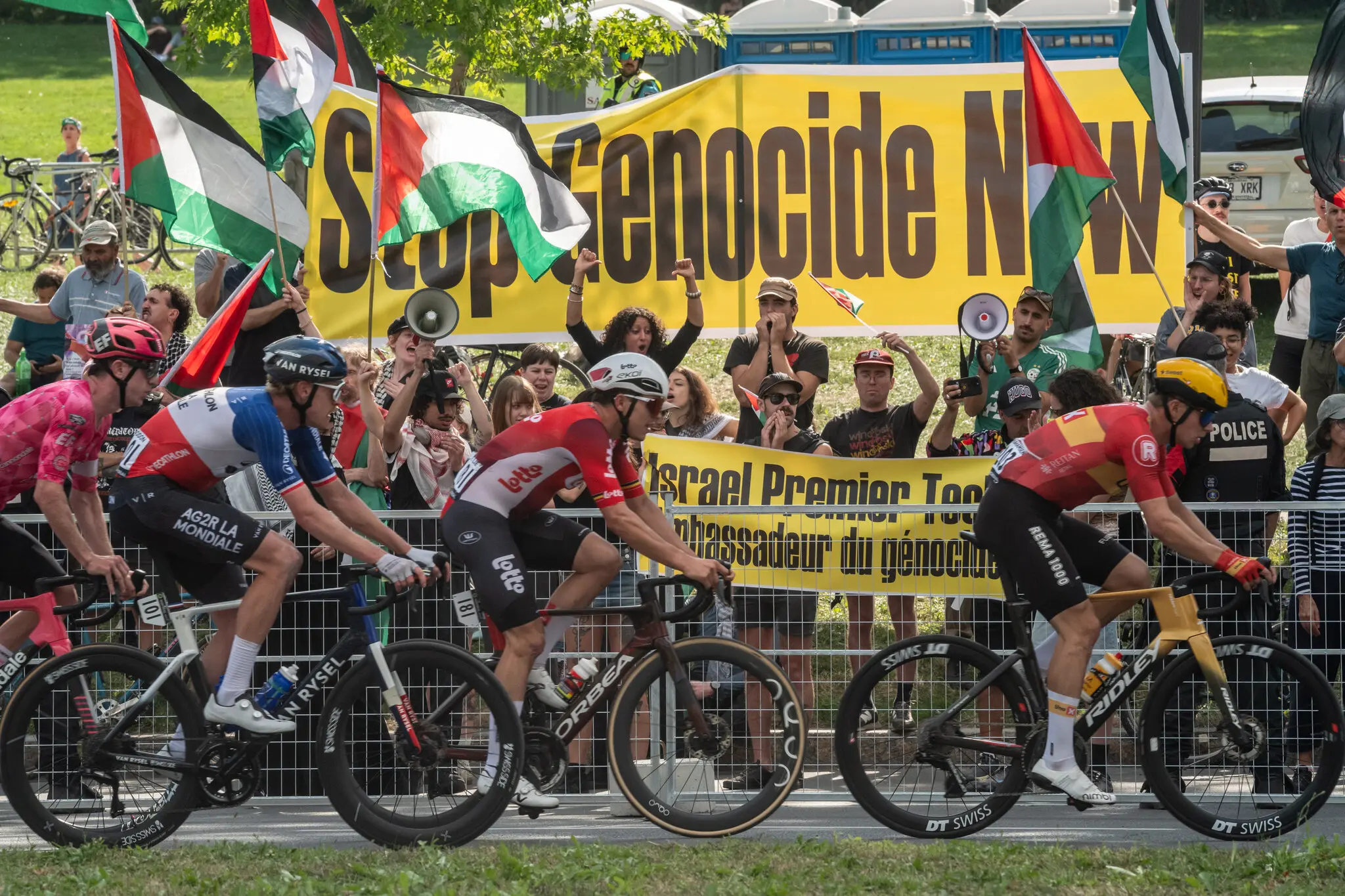
The disruption in Spain was not an isolated incident. On the very same day, a major professional cycling race in Montreal faced similar demonstrations. Although the Canadian race managed to continue without suspension, the protests underscored a coordinated global campaign targeting Israel-Premier Tech.
In both locations, activists focused their criticism on the team, originally founded to highlight Israeli cycling talent and national pride. Since the escalation of conflict between Israel and Hamas nearly two years ago, however, the squad has become a recurring focal point for pro-Palestinian groups.
A Pattern of Disruptions
This latest incident marked the fifth protest to directly impact this year’s Vuelta a España, a race often compared to the Tour de France in prestige and global viewership. Earlier demonstrations forced organizers to reroute or shorten multiple stages. During one stage, chaos erupted when protesters briefly blocked Israel-Premier Tech riders, causing crashes that led to minor injuries among athletes from other teams.
In an attempt to reduce visibility and ease tensions, riders from the team switched to jerseys featuring only their initials instead of the full team name. Despite this adjustment, the demonstrations showed no sign of slowing.

The Team’s Origins and Controversy
Israel-Premier Tech was founded by Sylvan Adams, a Canadian-born billionaire who relocated to Israel about a decade ago. Adams, the son of a Holocaust survivor, built a real estate empire in Quebec before turning his attention to promoting Israel through global sports. He envisioned the team as a bridge between cultures, showcasing Israeli athletes on the world stage.
Although the squad is officially registered in Israel, its roster and management feature strong Canadian representation, and one of its key sponsors is a Quebec-based company specializing in peat moss and industrial products.
In public statements, Adams has consistently argued that his sponsorship should not be viewed through a political lens. Speaking to The Jewish Chronicle in 2023, he emphasized that he prefers the term “sports diplomacy” rather than political engagement. “I like to make a distinction,” he said.
Nevertheless, opponents remain unconvinced. For activists, the team represents more than cycling—it symbolizes a broader political stance on Israel’s actions in Gaza, where tensions have remained high since the Hamas-led attack of October 7, 2023, and the war that followed.

Increased Security and Limited Solidarity
Since the outbreak of the Israel-Hamas conflict, Israel-Premier Tech has operated under heightened security at races across Europe and North America. Riders often train in unmarked gear to reduce risks, while security teams have tightened protocols before and after competitions.
Despite the precautions, few professional cyclists have openly voiced support for the team. Many riders fear that their involvement increases risks for all participants. Tadej Pogacar, Tour de France champion and current world cycling champion, admitted ahead of a Canadian race that many riders feel anxious. “I think all the riders are a little scared of what could happen,” he explained.
Jonas Vingegaard, winner of the truncated Vuelta stage, also acknowledged the demonstrators’ perspective. He described them as “desperate” to draw attention to the humanitarian crisis in Gaza.
Political Responses in Spain
The protests and race disruptions sparked political commentary in Spain, where Prime Minister Pedro Sánchez expressed admiration for demonstrators even before Sunday’s race was halted. Sánchez, a Socialist leader, praised Spanish citizens for mobilizing on behalf of the Palestinian cause, saying: “Spain today shines as an example before an international community that sees us stepping forward to defend human rights.”
After the race ended prematurely, Sánchez refrained from further comment, but his earlier statements highlighted how deeply intertwined sports and politics have become in this case.
Reactions From Israel and Adams
Following Sunday’s cancellation, Sylvan Adams expressed regret over the violent turn of events. While acknowledging the legitimacy of peaceful protest, he condemned the disruption of sporting events and the dangers posed to athletes. “Peaceful protest is a legitimate form of expression,” Adams said, “but the events of the past three weeks send a clear message that we cannot tolerate violence directed at the sport of cycling.”
Israeli Prime Minister Benjamin Netanyahu also weighed in, praising Adams and the team for refusing to bow to pressure. “Great job to Sylvan and Israel’s cycling team for not giving in to hate and intimidation,” Netanyahu said. “You make Israel proud!”

Rising Concerns Among Competitors
As the controversy escalates, professional cyclists have expressed growing concern about safety. Athletes point out that large-scale demonstrations in the middle of road races can create dangerous conditions for everyone on the course.
American rider Brandon McNulty, a teammate of Pogacar, expressed relief after the Montreal race concluded without major disruption. “We were able to race, while they got their message out,” he told reporters, striking a delicate balance between acknowledging protestors’ rights and prioritizing athlete safety.
Online Campaigns and Local Opposition
Ahead of the Canadian races, activists launched online petitions urging Montreal’s mayor, Valérie Plante, to exclude Israel-Premier Tech from the competition. While city officials did not intervene, the campaign fueled expectations of major protests.
On Friday in Quebec City, only a few dozen demonstrators appeared. But by Sunday in Montreal, the protests swelled, with crowds waving Palestinian flags, chanting slogans, and banging pots as the team rode past. Authorities deployed heavy police presence, including riot officers, and lined the streets with steel barriers to prevent confrontations.

A Collision of Sports and Global Politics
The Israel-Premier Tech controversy highlights the difficulty of separating athletics from geopolitics. While Adams frames his project as “sports diplomacy,” opponents argue that its very existence constitutes political symbolism. The repeated interruptions at the Vuelta a España raise questions about how international sports can remain neutral when global conflicts loom large.
Cycling, often praised for its scenic tours across diverse countries, is now facing pressure to reconcile with political realities. For the riders, the disruption brings both physical risks and mental stress. For organizers, it presents a dilemma between protecting free expression and ensuring athlete safety.
As the dust settles from Sunday’s halted race, one thing is clear: Israel-Premier Tech has become more than just another cycling team. It has become a symbol in an ongoing global debate, drawing attention from both supporters and critics who see cycling not only as a sport but also as a stage for international politics.




Leave a Reply