
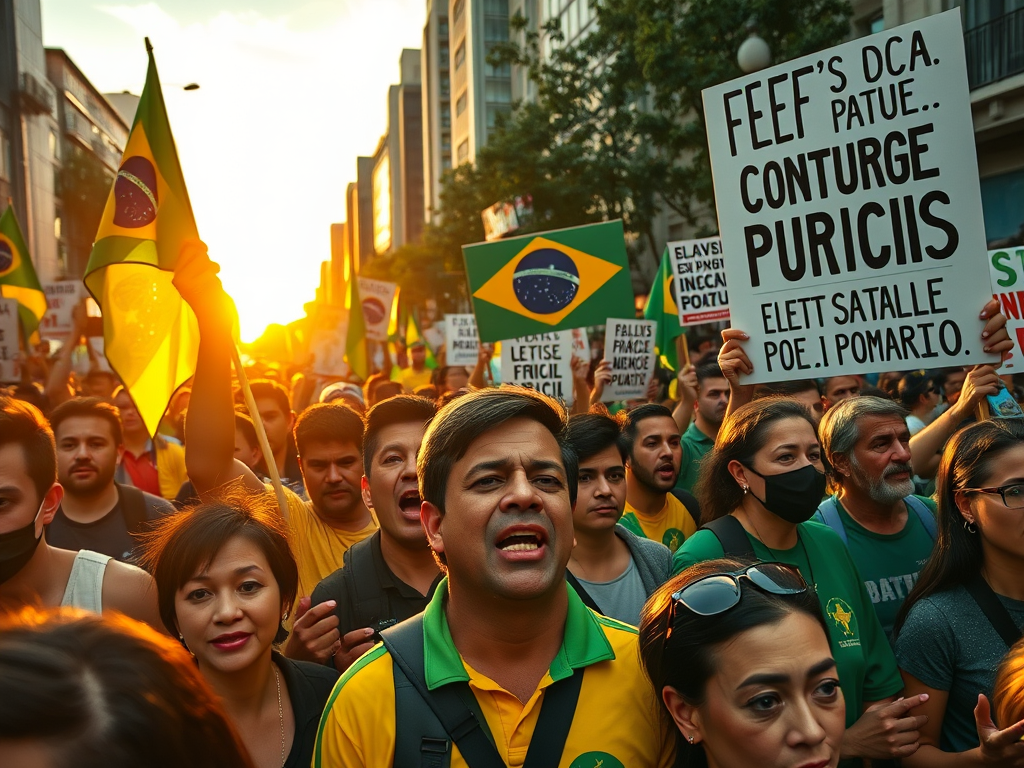

On Brazil’s Independence Day this year, the streets of major cities became a stage for one of the country’s most divisive political moments in recent memory. Thousands of demonstrators poured into public spaces, waving flags, chanting slogans, and voicing sharply contrasting views about the future of former President Jair Bolsonaro. The protests unfolded against the backdrop of an upcoming Supreme Court ruling expected to convict Bolsonaro on charges of attempting to cling to power after his 2022 electoral defeat, a decision that could send shockwaves through Brazilian politics for years to come.
The atmosphere across Brazil’s cities was highly charged but mostly peaceful. On one side, Bolsonaro’s loyalists, wrapped in the green and yellow of the national flag — and in many cases, the Stars and Stripes of the United States — rallied to denounce what they believe is political persecution. Their anger centered on the criminal case that portrays Bolsonaro as orchestrating a coup attempt in the aftermath of his election loss. On the other side, progressive groups and democracy activists marched under banners demanding Bolsonaro’s imprisonment. They condemned not only the former president but also former U.S. President Donald Trump for pressuring Brazilian authorities to abandon the case.
The Numbers Tell a Story
By Sunday afternoon, aerial footage from São Paulo, Rio de Janeiro, Brasília, and other cities left no doubt that Bolsonaro’s supporters vastly outnumbered those who turned out to call for his imprisonment. For many observers, this visual contrast was a reminder that, despite his legal troubles and official ban from public office until 2030, Bolsonaro remains an undeniable force in Brazilian politics. The question hanging over the country, however, is whether his enduring popularity can change the outcome of his looming conviction.
A Legal Reckoning Approaches
The most pivotal moment of the week will arrive on Friday when Brazil’s Supreme Court is widely expected to deliver a guilty verdict against Bolsonaro. The case accuses him of attempting to subvert Brazil’s democratic system by refusing to concede defeat and encouraging unrest after losing the 2022 election. A conviction could carry a prison sentence of more than 40 years.
Adding to the geopolitical dimension of the drama is Donald Trump’s open intervention. In recent weeks, Trump has attempted to shield Bolsonaro by imposing steep tariffs on Brazilian imports and targeting sanctions at the Supreme Court justice leading the case. Far from halting the process, however, these moves appear to have galvanized support for President Luiz Inácio Lula da Silva and strengthened the court’s resolve to proceed.
In a nationally televised speech the night before presiding over the Independence Day military parade, President Lula directed a firm message toward Washington. “We are not, and will never again be, anyone’s colony,” he declared. “We do not accept orders from anyone.” The words were both a rejection of foreign interference and a reminder of Brazil’s turbulent history with outside influence.
The Battle Over Amnesty
Beyond the courtroom, Brazil’s political establishment is now embroiled in a heated debate over whether to grant amnesty to Bolsonaro and members of his right-wing movement. Hundreds of Bolsonaro’s supporters are already serving prison terms for storming government buildings in a failed bid to spark a military takeover after the 2022 election.
Lawmakers from multiple parties are exploring ways to craft amnesty legislation that might keep Bolsonaro out of prison but also strip him of the chance to run for public office again. The protests on Sunday reflected this debate: for many Bolsonaro supporters, amnesty is the last remaining hope.
“We know he will be unfairly convicted,” said Sheila Santos, a 56-year-old retired police officer who marched in Brasília wearing a shirt demanding amnesty for Bolsonaro. “This is our hope now,” she added, her voice echoing the sentiments of thousands in attendance.

Festive but Furious
The mood at pro-Bolsonaro rallies was an unusual mix of carnival-like celebration and sharp political anger. Food vendors lined the streets, selling skewered meat, popcorn, and beer to the massive crowds. At the same time, Bolsonaro’s political allies — including his sons — took to the stage with fiery speeches denouncing the Supreme Court and portraying the trial as an attack on democracy itself.
São Paulo’s main avenue was flooded with a sea of people in yellow and green, stretching for blocks, while Rio de Janeiro’s Copacabana Beach became a massive stage for right-wing slogans. Brasília also saw enormous crowds, where even symbolic gestures carried political weight: one man posed for photographs in a Donald Trump mask, while others waved giant American flags as if appealing for international rescue.
The Trump Factor
One of the more striking developments of this year’s protests was the overt embrace of the United States and its former president. In Rio, vendors sold T-shirts bearing Trump’s image alongside the word “Magnitsky,” referencing the U.S. law that has been used to sanction foreign officials accused of corruption or human rights abuses — in this case, the Brazilian justice overseeing Bolsonaro’s trial. In São Paulo, an enormous American flag was passed over the heads of protesters, symbolizing their hope that Trump could alter Brazil’s trajectory.
“It’s political persecution,” said Davidson Roque, a 36-year-old food vendor draped in the American flag. “Trump sees what is happening here, and he’s helping us.”


A Divided Nation
Yet while Bolsonaro’s backers held the numbers, opponents of the former president were no less passionate. Across city centers, protesters marched with banners depicting Bolsonaro behind bars and slogans reading “Defeat Trump.” For them, Bolsonaro’s trial is not political persecution but a necessary defense of Brazilian democracy.
“It’s absurd,” said Ana Baldas, a 76-year-old retired psychoanalyst protesting in downtown Rio de Janeiro. “Trump cannot dictate what we do in our country.” The rally she attended blended wealthy professionals with left-wing activists carrying communist flags, united by their opposition to amnesty for Bolsonaro.
The Shadow of the Past
The debate over amnesty carries a painful resonance in Brazil, where military officials responsible for atrocities during the dictatorship from 1964 to 1985 were shielded from prosecution under similar protections. Many critics argue that repeating such an approach today would undermine the rule of law and leave wounds unhealed.
Baldas acknowledged that Congress might still pass an amnesty law, but she expressed hope that it could be blocked through a presidential veto or a challenge in court. “We’ll end up with Bolsonaro being in prison anyway, and things will calm down,” she said. “That’s my most optimistic hope.”


Looking Ahead
As Brazil braces for the Supreme Court’s decision, the dueling protests on Independence Day underscore a broader reality: Bolsonaro, despite being sidelined from office, continues to cast a long shadow over the nation’s political landscape. His supporters see him as a victim of an unfair system, a leader betrayed by elites but still capable of mobilizing the masses. His opponents see him as a threat to democracy, a figure whose accountability is essential to Brazil’s future.
Whether Bolsonaro ends up behind bars or finds protection through amnesty, the Independence Day protests have revealed the profound fault lines in Brazilian society. They also serve as a reminder that Brazil’s struggle to define its democratic identity is far from over.




Leave a Reply