
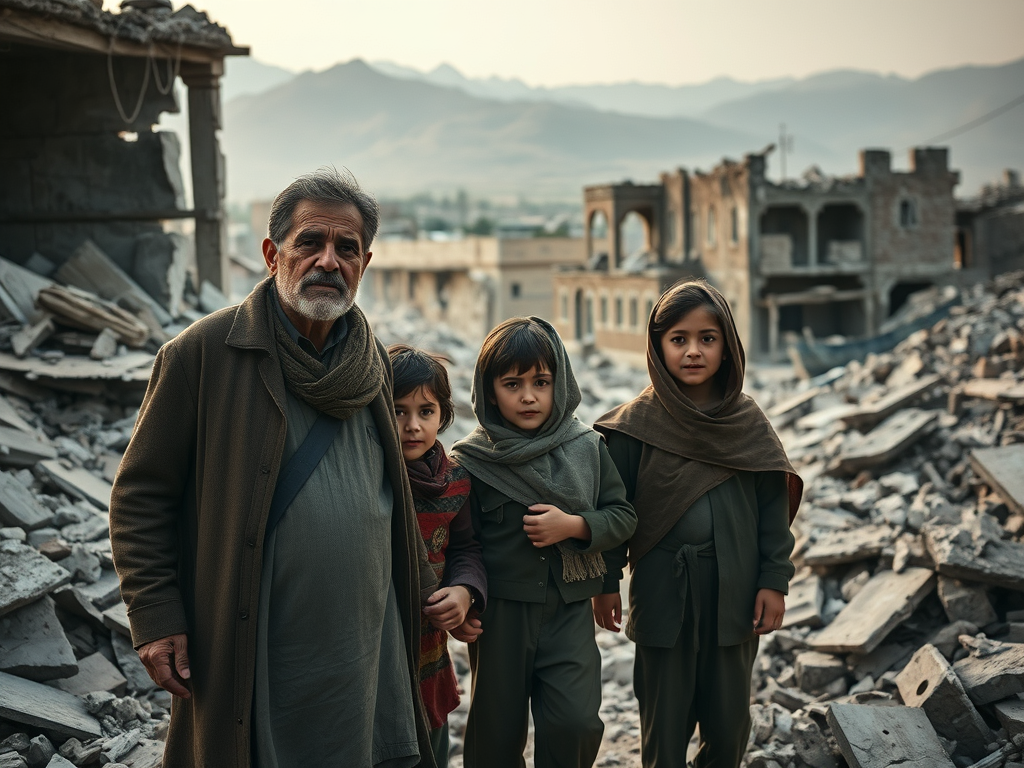

When a loud blast shook the home of Mirza Gul Sayar late Sunday night, he thought it was an explosion. Jolted out of bed, he woke his wife and quickly rushed outside with their two children. In the darkness of eastern Afghanistan, his parents, younger brother, and sister-in-law were already standing outside. But his older brother’s family had not yet emerged.
Moments later, as relatives hurried back into the house to search for them, a second tremor struck. The earth rumbled violently beneath their feet, and in seconds, the family home collapsed. Screams filled the village as neighbors called out for missing relatives.
“For us, it felt like the end of the world,” Sayar said, speaking from a carpet spread across his cornfield, where he and his surviving family members had taken shelter the following night.
The Scale of the Disaster
The earthquake that devastated eastern Afghanistan on Sunday has already claimed over 1,400 lives and left more than 3,100 people injured, according to Afghan officials. The death toll is expected to rise as rescue teams struggle to reach remote mountain communities. Entire villages perched on steep hillsides or nestled deep within narrow valleys were reduced to rubble.
Thousands of homes built with fragile materials crumbled under the force of the tremors, leaving survivors to sleep outdoors in fields, often without food, water, or blankets. The Afghan military has evacuated hundreds of injured residents and retrieved bodies, while United Nations agencies have scrambled to restore helicopter services that were previously grounded after funding cuts from the United States and other donors.
Even days after the earthquake, the true extent of the devastation remains unclear. Rescue workers say some communities remain unreachable, cut off by blocked roads and collapsed terrain.
“All of the reported figures so far only reflect the villages that government and military teams have managed to reach,” explained Zahidullah Safi, head of a local clinic in Kunar Province, one of the worst-affected regions. “There are villages still buried beneath rubble where no aid has yet arrived.”

A Nation Already in Crisis
This disaster comes less than two years after another catastrophic earthquake in Afghanistan and has piled tragedy upon an already dire situation. The country is grappling with overlapping economic, humanitarian, and environmental crises, each worsening over the past year.
International aid had already been scaled back dramatically. The United States, previously the largest donor to Afghanistan, cut nearly all of its humanitarian contributions after dismantling foreign aid programs in recent years. Last year, U.S. funding accounted for almost half of Afghanistan’s aid budget. That support has now largely disappeared.
The United Nations estimated that Afghanistan required $2.4 billion in humanitarian assistance this year, but less than 30 percent of that funding has been secured. The earthquake has further strained these already limited resources.
On Tuesday, Britain pledged $1.3 million in emergency support, with Foreign Secretary David Lammy stressing that funds would be distributed through trusted international organizations such as the Red Cross and U.N. agencies to ensure aid reached civilians rather than the Taliban authorities. The European Union has also announced plans to work with UNICEF, while the U.N. humanitarian office has unlocked an additional $5 million in emergency relief.
Despite these pledges, many governments remain hesitant to commit larger sums, wary of aid falling into Taliban control. A report from the U.S. Special Inspector General for Afghanistan Reconstruction last month highlighted how Taliban officials have routinely diverted aid to areas of their choosing.
Humanitarian workers, however, insist that political concerns must not come at the expense of human lives. “The need for help is overwhelming,” said Homa Nader, acting head of the International Federation of the Red Cross and Red Crescent in Afghanistan.

Families Torn Apart
For survivors, the tragedy is deeply personal. In the Mazardara Valley of Kunar Province, where Sayar’s family lived, villagers spent Monday and Tuesday searching tirelessly for neighbors and relatives trapped beneath debris. Some carried the dead and injured on makeshift stretchers made of bed frames, struggling down steep slopes toward flattened cornfields where helicopters were landing.
From there, the wounded were flown to hospitals in Jalalabad and Kabul, the nearest major cities.
Among those arriving was Khalil Ur Rahman Babakhil, a 30-year-old from Kabul who traveled to Mazardara to check on his in-laws. He arrived only to find their house collapsed and the bodies of his wife’s parents and three siblings lying outside.
“I don’t know how to tell my wife,” Babakhil said quietly.
Because supplies had run out, many families could not wrap the dead in traditional white burial shrouds. Instead, they laid them in colorful blankets, a heartbreaking symbol of scarcity amid tragedy.
Poverty and Vulnerability
Even before the earthquake, Afghanistan’s population of 42 million faced extreme hardship. More than half relied on humanitarian assistance for survival. In districts like Nurgal in Kunar Province, where Sayar lives, families often earn less than $250 annually from seasonal corn harvests.
UNICEF estimates that 3.5 million Afghan children under five suffer from malnutrition. For these children, the earthquake has compounded an already precarious struggle for survival.
On Tuesday, children wandered aimlessly among the ruins of collapsed homes. Some sat silently in ambulances, too shocked to cry.
One teenager, Nezarullah, stood before his destroyed house with his 13-year-old brother. They had lost 12 relatives in the quake. “The night before, we had dinner together and went to sleep as a family,” he recalled. “Now I don’t know how to take care of my younger brother, or how to rebuild when we have nothing left.”

The Human Toll
For Sayar, the memories of that night remain unbearable. He remembers hearing the voice of his sister-in-law screaming from inside the collapsed house. With no tools and only the dim light of the moon, neighbors and family members could do nothing.
By sunrise, Sayar found her body alongside her young son. Nearby, he discovered the remains of his parents and younger brother, who had perished when they ran back inside the collapsing structure. In total, Sayar lost seven family members that night.
“This is a disaster we cannot recover from alone,” he said.
Looking Forward
The earthquake has underscored Afghanistan’s deep vulnerability. Natural disasters in the region are not rare, but the lack of resilient infrastructure, reliable aid, and a functioning economy magnify their impact. Entire villages built with mud and stone stand little chance against powerful tremors.
International aid organizations warn that without swift and substantial assistance, survivors will face worsening conditions in the coming weeks. Exposure to the elements, food insecurity, and lack of medical care could drive the death toll even higher.
As the global community debates how best to deliver aid without strengthening the Taliban, ordinary Afghans remain caught in the middle. For them, the question is not political—it is about survival.
In fields now dotted with temporary tents, families like Sayar’s sit quietly, staring at the ruins of their homes. The future is uncertain, but one thing is clear: Afghanistan faces not only the immediate challenge of recovering from this earthquake but also the ongoing struggle to rebuild a society already fractured by years of conflict, poverty, and neglect.





Leave a Reply