
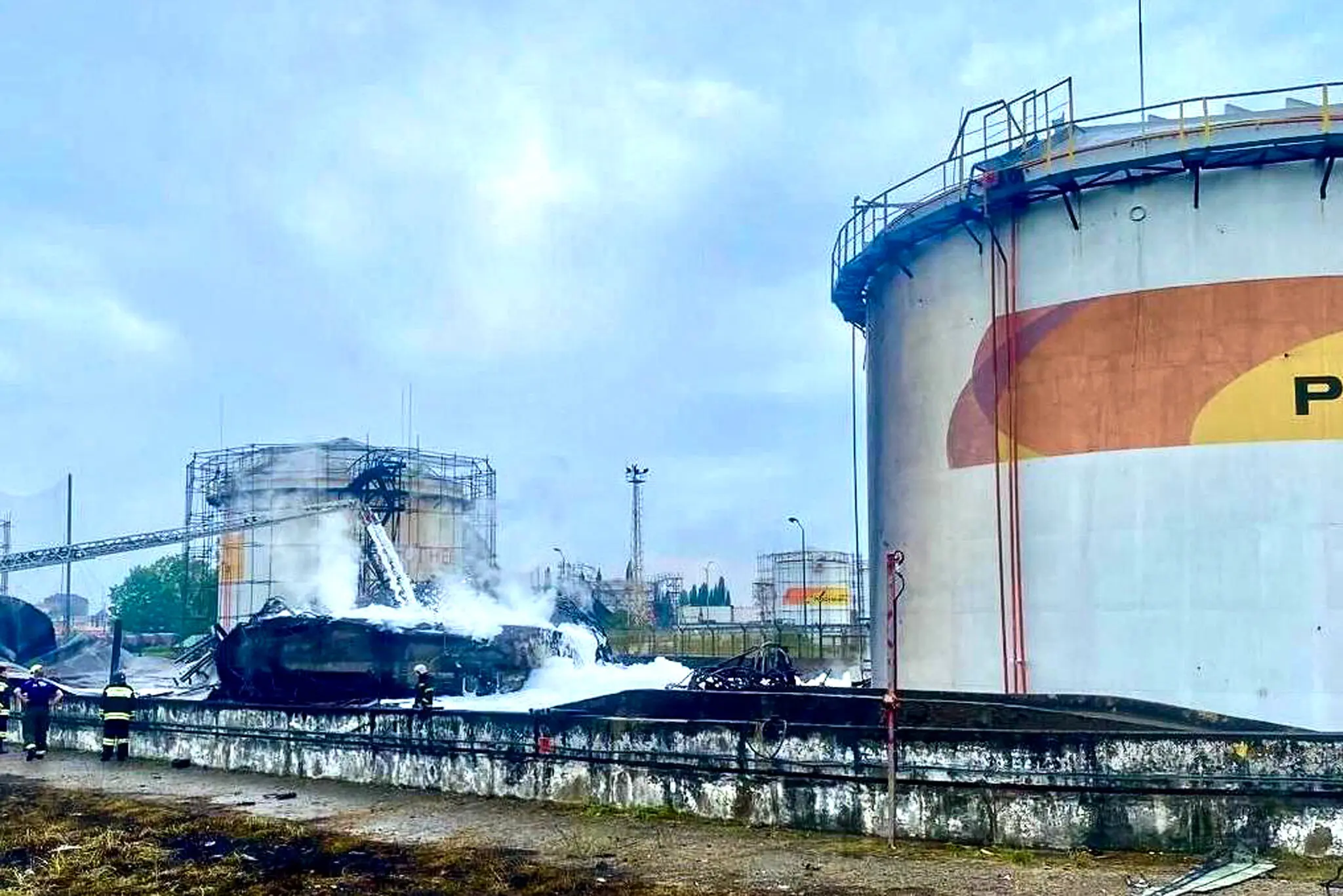

A fire blazing at a gas terminal near St. Petersburg, oil storage tanks reduced to twisted ruins in southern Ukraine, and drone strikes forcing the temporary shutdown of one of the world’s longest oil pipelines—these images have become symbols of the intensifying “energy war” between Kyiv and Moscow. At a moment when world leaders are once again attempting to revive peace talks, both sides are doubling down on targeting critical energy infrastructure, hoping to gain leverage at the negotiating table.
Ukraine’s Offensive on Russian Oil Facilities
This month alone, the Ukrainian military has claimed responsibility for at least ten attacks on Russian oil facilities. Russian officials have confirmed about half of these strikes, acknowledging the damage. Analysts estimate that the attacks temporarily disabled nearly one-sixth of Russia’s refining capacity. The immediate result was a sharp increase in gasoline prices across the country, highlighting the vulnerability of Russia’s energy system even though it remains one of the world’s largest oil producers.
Ukraine’s growing drone fleet, now more advanced and numerous than ever before, has been central to these operations. Long-range drones have struck refineries deep inside Russian territory, sparking massive fires at facilities in regions such as Volgograd and central Russia. One of the most notable incidents involved a strike on the Lukoil refinery in Volgograd, among Russia’s top producers. According to Ukrainian and Russian sources, these strikes disrupted approximately 17 percent of Russia’s refining capacity—a significant blow considering the restrictions Russia faces under Western sanctions, which complicate repair efforts by limiting access to essential equipment and components.

Kyiv argues that its strikes serve three main purposes: to disrupt the fuel supply that powers Russian military operations, to reduce the Kremlin’s revenue from oil exports, and to cause disruptions to everyday life for Russian civilians. While analysts caution that Russia still has enough spare capacity to cover most of its refining needs and that crude oil, rather than refined products, accounts for the majority of export revenues, the impact on Russian daily life appears more tangible. Gasoline shortages, rising prices, and long queues at gas stations have been reported in regions as far apart as Crimea and Vladivostok.
Russia’s Counterattacks on Ukraine’s Energy Grid
Moscow, meanwhile, has intensified its own campaign against Ukraine’s energy infrastructure. Over the past ten nights, Ukrainian officials reported that at least 20 energy facilities—including power plants, thermal stations, and oil refineries—were hit. Ihor Klymenko, Ukraine’s interior minister, warned that such strikes could create severe shortages in the coming winter. Gas in particular plays a central role in Ukraine’s economy, providing heating for much of the population and fueling production of fertilizers and other chemicals.
The consequences of these attacks are already being felt. Ukrainian lawmakers estimate that about 1 billion cubic meters of natural gas—around 5 percent of the country’s annual consumption—has been lost. This has forced Kyiv to urgently appeal to European partners for financial support to secure additional imports before the winter season. Without sufficient supplies, officials fear widespread industrial shutdowns, heating crises in residential areas, and social unrest.
Russia’s energy strategy is not new. Since the war began, Moscow has repeatedly struck Ukraine’s power grid in an effort to weaken civilian morale by plunging cities into darkness and disrupting the economy. However, in the first three years of the conflict, Russia largely avoided attacking gas facilities, partly because pipelines across Ukraine were still being used to transport Russian gas to European buyers. That restraint has now been abandoned.

The Collapse of the Energy Truce
Earlier this year, both countries had briefly agreed to suspend attacks on energy facilities during peace efforts brokered by the Trump administration. The White House celebrated this moratorium as a confidence-building measure toward potential reconciliation. But as negotiations intensified in the summer, both sides resumed targeting critical energy sites, effectively nullifying the truce.
Energy analysts argue that the renewed strikes are not merely tactical but deeply political. By hitting oil refineries, pipelines, and gas terminals, each side seeks to pressure the other into concessions during negotiations while signaling to Washington and European allies that it has the upper hand and the determination to keep fighting.
“For Ukraine, these strikes serve as important leverage,” explained Andrian Prokip, an energy expert at the Kennan Institute in Washington. “They remind Russia—and the international community—that Kyiv is capable of inflicting real damage on one of Moscow’s most valuable industries.”
Civilian Life Disrupted in Russia
Although Russia’s battlefield operations are not immediately constrained by fuel shortages, daily life for Russian citizens is beginning to feel the strain. Wholesale gasoline prices surged by 12 percent within a month, a spike coinciding with peak travel and harvesting seasons. In Crimea, annexed by Russia in 2014, local media reported long lines at gas stations, with drivers moving from one location to another in search of fuel. Regional leaders attributed these shortages to reduced refinery output, though drone strikes were rarely mentioned directly.
In Russia’s Far East, authorities in some areas were forced to suspend sales of certain fuel types altogether. In the city of Vladivostok, residents turned to local news outlets and social media to share updates on fuel availability and prices, underscoring how shortages were affecting daily routines.
In response, the Russian government imposed a temporary ban on gasoline exports at the end of July, later extending the restrictions into August. Officials justified the decision by citing high summer demand, avoiding any acknowledgment that Ukrainian strikes might be a contributing factor.

Ukraine’s Strategic Strikes Beyond Russia
Kyiv has also expanded its focus to target infrastructure that links Russia to Europe. Last week, Ukraine attacked the Druzhba pipeline, a critical artery delivering crude oil to Hungary and Slovakia. Both countries maintain relatively close ties with Moscow and have often been critical of Ukraine’s ambitions to join the European Union.
Hungarian Prime Minister Viktor Orban, one of Europe’s most pro-Russian leaders, condemned the attack as a direct threat to his nation’s energy security. In a letter to then-President Donald Trump, Orban complained that the strike was an “unfriendly move.” Trump expressed strong disapproval of Ukraine’s actions, according to Orban’s governing party, though Ukrainian officials appeared unbothered by Washington’s reaction. The head of Ukraine’s drone forces even boasted publicly about the pipeline attack, framing it as a show of strength.
“The strikes,” noted Ukrainian lawmaker Andrii Zhupanyn, “are a way to demonstrate that we still have leverage, even as negotiations unfold.”
The Bigger Picture
The intensifying battle over energy resources highlights how central oil and gas have become in this war—not only as economic lifelines but also as political weapons. While neither side has succeeded in forcing the other into major concessions, the strikes have created economic instability, public frustration, and logistical challenges.
For Russia, the challenge lies in maintaining energy supplies at home while sustaining export revenues under sanctions and ongoing attacks. For Ukraine, the stakes are survival: keeping its population warm in winter, preserving industrial output, and convincing its Western allies to keep financial and military support flowing.
As peace talks continue, the targeting of energy infrastructure reveals how far both nations are willing to go to secure negotiating power. What was once considered a temporary tactic has now evolved into a defining strategy of the conflict.




Leave a Reply