
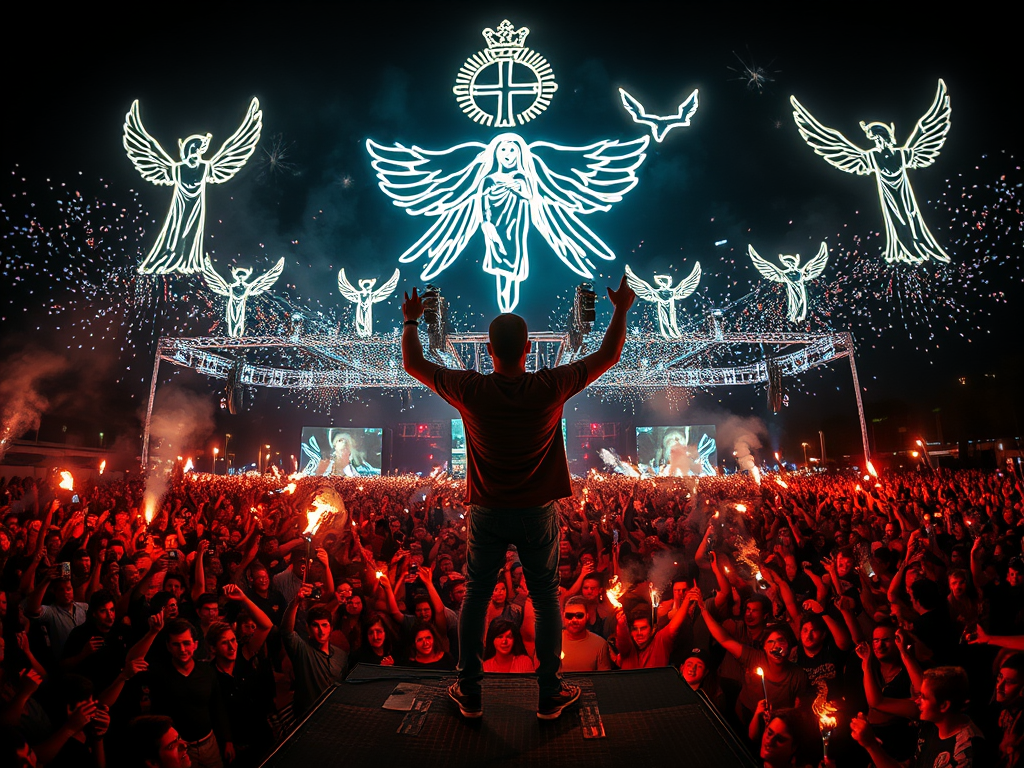

Hundreds of illuminated drones soared through the night sky above Zagreb, forming the outlines of the Virgin Mary, angels, and a glowing cross. Below the spectacle, flames and fireworks burst into the air as Marko Perković, better known by his stage name “Thompson,” launched into one of his most famous songs. The crowd of thousands roared in unison, waving flares and chanting in response to the singer’s booming voice.
“For the homeland!” he cried.
“Ready!” the audience thundered back.
This striking call-and-response, rooted in a salute once used by Croatia’s fascist government during World War II, has followed Perković for decades. At 58, the rock musician and songwriter, who fought in the Balkan wars of the 1990s, remains one of Croatia’s most polarizing cultural figures. To his fans, he embodies pride, patriotism, and resistance against outside criticism. To his detractors, he symbolizes the dangerous glorification of a dark chapter in Croatia’s past.
A Career Fueled by Nationalist Rhetoric
Since his debut in the early 1990s, Thompson has wrapped his music in messages of national struggle and cultural pride. Emerging from the battlefields of the Croatian War of Independence, he quickly became a voice for a generation seeking symbols of identity. His 1991 breakthrough song, Bojna Čavoglave, was written while he was still a soldier. Inspired by a battle in his hometown, it elevated him from frontline fighter to patriotic rock icon.
That same song continues to open many of his concerts, often accompanied by the controversial salute. Perković insists that the chant is not hate speech, citing a Croatian court ruling that allowed its use in the context of honoring veterans. For him, the salute represents freedom of expression and a tribute to those who fought in the war.
“This is freedom,” he declared during a recent performance in Sinj. “Freedom to express our views, freedom for which our veterans gave their lives. Anyone living in our homeland must respect the sacrifice of our soldiers and their symbols.”

Growing Crowds and Mainstream Recognition
In recent years, Thompson’s popularity has only intensified. His concerts are drawing record-breaking audiences, with organizers claiming over 500,000 people attended his July 5 performance in Zagreb — one of the largest crowds of his career. Just a month later, another 150,000 people gathered in Sinj, further solidifying his enduring influence.
At these shows, many supporters wear black berets and military-style clothing that resemble the uniforms of the Ustaše, Croatia’s fascist regime during World War II. Some T-shirts even bear slogans echoing the infamous wartime salute.
Despite international criticism, Croatian political leaders have not shied away from associating with the singer. Prime Minister Andrej Plenković was photographed with Perković and his children ahead of the Zagreb concert. The country’s defense minister, Ivan Anušić, openly admitted joining in the controversial salute during the performance.

Echoes of a Troubled Past
The Ustaše regime, which ruled the puppet state of Croatia under Nazi Germany, is remembered for its brutal campaigns of persecution and mass killings. Historians estimate that hundreds of thousands of Serbs, along with Jews, Roma, and political opponents, were murdered. Even Nazi officials at the time were horrified by the scale of the atrocities, calling the Ustaše “mad with rage.”
This history continues to cast a shadow over Perković’s performances. The European Commission has condemned displays of fascist imagery and slogans at his concerts, stressing that such expressions “remind us of the darkest periods of European history.” Serbian President Aleksandar Vučić has also criticized the events, calling them a promotion of “neo-Nazi values.”
A “Forbidden Fruit” Appeal
For many of his fans, however, Thompson’s controversial image is precisely what makes him attractive. Hrvoje Klasić, a history professor at the University of Zagreb, explained that young people in particular are often drawn to what is considered taboo.
“For decades, Thompson has been a controversial figure, and as is often the case — especially with youth — what is forbidden becomes fascinating,” Klasić said.
This fascination is magnified by broader social frustration in Croatia. Since joining the European Union in 2013, the country has seen a significant exodus of young people seeking higher wages and opportunities abroad. Between 2011 and 2021, the population dropped by 10 percent, a reflection of ongoing economic stagnation and political disillusionment. Against this backdrop, Thompson’s music offers a sense of belonging and identity to those who feel left behind.

Patriotism or Provocation?
To his loyal followers, Perković represents a proud defender of Croatia’s heritage. His music is played at patriotic gatherings and major national events, including Croatia’s 2018 World Cup homecoming celebration after the team’s runner-up finish.
“He’s the only one who remains true to the homeland,” said Marin Bilandžija, a fan who attended the Sinj concert with his family.
Critics, however, argue that Perković exploits religious and nationalist symbolism to sanitize the darker aspects of Croatia’s past. They warn that his growing popularity signals a broader rightward shift in Croatian politics and culture, with mainstream leaders increasingly willing to embrace nationalist rhetoric.

Music, Memory, and Contested Symbols
Two of Thompson’s biggest hits commemorate a 1995 military campaign that expelled Serb forces from Croatian territory. While Croatians celebrate the operation as a triumph of bravery and strategy, human rights groups and Serbian officials describe it as ethnic cleansing. The International Criminal Tribunal for the former Yugoslavia initially convicted two generals for war crimes related to the operation, though those decisions were later overturned.
Supporters of Perković downplay these controversies, insisting that his songs honor sacrifice rather than glorify fascism. For many veterans, the wartime symbols he invokes have been redefined in the context of the 1990s conflicts.
“Croatia loves everyone — Serbs, Bosnians, all our neighbors,” said war veteran Davor Perkov, who attended the Sinj show. “The meanings of these symbols changed when we fought barehanded against aggression. Today’s children won’t have to fight anymore because we already did that.”
He added that Thompson’s music reflects Croatia’s dual character: warm and welcoming, yet fiercely protective when threatened. “We’re like hedgehogs,” he said. “Gentle on the surface, but with sharp spines when attacked.”

Between Freedom and Responsibility
At the heart of the debate around Marko Perković “Thompson” lies a fundamental tension between freedom of expression and the responsibility of remembering history accurately. His concerts draw massive crowds and inspire patriotic pride, yet they also revive painful memories of a brutal past that Europe has worked hard to confront and reject.
For some, Thompson is a cultural hero, keeping alive the spirit of resilience and independence. For others, he is a dangerous provocateur who risks normalizing extremist symbols. As Croatia continues to grapple with its identity within the European Union and a rapidly changing global landscape, the debate over Thompson’s legacy is likely to persist.
Whether seen as a champion of national pride or as a musician who blurs the line between history and propaganda, Marko Perković remains a defining figure in Croatian cultural life. His ability to command massive audiences after more than three decades speaks not only to his musical talent but also to the unresolved questions of history, memory, and identity that continue to shape Croatia today.




Leave a Reply