
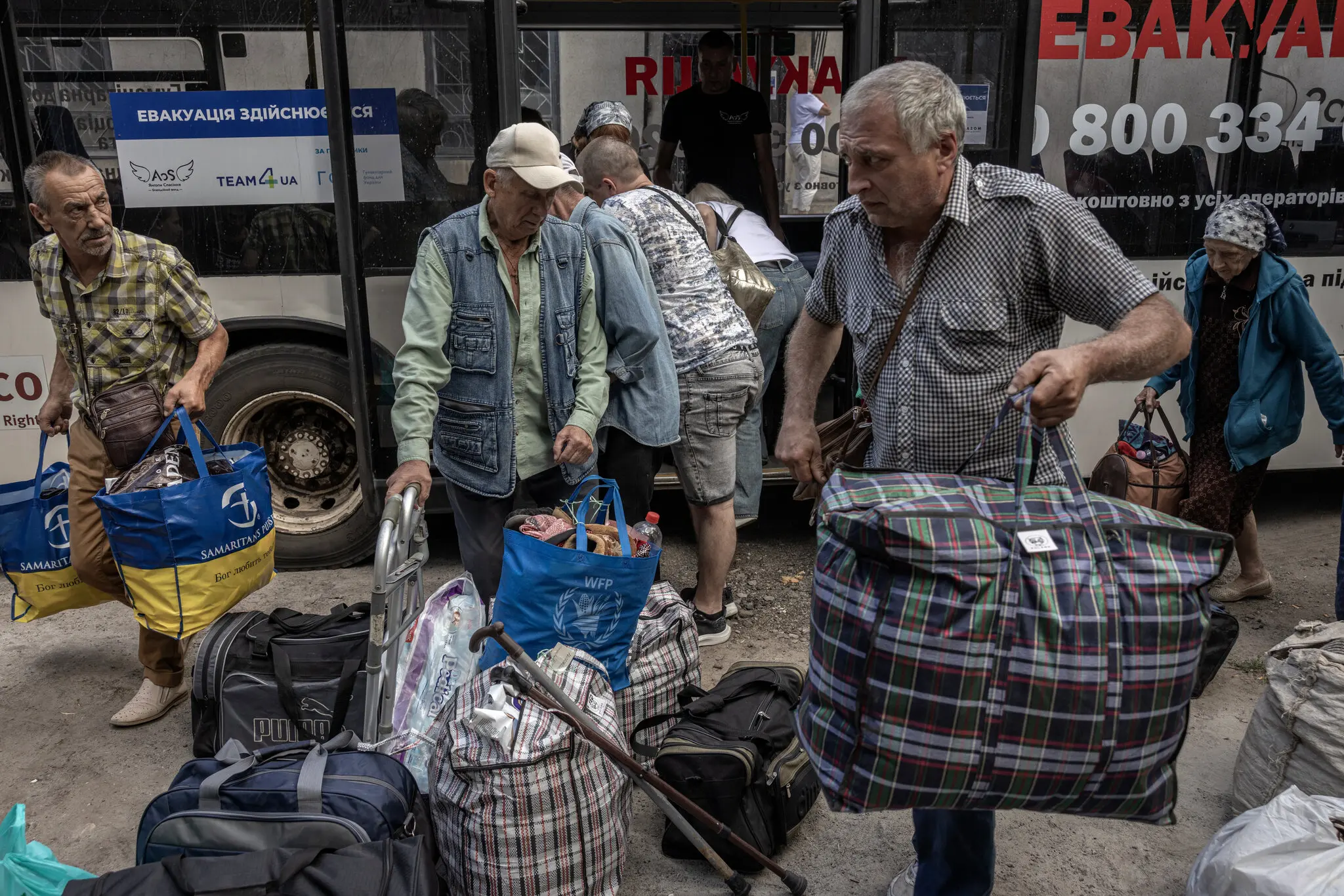

Valentyna Shevchenko, a 69-year-old Ukrainian children’s author, has lived through more than two decades of peace in the same home. That peace shattered when Russia launched a renewed offensive near her village, forcing her to abandon the house she had cared for over 21 years. Sitting now in a crowded shelter, clutching two of her own poetry books like protective charms, she could not hide her frustration. One of her collections, A Wonderful Adventure, once brought joy to young readers. Today, her life feels anything but wonderful.
“It’s not right that the presidents of two other countries discuss our fate without us,” she said, referring to the Alaska meeting between U.S. President Donald Trump and Russia’s Vladimir Putin. With anger rising in her voice, she admitted she wanted to strike both men with a wooden stick—or even a shovel. “This is insane. Here there is war, rivers of blood, and they are making some kind of deal.”
For many Ukrainians like Shevchenko, the Alaska summit was more than disappointing—it felt like betrayal.

Trump and Putin’s Quiet Agreement
While the high-profile meeting appeared outwardly friendly, it became clear afterward that real decisions had been made, decisions that could alter Ukraine’s future. In a Fox News interview, Trump revealed that he and Putin had broadly agreed on a controversial “territorial swap” as part of a larger peace framework. This contradicted Trump’s earlier position, where he had supported Ukraine’s demand that a cease-fire must come before any negotiation.

According to European diplomats, Putin is demanding complete control of the Donbas region, including areas still under Ukrainian defense. In practice, that would mean Ukraine surrendering territory in exchange for vague “security guarantees” from Moscow—an outcome unthinkable to many Ukrainians.
For ordinary citizens displaced by the war, the idea was unbearable. “It’s an insult,” said refugees who had fled to a shelter near Pavlohrad, half a world away from Alaska. The fact that Ukraine’s own president, Volodymyr Zelensky, was excluded from the talks added salt to the wound. To them, Trump’s warm tone toward Putin—a man sanctioned internationally and labeled a war criminal—was incomprehensible.

Voices from the Shelter
Kateryna Chernenko, 65, lay on a cot in the same shelter where Shevchenko was staying. A stroke years earlier had left her partially paralyzed, and she had been carried down from her apartment in the city of Dobropillia after Russian missiles destroyed much of the area. “I hate Putin,” she said firmly. “How can he do this for so long? Killing civilians while they sleep. This isn’t war—it’s murder.”
Her son, Serhii Khalturin, had returned home to care for her after her stroke. Together, they had built a modest but happy life, filling their apartment with new furniture and cherished photographs. Now, both mother and son refuse to accept the idea of ceding their homeland. “That’s where my childhood was,” Serhii said. “My school, my family photos, my brother’s pictures—it’s all still there. How can I just give that up?”
For Chernenko, even daily survival is an act of defiance. In a small room for elderly and disabled refugees, she used her bedpan in front of strangers, stripped of privacy and dignity. Outside, the echo of distant missile strikes was a grim reminder of what awaited if she tried to return.

Lives Reduced to Bags
Many in the shelter had fled with almost nothing. Some carried only a few bags, while others abandoned most of their belongings to make space for fellow evacuees on buses. Shevchenko herself had to leave behind 10 of her 15 carefully packed bags near a gas station. Yet she held onto her son’s guitar, a symbol of his military service where he was known by the code name “Maestro” for his musical talent.
The shelter itself, set up in a former Soviet cultural hall, told the story of disrupted lives. Bedsheets decorated with cheerful vacation slogans—“Around the World,” “Full of Tourists”—contrasted sharply with the exhaustion of those lying under them. Nearly 2,200 people had passed through in just one week, escaping intensified Russian attacks on eastern Donetsk.
Memories of Home
For refugees like Halyna Koleshchuk, 70, memories of home still feel immediate. She had lived in Bilozerske her entire life before bombs forced her family to flee. “We can hear terrible sounds—awful noises,” she recalled. “Then—boom! Everything shakes. Banks, pharmacies, post offices—everything destroyed.”
Even as they spoke of home in the present tense, reality had shifted permanently. Their towns lay in ruins, yet the idea of surrendering them as part of a political bargain was unimaginable.
The Price of Territory
Currently, Russia occupies nearly 20 percent of Ukraine: most of Donetsk, nearly all of Luhansk, and the entire Crimean Peninsula. If Putin were granted full control of the Donbas, it would not stop there, many Ukrainians believe. “Give him just a slice,” Shevchenko warned, “and he’ll say, ‘I want Kharkiv, I’ll take Zaporizhzhia.’ He wants all of Ukraine. He won’t stop.”
Her own story illustrates what is at stake. Once an accountant, she moved to Oleksandrivka in Donetsk, where she lived in the servants’ quarters of a professor’s summer home. She cultivated the garden, maintained the property, and wrote children’s stories. After the professor’s death and the family’s departure, the estate was slowly destroyed by bombs and missiles. The servants’ house was obliterated, her boyfriend’s home split in half, and even the surrounding forest set aflame by shelling.
By the time she fled, only nine people remained in a village that once held 300. “If Putin wanted this land so badly,” she asked bitterly, “why destroy everything on it?”
A Crisis with No Easy End
The Alaska summit highlighted the gulf between global power negotiations and the lived experiences of Ukrainians on the ground. For Trump and Putin, the meeting may have been a diplomatic maneuver or a strategic calculation. For refugees like Shevchenko, Chernenko, and Koleshchuk, it represented the possibility that their sacrifices might be traded away without their consent.
As Shevchenko declared, “This is our land. Not an inch can be given away. We will fight to the end, because we are Ukrainians. We have no other choice.”
Her words echoed through the crowded shelter, summing up the feeling of thousands. To the world, Donbas may look like contested territory. To the people who once lived there, it is home, memory, and identity—and no political summit can erase that truth.




Leave a Reply