
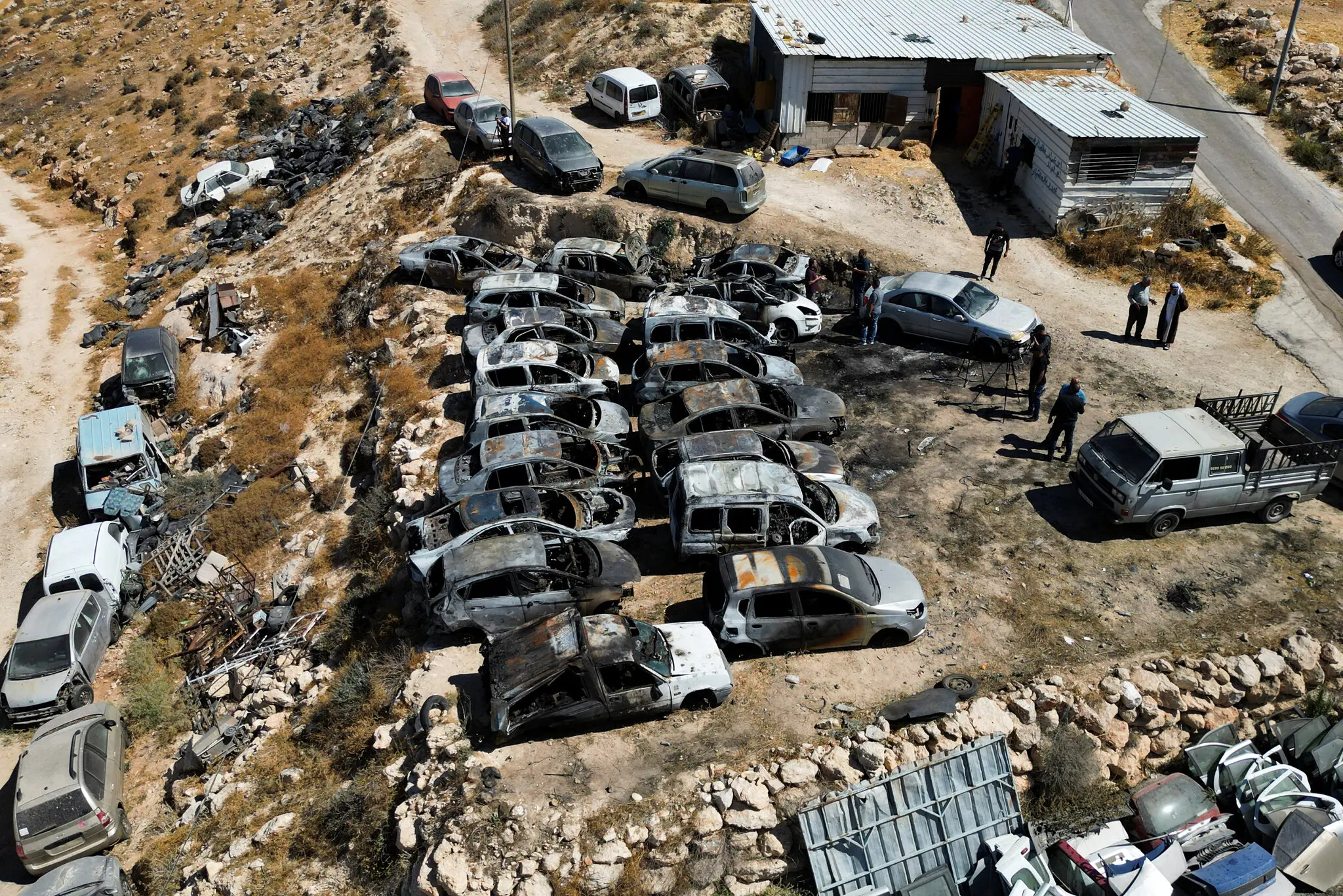

Past midnight in the quiet, hilly Palestinian village of Burqa, shadows moved silently along the slopes. A group of masked men, emerging from the direction of a nearby Israeli settlement, slipped into a junkyard on the village’s outskirts. Surveillance footage later showed them dousing several cars with a flammable liquid before setting them ablaze. One man sprayed graffiti on a barn wall, leaving the name of a nearby settlement and the Hebrew word for “Revenge.”
It was already the third attack that night in this central part of the Israeli-occupied West Bank. For Muhammad Sabr Asalaya, the 56-year-old owner of the junkyard, it was the seventh such assault since the war in Gaza erupted in October 2023.
“Before the war, we were harassed,” he said, “but not like this. Now, they want to drive out as many people as possible and take as much land as they can.”
A Pattern of Intensifying Attacks
Long before Hamas’s deadly October 2023 raid on Israel, settler violence in the West Bank had been rising. But since the war began, the scale and frequency of these incidents have escalated dramatically. With much of the world focused on the destruction in Gaza, extremist settler groups have intensified what many see as one of the most aggressive land seizure campaigns since Israel captured the West Bank during the 1967 Arab-Israeli war.
According to the United Nations Office for the Coordination of Humanitarian Affairs, settlers launched more than 750 attacks on Palestinians and their property in the first half of 2025 — averaging nearly 130 incidents each month, the highest monthly rate since the UN began tracking such data in 2006.
Israeli military data — though lower at 440 recorded incidents in the same period — confirms the surge. The army claims it works to prevent violence, but investigations over the years have found Israeli authorities consistently failing to impose meaningful consequences on settlers who commit crimes. Palestinians are typically tried in military courts, while settlers fall under civilian law, and prosecutions are rare.
Night Raids and Daylight Confrontations
In visits to five recently targeted villages, eyewitness accounts, security camera footage, and mobile phone videos reveal a consistent pattern. Masked settlers often arrive at night, torching vehicles, storage buildings, or homes. In daylight incidents, their presence has sparked confrontations with residents — sometimes deadly. In one case, a settler allegedly threw a firebomb into a child’s bedroom.
Most of the 700,000 Jewish settlers living in the West Bank and East Jerusalem — in communities deemed illegal by most of the international community — are not involved in such violence. Mainstream settler leaders argue they have a right to live there but reject attacks on Palestinians.
However, some hardline settler activists openly admit their goal is to make life so difficult for Palestinians in strategic areas that they will leave. “It’s not the nicest thing to evacuate a population,” said prominent activist Ariel Danino in 2023. “But this is a war over the land, and this is what happens in war.”

Displacement and Expansion
For years, these campaigns targeted small, semi-nomadic Palestinian herding communities along isolated hilltops northeast of Ramallah. That effort has largely succeeded: at least 38 such communities have been forced to abandon their homes and grazing lands since 2023, according to the Israeli human rights group B’Tselem. Their absence has allowed settlers to establish new outposts, many of them unauthorized but tolerated.
Since early 2023, settlers have built more than 130 such outposts — more than in the previous two decades combined, according to Peace Now, an Israeli advocacy group supporting a Palestinian state.
Now, the focus has shifted to larger, wealthier villages closer to Ramallah, such as Burqa and neighboring Beitin.
A Night of Coordinated Arson
Just after 1 a.m. in Beitin, retired teacher Abdallah Abbas awoke to find his car engulfed in flames, a Star of David sprayed on his garden wall. An hour later, surveillance footage captured two masked attackers entering the yard of 28-year-old mother Leila Jaraba. One poured liquid on her car; the other set it alight.
“I knew our turn would come,” she said, describing how she sheltered inside with her husband and their two young sons. “They want this land. They want us gone.”
About an hour after the Beitin incidents, the same group is believed to have moved on to Burqa, targeting Asalaya’s junkyard. Villagers suspect the same attackers hit multiple sites in quick succession — part of a broader wave of violence.
In the first half of 2025 alone, this roughly 40-square-mile area saw an average of 17 attacks per month, nearly double the rate in 2024 and five times higher than in 2022, UN data shows.

Political Backdrop
These attacks occur alongside aggressive settlement expansion under Prime Minister Benjamin Netanyahu’s government, which includes longtime settler activists. Since late 2022, Israel has authorized more than 30 settlements — the largest expansion since before the Oslo peace process in the 1990s.
Meanwhile, the Israeli military has demolished Palestinian neighborhoods in the northern West Bank and set up hundreds of roadblocks and checkpoints. Officials say these measures aim to curb Palestinian militant activity, but they have also deepened economic hardship, displaced tens of thousands, and made travel between towns increasingly difficult.
For people like Asalaya, the economic damage is crippling. His junkyard has lost tens of thousands of dollars in vehicles and parts destroyed by arson. “Life here isn’t becoming unlivable,” he said grimly. “It already is. We are surrounded. We can’t even take our livestock to graze. We’re trapped.”
Impunity and Weak Enforcement
The Israeli military has failed to prevent attacks or stop unauthorized settlement construction. Past investigations have shown authorities displaying notable leniency toward settlers accused of violence against Palestinians. In one striking example, a settler filmed shooting a Palestinian in front of an Israeli soldier was questioned for just 20 minutes and never arrested.
A senior military commander in the central West Bank, speaking anonymously, insisted his troops try to protect both settlers and Palestinians, noting recent clashes between soldiers and settlers. Yet, in the case of the coordinated arsons in Beitin and Burqa, soldiers arrived only after the fires burned out.
Israeli police say they have opened investigations into each incident. “In some cases, suspects were arrested,” a police spokesperson said, “though later released due to lack of evidence.” No one has been prosecuted.

A Future in Question
For many Palestinians in Burqa and Beitin, these events have reshaped daily life into one of constant fear and uncertainty. The repeated destruction of property is not only an economic blow but also a psychological weapon, reinforcing the message that their presence is no longer welcome.
Human rights organizations warn that if the trend continues unchecked, it could permanently alter the demographic and political reality in large swaths of the West Bank — erasing Palestinian communities from strategically valuable areas and making any future two-state solution even harder to envision.
As Asalaya walks among the blackened shells of cars in his junkyard, the smell of burnt rubber and metal still lingers. “This is more than property damage,” he said. “It is a message: leave, or we will make you leave.”




Leave a Reply