
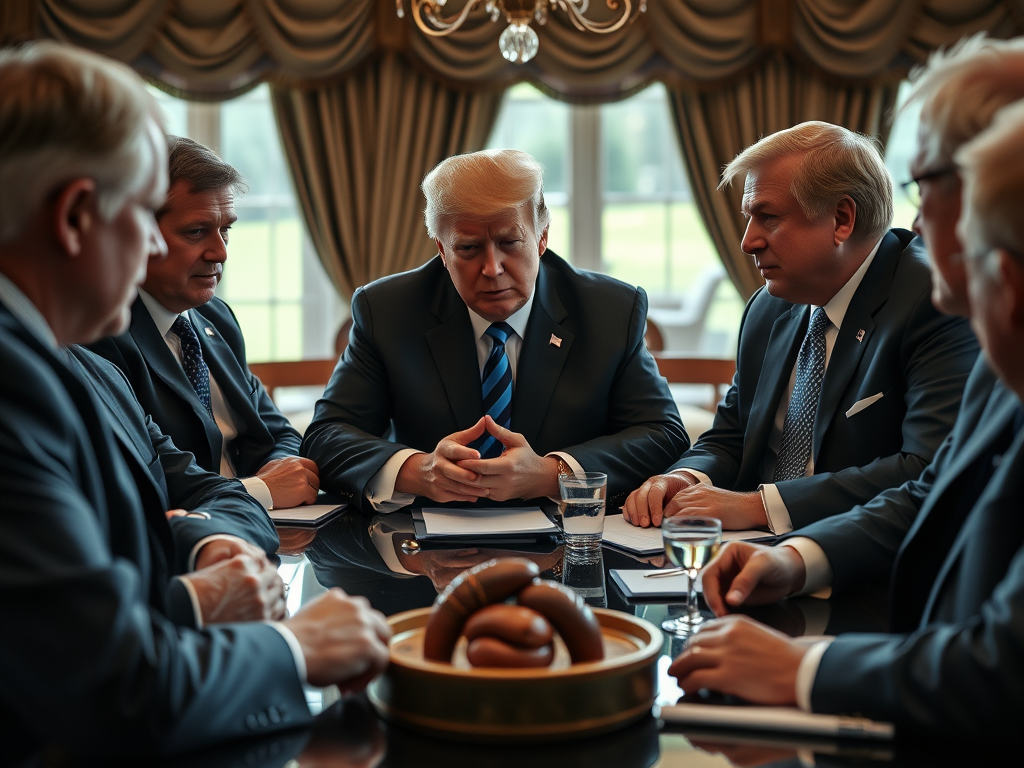

Flatter, Defer, Nudge: Europe’s Playbook for Trump Yields Some Results

During President Trump’s recent five-day visit to Scotland, European leaders executed a carefully calibrated diplomatic approach they had developed over months of trial and refinement. Their strategy was subtle yet deliberate: gently pushing for U.S. engagement on key European priorities, offering generous praise, and above all, steering clear of direct public confrontation.
This carefully orchestrated strategy aimed to navigate the challenges of working with a leader who had previously declared the European Union as being “formed in order to screw the United States,” while simultaneously threatening to sever ties with NATO and halt American support for Ukraine. Despite these volatile dynamics, European officials managed to guide President Trump into making a number of concessions—some of which, though seen by critics as too generous, defused potentially damaging outcomes.
Most notably, the European Union reached a trade agreement that many within the bloc, especially in France, perceived as overly favorable to the United States. Nonetheless, the deal succeeded in persuading Trump to walk back some of his more extreme tariff threats. European leaders also coaxed him into pledging humanitarian aid for Gaza and encouraged a tougher stance toward Russian President Vladimir V. Putin. Trump even agreed to reduce the time frame he had previously proposed for Russia to complete its invasion of Ukraine.

The meetings, held unusually at Trump-owned golf resorts in Scotland, concluded a surprisingly productive chapter in recent transatlantic diplomacy. Over the previous weeks, European heads of state had managed to secure Trump’s support for continued military assistance to Ukraine and a renewed American commitment to NATO—moves made easier by increased financial contributions from other alliance members.
Charles Kupchan, a senior fellow at the Council on Foreign Relations and a professor at Georgetown University, noted the effectiveness of Europe’s evolving approach: “They’ve more or less figured out how to work with Trump. Six months ago, few would have predicted that U.S.-Europe relations would be in this relatively stable place. That said, Trump remains unpredictable—anything could happen tomorrow.”

While President Trump remains widely unpopular across much of Europe—with the notable exception of Hungary—many of the continent’s leaders have grown adept at managing him. Rather than openly challenging his assertions or policies, they’ve opted for quiet diplomacy, carefully choosing their battles to minimize risk to their countries.
One major break from protocol during this diplomatic visit was the hosting arrangement. Traditionally, a U.S. president visiting a foreign country is received by that nation’s leaders. However, due to Trump’s ownership of golf courses in Scotland and his preference for controlling the optics of public appearances, he assumed the role of host. This setting not only made Trump visibly more comfortable but also gave him opportunities to spotlight his personal business interests. At Turnberry, for instance, he drew attention to a newly renovated ballroom during what was otherwise a formal diplomatic engagement—raising concerns over conflicts of interest.
Still, European officials remained focused on a higher priority: ensuring continued American involvement in global affairs. Trump has long advocated a more isolationist U.S. foreign policy. He previously dismantled large portions of the United States Agency for International Development (USAID), which had played a crucial role in providing foreign aid to crisis zones like Gaza. Just a day before one meeting, Trump had dismissed the humanitarian catastrophe in Gaza as “not a U.S. problem.” Yet, after quiet lobbying by European leaders, he publicly acknowledged the crisis the very next day.
This success reflects an important lesson European leaders have learned: challenging Trump in public, especially when he presents factually incorrect views, can backfire. Past incidents involving the leaders of Ukraine and South Africa have demonstrated the risks of openly contradicting the U.S. president.
Instead, leaders like Ursula von der Leyen, President of the European Commission, adopted a more tactful approach. She repeated Trump’s favored expressions and framed her arguments in terms he would find familiar and affirming. Likewise, British Prime Minister Keir Starmer used visual evidence of starvation in Gaza to appeal to Trump’s sensibilities, while simultaneously complimenting him on his leadership and negotiating abilities.

This approach seems to mirror tactics developed by NATO Secretary General Mark Rutte. After the United States launched strikes on Iranian nuclear facilities, Rutte privately messaged Trump, praising his “decisive action,” which Trump then proudly publicized. Rutte had even gone so far as to liken Trump to a father figure resolving conflicts among squabbling children. Eventually, Trump softened his earlier criticism of NATO, describing the alliance as “no longer obsolete.”
Nonetheless, Trump has exerted significant pressure on Europe. The recently negotiated trade deal was met with considerable skepticism, especially in France. Prime Minister François Bayrou lamented that it marked “a dark day when an alliance of free nations, united to defend their values and interests, surrendered to submission.”
Hungarian Prime Minister Viktor Orban, one of Trump’s closest European allies, ridiculed the EU’s approach, saying, “It was Donald Trump eating Ursula von der Leyen for breakfast.”
Yet others viewed the European strategy as successful in moderating Trump’s more extreme impulses. At one point, Trump had proposed a 30% tariff on European imports, effective August 1. European negotiators, anticipating such threats, made efforts to align with Trump’s rhetoric. Von der Leyen echoed Trump’s fixation on trade deficits—an economic concept dismissed by many experts—by acknowledging that the EU had a trade surplus and that the imbalance “needed to be corrected.”
Alan Sykes, a Stanford law professor specializing in international trade law, remarked that von der Leyen may have been “tapping into Trump’s worldview to win his favor,” even though the logic behind trade deficits is widely disputed among economists.

Despite these efforts to placate him, tension was never far from the surface. At one point, Prime Minister Starmer tentatively pushed back on Trump’s longstanding grudge against London Mayor Sadiq Khan. During a press event at Turnberry, Trump derided Khan’s performance, calling it “terrible.” Starmer quietly interjected, saying, “He’s a friend of mine.” Trump, uncharacteristically, let the comment slide, and what could have turned into a diplomatic flare-up was avoided.
Meredith Crowley, an economics professor at the University of Cambridge, praised Britain’s approach to fostering a productive relationship with Trump. She noted that an early gesture—King Charles inviting Trump to Balmoral Castle—had helped to establish goodwill. “That seems to have generated enough trust that Britain might just weather the Trump era better than others,” she said.
Indeed, Britain may have emerged with a more favorable outcome than the broader EU. Starmer’s trade agreement secured lower tariffs on a range of goods—around 10%—compared to the EU’s deal.
Still, Georgetown’s Kupchan cautioned that Europe should prepare for alternative futures. While recent progress is encouraging, it would be unwise to assume stability will last. Discussions among Britain, France, and Germany about forming a separate mutual defense pact underscore the uncertainty.
“If everything continues as it has, the transatlantic alliance could endure for years to come,” Kupchan said. “But Europe must begin planning for a scenario where it may have to stand alone.”eseeable future,” he said. “But Europeans have no option but to begin to plan for, to think about, and confront the alternative: That is, Europe alone.”




Leave a Reply