
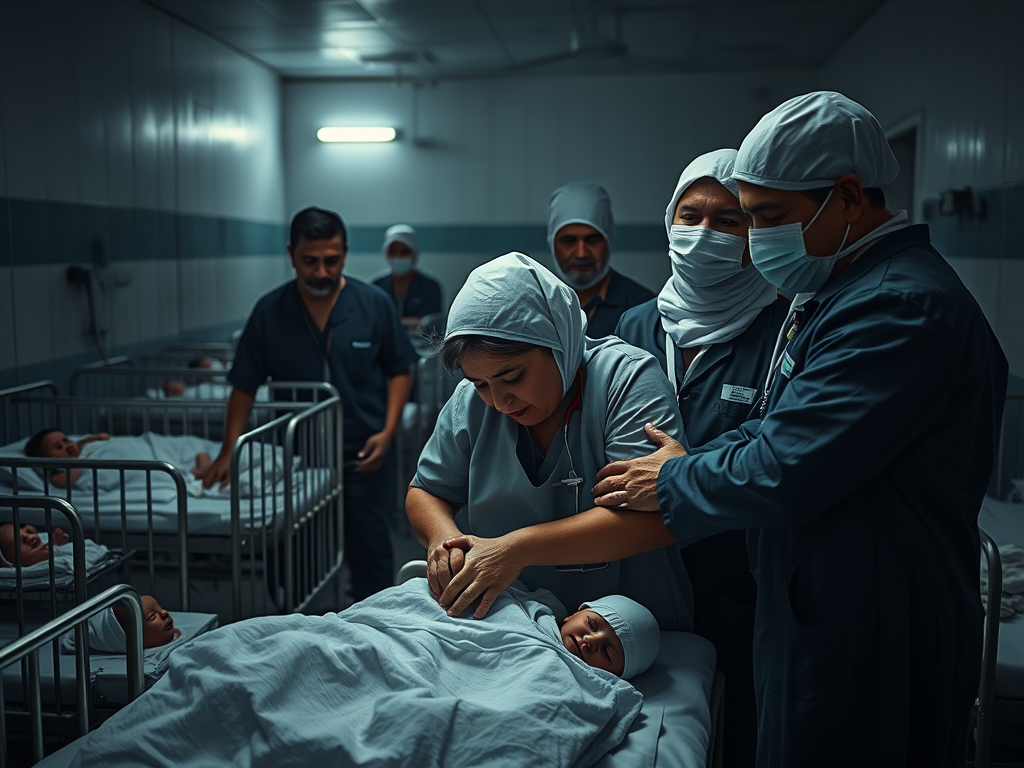

In several remaining operational hospitals in Gaza, an escalating humanitarian crisis is unfolding. Medical professionals, overwhelmed and undernourished, are collapsing from hunger and dehydration. Hospital administrators are often unable to provide even basic meals to their patients or staff. Among the most heartbreaking cases are newborn babies who are deprived of essential infant formula; in many instances, they are being given only water to survive.

Three of Gaza’s major hospitals currently lack the specialized nutritional fluids required to effectively treat severe cases of malnutrition among children and adults. The absence of these essential medical resources is turning already desperate situations into tragedies.
These grim conditions were recounted in interviews conducted on Friday with seven doctors who recently worked in four of Gaza’s key medical centers. Four of these physicians are local, while the remaining three are international volunteers from Australia, the United Kingdom, and the United States. Each of them painted a similarly harrowing picture of what they witnessed during their time in Gaza over the past week.
Despite repeated warnings over recent months, global health organizations, international aid agencies, and medical experts now confirm that famine is spreading rapidly across the region. The mounting crisis has been fueled by strict aid restrictions imposed by Israel. According to figures released on Saturday by Gaza’s Health Ministry, 56 Palestinians died from starvation just this month — nearly half of all reported starvation-related deaths since the beginning of the conflict 22 months ago.
The worsening food crisis has placed an immense strain on Gaza’s already fragile healthcare infrastructure. Hospitals are barely managing the continuous influx of patients suffering war-related injuries, and are now also confronted with an alarming rise in malnutrition cases. The healthcare system is on the brink of collapse.
In several wards, medical staff are so physically weakened by hunger that they are fainting during their shifts. Their colleagues, equally exhausted, attempt to revive them using intravenous drips of saline and glucose. Essential medical supplies like antibiotics and pain relievers have long been in short supply. Now, even the nutritional IV fluids used to stabilize malnourished patients are becoming scarce.
Doctors across all four hospitals expressed deep frustration and sorrow at their inability to save emaciated infants. In many instances, the babies are too frail to handle full re-nourishment, as a sudden intake of nutrients could trigger refeeding syndrome — a potentially fatal condition caused by a rapid shift in electrolytes and fluids. Even when appropriate fluids are available, they often aren’t sufficient to reverse the decline.
Dr. Ambereen Sleemi, an American volunteer surgeon currently working at Nasser Hospital in southern Gaza, said she has seen babies on the verge of death, brought in skeletal and severely underweight. “They arrived at the hospital in critical condition, already starving,” she explained in a phone interview on Friday. “We’ve done everything we can, but for many, it’s just too late.”
Dr. Nick Maynard, a British surgeon who had volunteered at the same hospital until mid-week, recalled seeing an infant who appeared to be only a few days old, yet was actually seven months old. “The term ‘skin and bones’ doesn’t even begin to describe it,” he said. “The level of malnutrition I witnessed is unimaginable in any civilized part of the world. This isn’t just a crisis — it’s deliberate starvation being used as a method of warfare. Unless food aid is permitted to enter Gaza immediately, more lives will be lost.”
In response to mounting criticism, COGAT, the Israeli military agency responsible for overseeing aid to Gaza, issued a statement asserting that it is “continuing to work with international organizations to facilitate humanitarian aid in accordance with international law.” On Saturday evening, the Israeli military began dropping aid supplies by air over northern Gaza and announced limited daily pauses in military operations to allow land-based aid deliveries.

Despite these claims, the humanitarian situation on the ground continues to deteriorate. According to the World Food Program, approximately one-third of Gaza’s population is now enduring days without any food at all. Doctors Without Borders reported last week that about 25% of young children and pregnant women treated in its Gaza clinics are suffering from malnutrition.
Medical experts are increasingly concerned that many individuals are succumbing not only to malnutrition, but also to otherwise treatable illnesses and injuries that their weakened bodies can no longer fight. Malnourishment is contributing to a rise in miscarriages and premature births, with newborns exhibiting weakened immune systems and medical complications.
“The consequence is an increase in infections, dehydration, and, in many cases, complete immune failure in infants,” said Dr. Hani al-Faleet, a pediatric consultant at Al-Aqsa Martyrs Hospital in central Gaza. “Sometimes, it’s as simple as this: the child and the mother aren’t getting enough to eat — and they die.”

The crisis has grown worse since Israel enforced a total blockade on food aid between March and May. Although food deliveries have resumed, the new distribution system — primarily run by Israeli-backed private contractors — is deeply flawed. Aid is now dispensed from only a few centralized locations, often situated miles away from where most civilians live and within or beyond Israeli-controlled zones.
Unlike the previous U.N.-led model, which offered food at various nearby sites, the current system forces desperate Palestinians to travel long and dangerous distances through active conflict zones. Israeli soldiers have reportedly killed hundreds attempting to access food, turning a basic act of survival into a lethal gamble.
While some food remains available in local Palestinian-run markets, the prices are so high that they’re unreachable for most people, especially with widespread unemployment. Flour and tomatoes each cost around $30 per kilogram. Meat and rice have virtually disappeared from the market altogether.
This dire economic situation forces families into impossible choices: either risk starvation or brave sniper fire in an attempt to secure aid that often runs out before they arrive.

Israel argues that the shift in the aid system is necessary to prevent supplies from falling into the hands of Hamas. Yet, according to reports by The New York Times, Israeli officials have not presented evidence of widespread theft by Hamas of food provided through United Nations channels. They also acknowledged that soldiers have fired “warning shots” to control crowds near aid routes. However, doctors such as Dr. Maynard and Dr. Sleemi have described injuries suggesting targeted gunfire aimed at civilians’ torsos.
Meanwhile, Israel has deflected blame onto U.N. agencies, accusing them of failing to distribute aid in a timely manner. Israeli officials claimed they had to destroy around 100 truckloads of expired food in recent months. The U.N. counters that it has struggled to operate convoys within an active war zone due to Israeli-imposed restrictions.
For Gaza’s doctors, the lack of food is yet another burden in an environment already overwhelmed with suffering. “Some of our medical staff have passed out in the middle of operations. Others collapse while tending to emergency patients,” said Dr. Mohammad Abu Salmiya, director of Al-Shifa Hospital in Gaza City. “They are carrying an unimaginable weight on their shoulders.”
The consequences are deeply personal for families like that of Salam Barghouth, a 3-month-old girl receiving treatment for malnutrition at Al-Aqsa Martyrs Hospital. Her 22-year-old mother, Hanin, is too malnourished to walk to distribution sites or produce enough breast milk. Her father, Akram, has repeatedly failed to reach the aid stations before supplies run out.
The family, like most in Gaza, is unemployed and survives largely on overpriced falafel. Since the war began, Ms. Barghouth has lost 29 pounds — nearly 20% of her body weight. She is now struggling to keep Salam alive.

At birth, Salam weighed 6.6 pounds. Three months later, she weighs only 8.8 — at least three pounds below a healthy weight for her age. Formula is prohibitively expensive, with a single container costing about $120 — over double the international price.
“She was born into war,” Ms. Barghouth said softly, “and every day since, I’ve been fighting just to keep her alive.”
While Salam still has access to medical care in central Gaza, children further north are even more vulnerable. One such child, Yazan Abu al-Foul, a 2-year-old living in a bomb-damaged building near Gaza City, is slowly wasting away. His bones are visible through his skin, and his family cannot find enough food to sustain him. Hospitals in the area are turning patients like Yazan away due to shortages of supplies and staff.
“There are no supplements, no vitamins, no special formulas — nothing,” said Dr. Abu Salmiya. “Their small bodies need these essentials to live, and without them, they won’t make it.”




Leave a Reply