

Iran’s Leaders Turn to a New Brand of Nationalism After Israeli and U.S. Attacks

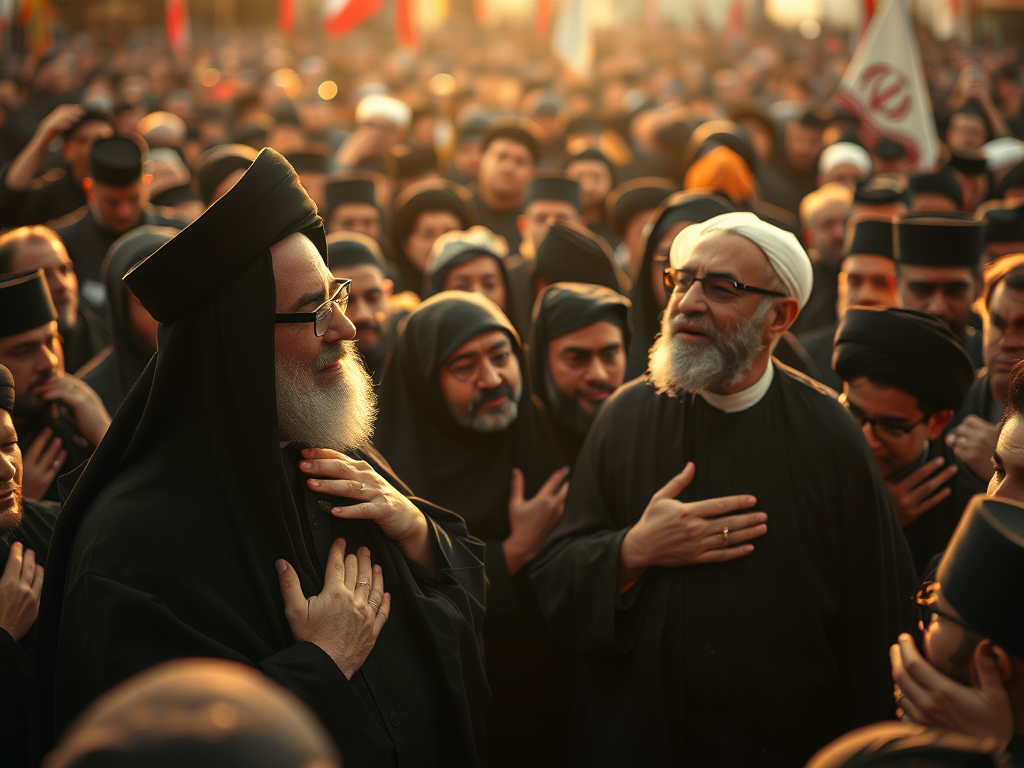
The recent Ashura ceremony in Iran bore all the familiar features associated with this sacred Shiite mourning period. Devotees, clad in somber black attire, knelt in reverence, rhythmically beating their chests in collective mourning. Yet, amid the traditional rites, an unexpected moment unfolded. Iran’s Supreme Leader, Ayatollah Ali Khamenei, summoned the man leading the chants. As shown in video recordings, he leaned in to whisper something into the chanter’s ear.
Moments later, the religious singer broke into a patriotic song rarely heard in such settings—“Ey Iran, Iran.” Just weeks earlier, such a choice of song would have been deemed highly inappropriate for a religious gathering in the Islamic Republic. Yet now, the crowd echoed the refrain with surprising fervor: “In my soul and spirit, you remain, O homeland. Wasted be the heart that does not tremble for you.”
This striking shift occurred as Iran reeled from a brief but deeply scarring military conflict with Israel, which also saw limited U.S. involvement. The aftermath of the 12-day war left Iran’s defensive infrastructure severely weakened, its nuclear facilities damaged, and its civilian population burdened with heavy losses.
Despite the adversity, Iran’s leadership appears determined to capitalize on the emotional fallout. The government sees the national outrage and grief sparked by the conflict as a chance to foster unity through a surge of patriotic sentiment—one that might help bolster a regime under pressure from economic instability and political unrest.
In response, officials have invoked historical imagery and nationalist symbolism, once embraced mainly by secular Iranians who considered it outside the purview of theocratic leadership. Iran’s conservative establishment, traditionally focused on Islamic values and wary of pre-Islamic heritage, is now drawing from the country’s ancient cultural reservoir to inspire national solidarity.
One telling example comes from Shiraz, one of Iran’s oldest cities. There, a large billboard depicts Israeli Prime Minister Benjamin Netanyahu kneeling before a statue of the Persian King Shapur I. The imagery directly references a famous frieze from Persepolis, the ruins of the ancient Achaemenid Empire’s ceremonial capital.
In Tehran’s bustling Vanak Square, another billboard features Arash the Archer, a legendary figure from Persian mythology. Arash is said to have defined Iran’s borders with a single arrow infused with his life’s energy. Today, the image is modified—his arrows accompanied by the missiles of the Islamic Republic, symbolizing the defense of modern Iran through ancient pride.

“This is the emergence of a hybrid identity—merging Shiite religious devotion with Iranian nationalism,” explained Mohsen Borhani, a law professor at the University of Tehran and a well-known political analyst. “It’s a direct consequence of the attacks.”
The efficacy of this patriotic revival, however, remains a matter of debate. In the absence of reliable polling data, experts and citizens alike question whether the nationalist wave will genuinely boost public support for the government—or simply reflect momentary anger toward foreign intervention.
Even before the hostilities with Israel, domestic conditions in Iran were fraught. A mounting economic crisis was exacerbated by infrastructural failures: power outages, fuel shortages, and dwindling water supplies amid scorching summer heat. Many analysts had forecasted potential unrest.
Yet, paradoxically, the war appears to have staved off the expected turmoil—at least temporarily. In the wake of external aggression, some Iranians seem more willing to tolerate further government restrictions. The state has, for instance, begun implementing tighter controls on internet usage. Concurrently, a broad crackdown has been launched on so-called infiltrators and foreign agents. Human rights organizations contend that the crackdown also targets political dissidents and ethnic minorities.

Statements by former U.S. President Donald Trump and Israeli leaders encouraging Iranians to rise against their government have, in fact, had the opposite effect in some circles. Even critics of the regime now voice discomfort at the idea of protests sparked by foreign influence.
One Tehran resident, Lida, expressed this sentiment in a voice message to The New York Times. Requesting anonymity due to government warnings against foreign media contact, she said, “It goes against my national pride that a foreign power would violate my country’s sovereignty and bomb our nuclear sites. The nuclear program may not represent my personal aspirations, but it’s still a part of my homeland.”
The use of nationalism as a political tool is not unprecedented in the Islamic Republic. During the latter stages of the Iran-Iraq War in the 1980s, leaders often leaned on nationalist rhetoric to maintain public morale. But Iran experts note that the current campaign is broader in scope and deeper in its appeal to cultural identity.
Ali Ansari, the founding director of the Institute for Iranian Studies at the University of St. Andrews, observed, “The leadership understands that in times of national crisis, invoking patriotic sentiment can be essential to unify the people. They’re attempting to use this war to reignite a sense of national cohesion that has been absent for many years.”
This strategy has been particularly visible during Muharram, the month of mourning in Shiite Islam. Ashura, the tenth day of this period, commemorates the martyrdom of Imam Hussein, the Prophet Muhammad’s grandson. Traditionally a somber and religious occasion, this year’s Ashura events were markedly political.
In Yazd, a city known for its religious heritage, madahs—religious singers—performed spiritual hymns infused with nationalistic themes. They sang renditions of once-banned patriotic songs, including an anthem originally written during World War II and long associated with the Pahlavi dynasty overthrown in the 1979 Islamic Revolution.
Not everyone welcomed this blend of faith and nationalism. The family of Tooraj Negahban, the lyricist behind “Ey Iran, Iran,” expressed discomfort with the song’s appropriation. In a post on an Instagram page bearing his name, they wrote: “For years, you silenced our voices and erased our names from public records. Now, having run out of your own slogans, you turn to the very songs you once condemned.”
Negahban, a vocal critic of the regime, passed away in exile in Los Angeles in 2008. The version of his song sung at Ashura incorporated religious references such as “Iran of Karbala” and “Iran of Ashura,” further blending the sacred with the nationalistic.

To some observers, this confluence of themes underscores a shift in the regime’s strategy. As Borhani noted, the younger generations—particularly those under 35 who make up the bulk of the population—are less responsive to purely religious messaging. The pivot to nationalism may thus reflect a recognition that religious narratives alone no longer suffice.
Yet, there are those who regard the sudden surge in patriotic expression with suspicion. Shahrzad, a university student in Tehran, characterized the movement as “engineered nationalism.”
“True patriotism arises from the ground up—from shared experiences, protests, and struggles,” she said in a voice message. “What we’re seeing now is nationalism dictated from the top.”
Even if the current nationalist fervor helps the government maintain its grip on power, questions linger about its sustainability. As Ansari pointed out, “Once the emotional fog lifts, people will be reminded that their basic needs remain unmet—no electricity, no fuel, no water.”
He concluded with a sobering prediction: “Ultimately, unless there’s a real economic transformation, this patriotic surge will fade. The country simply cannot move forward without it.”




Leave a Reply