
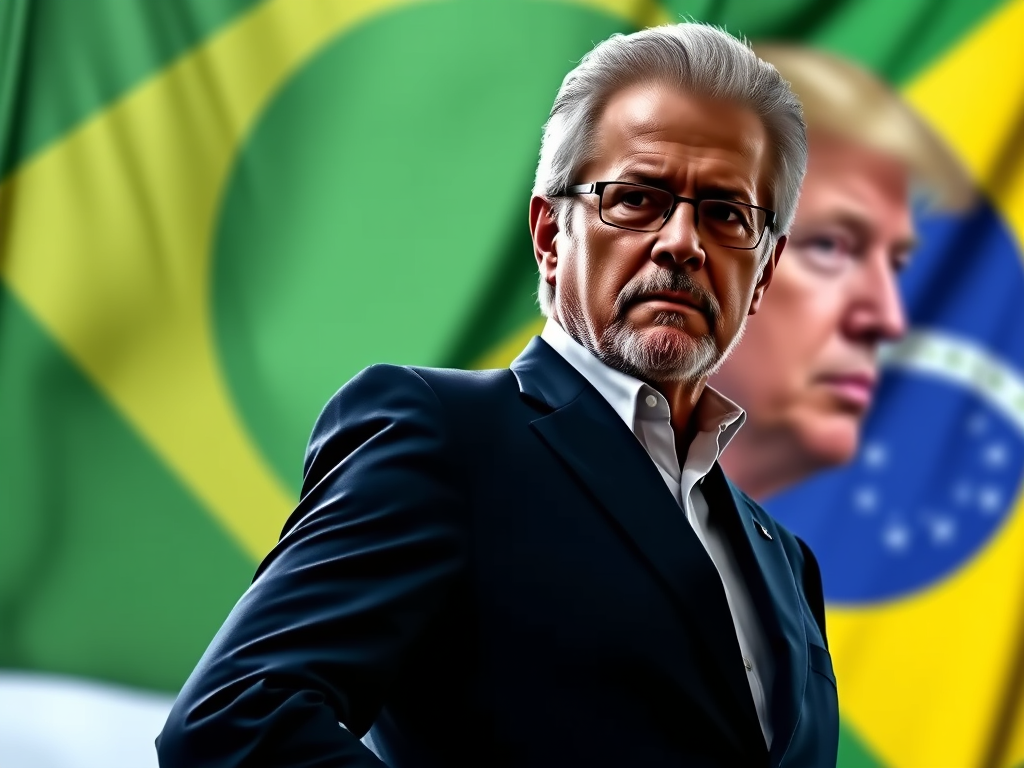

Anti-Trump Bump Rekindles Support for Brazil’s President

As Brazil’s 2026 presidential election approaches, the political scene was beginning to mirror that of the United States — an aging incumbent struggling to maintain support while being challenged by a provocative populist who has cast doubt on the legitimacy of previous elections. However, a new and unexpected variable has disrupted the anticipated trajectory of the race: former U.S. President Donald Trump.
Last week, Trump declared his intent to impose 50% tariffs on Brazilian exports, an aggressive move he framed as a defense of former Brazilian President Jair Bolsonaro. Bolsonaro, who is currently facing potential imprisonment over alleged coup-related activities, has received vocal support from Trump, who has characterized the legal proceedings as politically motivated. Trump’s intervention, however, has had unintended consequences — providing current President Luiz Inácio Lula da Silva with a timely political advantage.
Trump’s announcement prompted Lula to take a firm stance, using the threat as an opportunity to portray himself as a leader standing up to foreign interference. His defiant response, emphasizing Brazil’s national sovereignty, was widely covered in Brazilian media and resonated with the public. The messaging gained traction on social media, where Lula’s image as a defender of democracy went viral, reinvigorating his base and offering renewed hope that he could secure a fourth term — just days before his 80th birthday.
Public sentiment appears to be shifting. A surge in Lula’s approval ratings followed Trump’s tariff threat. Recent polls show that between 43% and 50% of Brazilians now approve of Lula’s performance, marking a notable increase of three to five percentage points compared to just a few months ago.
“It was a lucky break for Lula,” said Camila Rocha, a political scientist with the Brazilian Center for Analysis and Planning. “This confrontation gave him a narrative that energizes his supporters and helps reframe the election.”
This development is yet another instance of what political analysts call the “anti-Trump effect,” a phenomenon where opposition to Trump’s policies and rhetoric galvanizes support for his political adversaries — even beyond U.S. borders. Similar patterns have been observed in countries like Canada and Australia, where politicians gained momentum by positioning themselves in opposition to Trump.
For much of the past year, Lula has struggled with a series of domestic challenges. Rising food prices, difficulty advancing his legislative agenda, and mounting criticism from a right-leaning Congress had all contributed to a decline in his popularity. At one point, nearly 60% of Brazilians indicated they did not want Lula to seek re-election. The political tide appeared to be turning against him.
Then came Trump’s threat.
Trump accused Brazil’s judicial system of conducting a “witch hunt” against Bolsonaro, who faces criminal charges stemming from efforts to overturn the 2022 election results. Bolsonaro has also been implicated in a broader scheme to undermine democratic institutions, including alleged plans to give the military expanded powers and even assassinate Lula — claims Bolsonaro vehemently denies.
In response, Lula delivered a firm and unambiguous statement: “Brazil is a sovereign nation with independent institutions. We will not be intimidated or submit to outside pressure.” While he left the door open to dialogue with the United States, Lula made clear that the Bolsonaro case would proceed according to Brazilian law.
Trump’s proposed tariffs are scheduled to take effect on August 1, just as Bolsonaro is expected to stand trial. Bolsonaro, despite being barred from running for public office until 2030 due to his role in spreading misinformation about election fraud, has hinted at his intention to run again. Earlier this year, polls showed him with a narrow lead over Lula, although the difference was within the margin of error.
In recent statements, Bolsonaro expressed disappointment over Trump’s trade stance but suggested that political amnesty — both for himself and his allies — could serve as a basis for improved relations with the United States. Supporters in Congress are now pushing for an amnesty bill that would halt legal proceedings. Although Lula would almost certainly veto such legislation, the legislature could override him if it musters enough votes.
Meanwhile, Lula has threatened retaliatory measures of his own. Should Trump’s tariffs take effect, Lula has pledged to impose tariffs on American products. This development could lead to a trade war between the United States and Brazil — two countries with significant economic ties. In 2024, the United States ran a $7.4 billion trade surplus with Brazil, driven by roughly $92 billion in bilateral trade.
Economists warn that such a confrontation could have dire consequences for Brazil’s already fragile economy. Increased tariffs could drive up the cost of essential goods, such as food, medicine, and fuel, triggering inflation and economic hardship. Historically, Brazilian voters have held incumbent leaders responsible for economic downturns. But in this case, Lula may be able to deflect the blame by pointing the finger at Bolsonaro and his son, Eduardo Bolsonaro, who has reportedly been lobbying U.S. politicians on his father’s behalf.
“The former president should be held accountable,” Lula told reporters. “It was his son who went to Washington and tried to manipulate the American government.”

Political analysts believe Lula’s aggressive response to Trump’s interference could help him reframe the upcoming election as a referendum not just on domestic issues, but on Brazil’s autonomy and democratic principles.
“Bolsonaro’s loyal base won’t be swayed,” said Rosana Pinheiro-Machado, a professor of international development at University College Dublin. “But centrist and moderate voters may be persuaded by Lula’s argument that Brazil must resist foreign influence.”
Lula’s political journey has been nothing short of dramatic. Once dubbed “the most popular politician on Earth” by Barack Obama, Lula presided over a period of economic prosperity from 2003 to 2011, buoyed by a global commodities boom. However, his reputation suffered when he was convicted in a massive corruption scandal — a verdict that was later overturned, paving the way for his comeback and narrow victory over Bolsonaro in 2022.
Since returning to office, Lula has struggled to regain the momentum of his earlier presidencies. A fractured Congress and internal tensions within his coalition have hindered his ability to pass key reforms. Concerns about his age and stamina intensified after he suffered a fall in his home last year, prompting speculation that he might step aside for a younger successor.

But Trump’s latest move may have shifted the national conversation, refocusing public attention on Brazil’s position in the global arena.
“Trump changed the narrative,” said Andrei Roman, CEO of AtlasIntel, a polling and data analysis firm based in São Paulo. “People are now evaluating Lula on new criteria — his strength, his ability to stand up for Brazil’s sovereignty. And at least for now, that’s working in his favor.”
As the 2026 election draws closer, it remains to be seen how long this bump in support will last. But for the moment, Lula appears to have found new political footing, thanks in no small part to an unlikely helper from across the hemisphere.
询问 ChatGPT




Leave a Reply