

Would Europe Actually Retaliate Against Trump’s Tariffs?

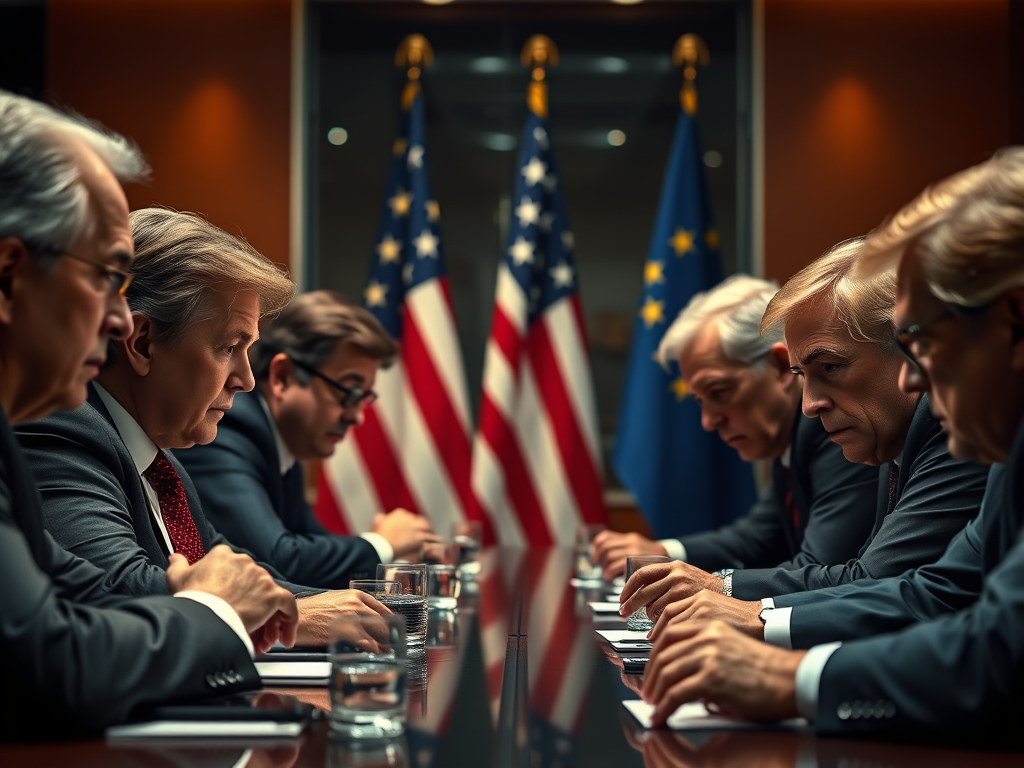
Throughout the week, European Union leaders have been diligently working on finalizing a comprehensive strategy to counter President Trump’s latest move to impose steep tariffs on European exports. The bloc is setting the stage to retaliate with duties on over $100 billion worth of American goods should efforts to negotiate a new trade agreement collapse.
Still, a fundamental question remains unanswered.
“Will they actually follow through?” asked Frances Burwell, a senior fellow at the Europe Center of the Atlantic Council, a Washington-based think tank focused on international affairs.
For months, officials from the EU’s 27 member countries have been devising a measured response to Washington’s aggressive trade actions. While they have repeatedly opted for diplomacy over confrontation, they now seem to be approaching a critical juncture. Back in April, EU policymakers gave the green light to a plan that would have imposed tariffs on American exports valued at €21 billion (approximately $25 billion). Yet, in an effort to de-escalate tensions, they chose to pause the implementation of those levies when President Trump unexpectedly delayed some broad-based tariffs at the last moment. That move was seen as a potential opening for dialogue.

However, no agreement emerged from those talks.
Instead, President Trump escalated the conflict by announcing via social media that he intends to introduce a 30 percent tariff on European goods beginning August 1. Following this declaration, EU authorities decided to once again postpone the retaliatory tariffs—which had only been on hold through July 14—to give diplomatic talks another chance. Simultaneously, they renewed their commitment to respond with strength if diplomacy fails.
EU trade representatives are now in the final stages of assembling a much more extensive list of tariffs, this time targeting €72 billion (about $84 billion) worth of U.S. products. This updated list includes high-profile items such as Boeing aircraft and Kentucky bourbon, and it was distributed to member states earlier this week, according to diplomats who spoke under anonymity due to the confidential nature of the discussions. A formal vote on the new measures has not yet taken place.
The urgency to complete this second wave of retaliatory tariffs underscores a hard truth: while the EU would far prefer a peaceful, negotiated settlement to a full-scale trade war, the risk of talks breaking down is real. Many European officials now believe that demonstrating toughness is essential in dealing with President Trump, who they say seems to respond primarily to strength.
“You have to show your strength,” said Lars Løkke Rasmussen, Denmark’s Foreign Minister, on Monday. “If peace is your objective, sometimes you have to be ready for confrontation.”
Nevertheless, European leaders have not given up on finding a diplomatic path. On Monday, Maroš Šefčovič, the EU’s Commissioner for Trade, spoke with U.S. Commerce Secretary Howard Lutnick. He was also expected to hold discussions with Jamieson Greer, a representative of the U.S. Trade Office, the following day. In parallel, technical trade negotiators from the EU were making their way to Washington, as confirmed by European Commission spokesperson Olof Gill during a press briefing.

Commissioner Šefčovič emphasized that while Europe still seeks compromise, European ministers are increasingly resolved to act if negotiations prove fruitless. He and his team had been laboring for months to craft a framework for a broad agreement. Until just last week, they believed they were on the verge of finalizing a deal—only for those hopes to unravel when President Trump made his new tariff announcement.
“We must stand up for our industries and protect employment,” Šefčovič told reporters in Brussels.
However, enacting retaliatory tariffs presents difficult choices for the EU. Taxing American imports such as soybeans, handbags, and industrial equipment would likely drive up costs for consumers and businesses in several major European economies, including France, Germany, and Italy. Because of these consequences, internal deliberations on which products to target have been particularly intense.
The tariffs proposed in April, though never enforced, are ready to be implemented on short notice, having already been through the approval process. However, even if those were activated, their impact would be limited. A €21 billion package is relatively small within the broader context of the €1.6 trillion trade volume shared between the U.S. and EU.
“We are preparing additional countermeasures to ensure we are completely ready,” said Ursula von der Leyen, President of the European Commission, during a public address on Sunday.
To proceed, EU member nations would need to formally approve the newer, broader tariff list. Initially targeting €95 billion worth of U.S. products, the list has since been revised downward to €72 billion after consultations and industry feedback.
Beyond traditional tariffs, the EU could also turn to a recently developed legal mechanism called the anti-coercion instrument. This tool would allow the EU to impose targeted restrictions on American service companies or major tech firms. While such measures would strike a powerful economic blow, they are seen as an option of last resort, sometimes dubbed the “nuclear option” within EU policy circles, because of the potential to dramatically escalate the dispute.
“We’re not at that point yet,” von der Leyen reassured the public on Sunday. “We remain in a phase of active negotiation.”

The European Union continues to prefer a diplomatic tone but is making it clear that it has significant retaliatory capabilities if required. It hopes to avoid using them.
EU officials remain optimistic that an agreement can be reached before the U.S. tariffs come into force. They argue that duties ultimately harm consumers and economies on both sides of the Atlantic. In that light, delaying a retaliatory strike should not be misinterpreted as weakness—it is, rather, a reflection of strategic patience.
“This isn’t about being weak,” said Minister Løkke Rasmussen. “It signals a serious intent to resolve things without escalation.”
Nonetheless, relying on goodwill and patience has yielded little progress so far.
According to Mujtaba Rahman, Managing Director for Europe at the Eurasia Group, a consultancy specializing in political risk, Europe has a high tolerance for economic pain and won’t respond unless Trump’s measures reach an extreme level. A scenario involving sweeping 15 percent tariffs across multiple sectors might finally compel the EU to retaliate.
Rahman emphasized that the EU is also keen to maintain good relations with the U.S., particularly in light of the ongoing crisis in Ukraine, where American support is critical. “Only if the U.S. takes truly extreme steps will the EU feel it has no choice,” he said.
Yet Ignacio García Bercero, a former EU trade negotiator now affiliated with the Bruegel think tank, believes Trump’s latest actions may cross that line.
“A 30 percent tariff is too large to ignore,” he warned. “If that’s enacted, the EU will be forced to respond.”
In the end, Europe is balancing the competing pressures of diplomacy and deterrence. While it continues to strive for dialogue, it is unmistakably preparing for confrontation—just in case words fail.




Leave a Reply