

American Allies Want to Redraw the World’s Trade Map, Minus the U.S.

The global trade landscape is undergoing a dramatic shift as escalating trade tensions, particularly those instigated by the United States, are compelling many of its closest allies to realign their strategies. As the U.S. takes an increasingly unpredictable approach to trade, long-standing partners are beginning to deepen ties with one another, leaving Washington more isolated. In this changing environment, the European Union is actively working to place itself at the center of a reimagined global trading framework.
Over the weekend, the European Union was shocked to learn that starting August 1, it would be subjected to new 30 percent tariffs by the United States. Ursula von der Leyen, President of the European Commission, responded firmly but diplomatically. She confirmed that the EU would continue negotiations in the coming weeks, but also emphasized that the bloc is readying a strong counter-response. While immediate retaliation will be delayed until early August, planning for potential retaliatory measures is already underway.
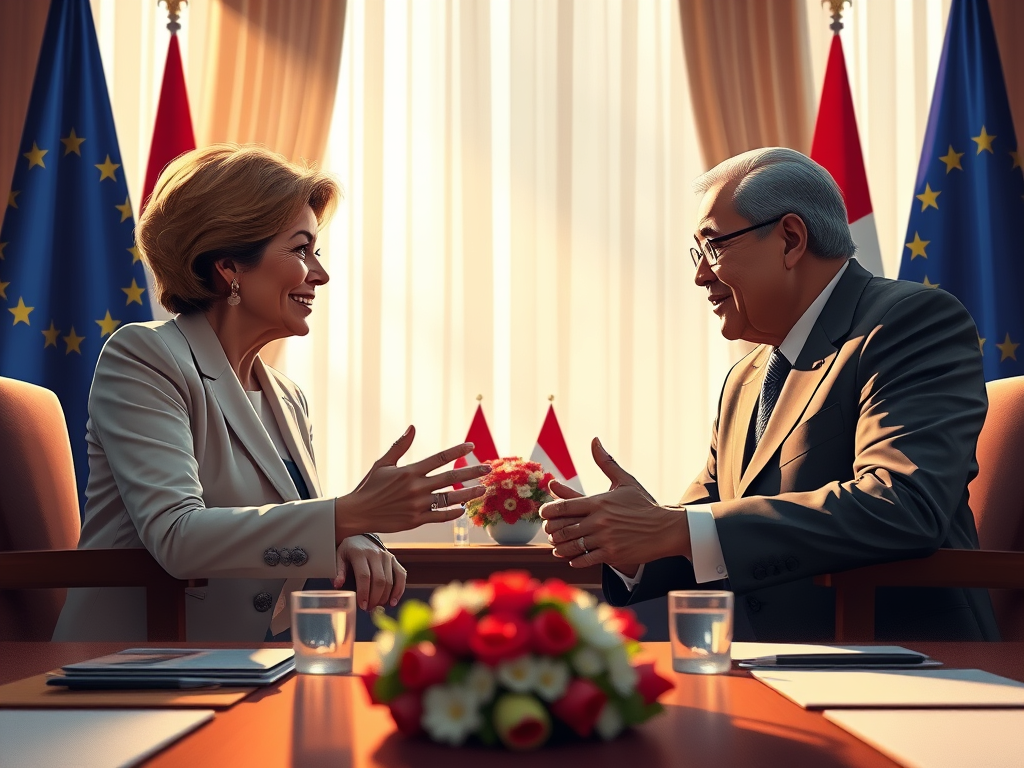
However, the EU’s approach extends far beyond preparing a tit-for-tat response. The broader strategy involves actively seeking new, more dependable trade alliances. This sentiment was echoed by von der Leyen during a joint press event with Indonesian President Prabowo Subianto in Brussels.

“These are turbulent times,” she stated, “and when economic instability intersects with geopolitical uncertainty, it’s more important than ever for reliable partners to come together.”
As President Donald Trump continues to threaten steep tariffs against a range of countries, including Indonesia, the EU is countering by reducing trade restrictions and fostering deeper economic connections with various global partners. Von der Leyen subtly criticized the U.S. administration’s approach, suggesting that while some nations respond to global instability with isolationism and protectionism, Europe is pursuing openness and cooperation.
Her message to leaders who are growing increasingly disillusioned with the U.S.’s unpredictability was clear: “Europe welcomes you. You can count on us.”
This divergence in approaches—America turning inward while Europe seeks collaboration—is becoming more pronounced. The EU, along with numerous other countries targeted by U.S. tariffs, is intensifying its efforts to forge new ties and strengthen old ones, gradually constructing a trade system that is less dependent on the whims of U.S. policy.
President Prabowo also highlighted this shift during his visit, expressing appreciation for Europe’s stabilizing influence on the global stage. “In Southeast Asia, and particularly in Indonesia, we view Europe as a crucial partner for maintaining global economic balance,” he noted.
Still, few expect a clean break from the U.S. any time soon. Prabowo acknowledged that America remains a global powerhouse with an unparalleled consumer market and cutting-edge innovation in technology and services. Its role as a leader in the global economy is unlikely to fade overnight.

Yet, even so, many U.S. trade partners believe they have no option but to diversify their economic relationships. Trade connections are notoriously complex to reconfigure—but once restructured, they can be even harder to revert. This realization is beginning to shape decisions across the world.
Prior to the surprise announcement from Washington, EU and U.S. negotiators had engaged in prolonged, detailed discussions. As recently as mid-week, European officials had believed that a compromise was within reach. Brussels was prepared to accept a 10 percent base tariff, provided that specific exemptions could be secured for sensitive sectors.
Instead, Trump unexpectedly shifted course. On Thursday, he began hinting that a broad, uniform tariff would be imposed on all EU imports. By Friday, the White House formally informed EU leaders that their months of careful negotiation had unraveled. And on Saturday, Trump publicly confirmed via social media that a 30 percent tariff would be applied.
Simultaneously, Trump announced similar tariffs on Mexican goods and even harsher rates for other nations—35 percent for Canada and Thailand, 50 percent for Brazil, and steep increases for numerous other trading partners.
Although the Trump administration has previously backed down from threatened tariffs and has left the door open for further negotiations before the August 1 deadline, the overall atmosphere has soured. Mujtaba Rahman, head of European analysis at the Eurasia Group, described the announcement as a calculated strategy to introduce uncertainty and pressure. He criticized the move as “a complete shift of the goalposts,” underscoring how the U.S. appears to be using instability as a negotiating tactic.
The EU’s internal response has been one of growing frustration and urgency. Brando Benifei, chair of the European Parliament’s delegation for U.S. relations, accused Trump of deliberately attempting to sow division among European nations. “This is a fear tactic,” he said, “and an attempt to break Europe’s unity.”
Still, von der Leyen emphasized restraint, announcing that the bloc’s pre-approved retaliatory tariffs—impacting roughly $25 billion worth of U.S. goods—would not take effect immediately. These countermeasures, previously suspended, had been set to activate early this week but will now be delayed until August.

“We are also preparing additional responses, should they become necessary,” von der Leyen stated.
Yet the EU’s strategic thinking goes beyond reactive measures. The ultimate goal may be to build a more resilient and diversified global trade network—one that depends less on the United States. Since Trump began his efforts to overhaul the trade system in February, the EU has worked diligently to negotiate new trade agreements and reinforce existing ones.
Canada and the EU have drawn closer in recent months, while the long-fractured relationship between Britain and the EU has shown signs of improvement, despite Brexit. Brussels is also actively exploring enhanced trade ties with countries like India, South Africa, and a host of nations across South America and Asia.
The EU is not alone in this effort. Canada is building stronger trade links with Southeast Asia. Brazil and Mexico are also focused on deepening their relationships beyond traditional Western markets.
Some international officials have even floated the concept of forming a new global trading coalition that excludes both the United States and China—two nations often criticized for their destabilizing trade behaviors. China, in particular, is widely blamed for fueling global overproduction and market flooding through aggressive industrial support policies.

Recently, von der Leyen proposed the idea of Europe forming a trading alliance with a group of 11 countries—including Japan, Vietnam, and Australia—that excludes both China and the U.S. This signals a bold attempt to reshape the dynamics of international trade in a way that prioritizes stability and trust over size or dominance.
The key question now, according to analysts, is whether these increasingly cooperative moves between U.S. allies will evolve into coordinated actions against Washington. Jacob Funk Kirkegaard, a senior fellow at the Brussels-based think tank Bruegel, suggested that unified retaliation might become the most effective way to push back.
“Coordination would be the logical step forward,” he noted. “If the goal is to maximize leverage, allies need to act together.”
In this new trade reality, old assumptions are breaking down. Where the United States once led through consistent, rules-based trade policy, it is now driving its partners to seek shelter in each other. And as the world’s trade map begins to redraw itself, Europe is preparing to be at its center.




Leave a Reply