
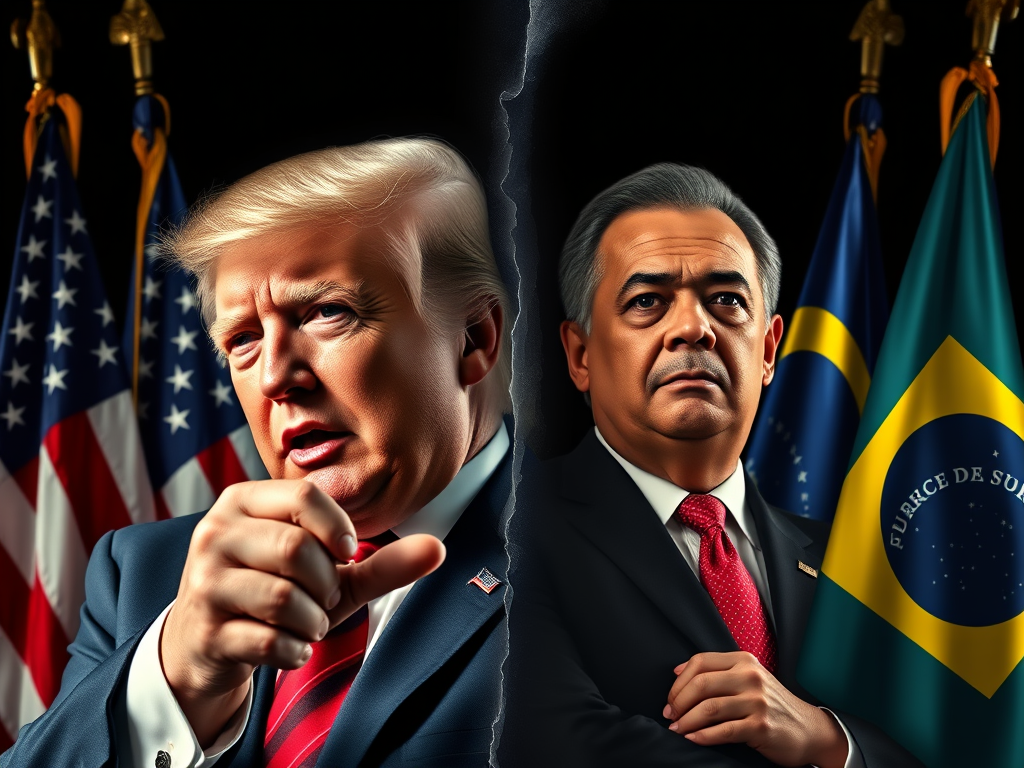

Trump’s Tariff Threat: The U.S.-Brazil Trade Conflict Explained

The two largest countries in the Western Hemisphere are on the brink of a serious trade conflict—though the catalyst this time appears to be more political than economic.
On Wednesday, former U.S. President Donald Trump announced plans to impose a sweeping 50% tariff on all Brazilian imports starting August 1. Notably, the move doesn’t stem from trade imbalances, as the U.S. actually maintains a trade surplus with Brazil. Instead, Trump’s motivation seems rooted in a political defense of his close ally, former Brazilian President Jair Bolsonaro, who is facing trial in Brazil for allegedly attempting to stage a coup after losing the 2022 election.
Shortly after Trump’s declaration, Brazilian President Luiz Inácio Lula da Silva responded firmly, promising reciprocal tariffs on U.S. goods. In a strongly worded statement, Lula asserted, “Brazil is a sovereign nation with its own independent institutions, and we will not tolerate external interference or oversight.”
According to a senior Brazilian government official, Brazil is considering targeted tariffs on specific American sectors, aiming to avoid widespread economic disruption. The strategy reflects an attempt to apply pressure while minimizing domestic economic harm.
This latest confrontation underscores the growing intertwining of international diplomacy and domestic politics. It also highlights how Trump, who is seeking reelection, may be using trade policy as a tool to support political allies and retaliate against perceived injustices.
What Prompted Trump’s Tariff Threat?

Trump’s announcement was dramatic and direct. He declared that unless Brazil halts its prosecution of Bolsonaro, the U.S. would initiate a steep 50% tariff on all Brazilian goods entering the country. If Brazil were to respond in kind, he warned, additional penalties would follow.
Unusually for trade policy, Trump made no secret of the political nature of his action. He framed the prosecution of Bolsonaro as a politically motivated “witch hunt” and insisted that the legal proceedings should be stopped immediately. In an open letter addressed to President Lula, Trump wrote, “This trial is a disgrace. It must be terminated without delay!”
Trump also raised concerns about freedom of expression, accusing Brazilian authorities of infringing on the rights of U.S. citizens. His media company has filed a lawsuit against a Brazilian Supreme Court justice who ordered American tech companies to remove certain social media content that allegedly posed a threat to Brazil’s democratic institutions. Some of the affected accounts were reportedly operated by individuals based in the United States.
In addition, Trump cited vague allegations of unfair trade practices, even instructing U.S. trade officials to launch a formal investigation into Brazil’s trading behavior. However, he inaccurately claimed that the United States runs a trade deficit with Brazil. In fact, official figures from last year show that the U.S. enjoyed a $7.4 billion trade surplus in its approximately $92 billion trade relationship with Brazil.
What Does the U.S. Import from Brazil?
Brazil counts the United States as its second-largest trading partner, behind China. Roughly 12% of Brazil’s exports are shipped to the U.S., making the relationship economically significant for both nations.
The two countries exchange a wide range of goods, including fuel, aircraft, iron and steel, as well as machinery. Brazil also exports a variety of agricultural commodities to the United States, including coffee, tea, beef, orange juice, and spices.

Among the most likely products to be affected by the proposed tariffs is coffee. Brazil is the world’s largest coffee exporter, while the U.S. is its biggest consumer. Last year alone, about 30% of America’s coffee imports originated from Brazil. With global coffee prices already on the rise due to poor harvests caused by severe droughts in Brazil, additional tariffs could drive prices even higher for American consumers.
In fact, U.S. import data this year indicates a noticeable increase in Brazilian coffee shipments, highlighting just how significant any trade barriers could be to both economies.
Trump, Bolsonaro, and Lula: A Triangular Political History
During Trump’s presidency, Jair Bolsonaro emerged as one of his most steadfast international allies. Bolsonaro openly emulated Trump’s political approach—leveraging populist rhetoric, criticizing minority rights, attacking the press, and engaging in inflammatory online behavior. The similarities earned him the nickname “Trump of the Tropics.”
The two leaders held meetings at the White House in 2019 and again at Mar-a-Lago in 2020. When Trump lost the 2020 U.S. presidential election, Bolsonaro was among the last global leaders to acknowledge Joe Biden’s victory, raising doubts about the election results.
In the months that followed, prominent Trump supporters echoed Bolsonaro’s claims that Brazil’s voting system was vulnerable to fraud. After losing Brazil’s 2022 election, Bolsonaro fled to the U.S. and remained there for several months, even appearing at the same Conservative Political Action Conference as Trump.
Meanwhile, Lula forged close ties with President Biden, as both leaders had survived attempts to undermine their elections. Lula has also shown strong public support for Vice President Kamala Harris and has not communicated directly with Trump since his return to political prominence.
The animosity between Trump and Lula has only deepened, with each trading public criticism of the other in recent months.
Bolsonaro’s Legal Troubles
Bolsonaro faces serious criminal charges in Brazil following a lengthy investigation. Prosecutors accuse him of orchestrating a plot to cling to power after his electoral defeat. The charges include efforts to invalidate the election, dismantle democratic institutions, and potentially assassinate his political rivals—including Lula.
A comprehensive 884-page report by Brazilian investigators alleges that Bolsonaro not only sanctioned but actively directed plans to overthrow the democratic order. The conspiracy reportedly included military involvement, the dissolution of the judiciary, and the annulment of election results.

After Lula assumed office in January 2023, thousands of Bolsonaro supporters stormed and vandalized key government buildings in a failed attempt to reverse the election results.
Though Bolsonaro denies any role in plotting a coup, he acknowledged in a recent Supreme Court testimony that he had explored “constitutional alternatives” that might have allowed him to remain in power. He also denied knowing anything about the alleged plot to assassinate Lula, his vice president, or a Supreme Court justice.
Brazilian police, however, report having discovered digital records of the assassination plan. The evidence includes files recovered from USB drives and phones, which show that the document outlining the plan was printed on two separate occasions in the presidential offices—once while Bolsonaro was present, and another time when the file was transported to the official residence.
Bolsonaro’s trial is expected to begin soon, possibly as early as next month. If found guilty, he could face a lengthy prison sentence. Despite his legal jeopardy, polls suggest Bolsonaro remains slightly ahead of Lula in voter support for the 2026 election—though he is currently barred from running until 2030 due to a separate ruling regarding election misinformation.
Looking Ahead: A Diplomatic Standoff?
It seems increasingly likely that the U.S. and Brazil will find themselves at an impasse over the Bolsonaro case.
Lula has made it clear that the matter lies solely in the hands of Brazil’s independent judiciary and will not be influenced by foreign political pressure. “This case is not for negotiation,” he stated emphatically.
Brazilian officials have indicated that while they are preparing countermeasures, they are also leaving the door open for dialogue. Lula emphasized in a Thursday interview that his country prefers peaceful resolutions and respects its longstanding partnership with the United States.
“Brazil has always chosen dialogue over conflict,” he said, adding that his government would both pursue tariff measures and raise the matter with the World Trade Organization if necessary.
Meanwhile, conservative Brazilian commentators like Paulo Figueiredo, who resides in Florida, are pressuring Trump and U.S. lawmakers to intervene in support of Bolsonaro. Some Bolsonaro allies hope Trump’s aggressive stance could persuade Brazil’s Congress to pass an amnesty law shielding the former president from prosecution. However, even if such a bill were approved, Lula would almost certainly veto it, and overcoming the veto would require a supermajority in Congress—an outcome that currently seems unlikely.
As the situation develops, the conflict promises to test the strength of U.S.-Brazil relations and raises significant questions about the intersection of international diplomacy and domestic justice.




Leave a Reply