
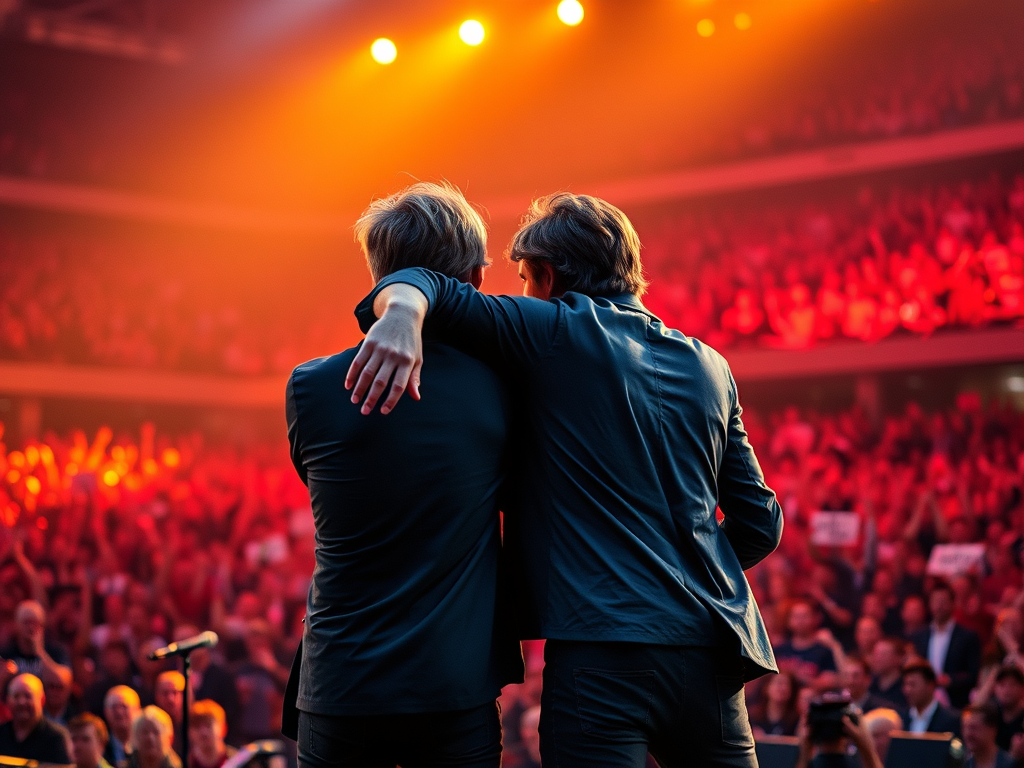

On a cool Friday evening in Cardiff, Wales, a moment long thought impossible finally materialized: Oasis took the stage together for the first time in over a decade and a half. The Gallagher brothers — Liam and Noel — appeared at Principality Stadium, with Liam’s arm slung casually over Noel’s shoulder, a gesture that was met with thunderous applause and emotional disbelief from the audience. Yet, despite the excitement and the sheer magnitude of the moment, there was a sense of hesitation in the air. The crowd of 62,000, though visibly thrilled, was waiting — not just to see the band, but to feel the magic they once delivered so effortlessly.
Oasis Reunites, Its Songs Still Stomping and Wounds Still Healing

Liam, always the more animated of the two, seemed to recognize the unspoken tension. Noel, ever the more brooding and introspective presence, offered a quieter contrast. Then, in a bid to break the ice, Liam urged the crowd to embrace each other — to physically reach out and hold someone nearby. That simple act became a spark, a cue for the energy that had been simmering under the surface to erupt.
The true ignition came moments later, with the gritty, anthemic “Cigarettes & Alcohol” — a cornerstone of their 1994 debut Definitely Maybe. The distorted guitars blared in their signature sleazy fashion, and Liam launched into the lyrics with unfiltered enthusiasm. Down on the stadium floor, fans leapt into euphoric clumps, bouncing and colliding like scrappy rugby teams. By the time the chorus hit, the collective restraint had vanished. The show had truly begun.
Over the next two hours, Oasis delivered a performance that was equal parts celebration and confrontation, a mix of rock-and-roll bravado and occasional uncertainty. It wasn’t a polished, cinematic return. It was raw, noisy, and very human — just as Oasis had always been. The set moved between soaring highs and awkward lulls, capturing both the glory and messiness that defined the band’s original run.
To call the concert a triumph would be an understatement. In fact, its very occurrence bordered on miraculous. The public and deeply personal feud between the Gallaghers is legendary — as bitter and dramatic as anything out of Shakespeare. Their sibling rivalry has played out like a soap opera in the full glare of the British tabloids. Even during their commercial peak in the late ’90s, their dynamic was volatile, often teetering on the edge of collapse. But therein lay part of the band’s allure — they turned chaos into art, unpredictability into power.
What always gave Oasis its emotional punch was the contrast between its two leading men. Noel, the chief songwriter, infused the music with a dreamy, sometimes wistful sensibility. Liam, the mouthpiece of those songs, spat them out with an irreverent snarl. It was a tension between yearning and defiance, between heart and swagger. Watching them on stage again, it was easy to recall why this alchemy had worked so well. Liam sang with his characteristic lean into the mic, giving each line a dangerous edge. Noel, quieter but not without charm, played with finesse and occasional serenity.
The band’s catalogue has aged with surprising grace. This became most evident during the emotional crescendo of the show: a closing trio of crowd favorites that showcased Oasis at their most resonant. “Don’t Look Back in Anger” began like a gentle nod to John Lennon and swelled into a cathartic sing-along, with Noel visibly moved despite his usual guarded demeanor. Next was the timeless “Wonderwall,” where Noel’s backing vocals clashed tenderly with Liam’s more declarative delivery, creating a beautiful tension. Finally came “Champagne Supernova,” a trippy, sprawling epic that, while less precise than the other two, still cast a hypnotic spell.
Much of the show’s power came in the second half. “Slide Away” oozed with sadness and grit, “Live Forever” was delivered with a breathless intensity, and “Whatever” showcased the Gallaghers’ signature love-hate chemistry in full force. The main set concluded with “Rock ’n’ Roll Star,” a scorched-earth finale that twisted itself into a glorious, molten climax.


In contrast, the first half of the show had a more uncertain feel. It included a three-song stretch featuring Noel on lead vocals — “Talk Tonight,” “Half the World Away,” and “Little by Little.” While these were met with appreciation from long-time fans, the energy noticeably dipped. The opening numbers — “Hello” and “Acquiesce” — appeared to be less about dazzling the crowd and more about making a statement: We’re back, and we’ve put the past (somewhat) behind us.
The uneven pacing might reflect Oasis’s complicated relationship with nostalgia. In their prime, they seemed to shun looking back, charging forward as the loud, proud voice of a generation. But this concert had its nods to the past — the merch booths sold throwback bucket hats and football kits, reminding everyone of the fashion statements the Gallaghers once embodied, particularly Liam with his love for lightweight jackets and swaggering silhouettes.
Even before the first chord was played, the night had already started to show its wild side. One fan, overcome with excitement, had to be carried out on a stretcher — fist pumping defiantly in the air. The real mayhem, however, came later. During “Rock ’n’ Roll Star,” a flare was lit, sending a column of fire and smoke into the air. Another flare followed during “Don’t Look Back in Anger,” this time near the center of the stadium. The acrid smell of smoke lingered in the air long after, a fitting scent for a band whose legacy is one of burning brightly and unpredictably.
Oasis’s original run burned like a supernova — intense, chaotic, and brief. After a string of less impactful albums in the 2000s, the band disbanded in 2009 under a cloud of conflict. Each brother pursued new projects, but neither achieved the same cultural resonance. This reunion, however, felt more stable, perhaps more grounded. Alongside the Gallaghers stood one other original member, guitarist Paul “Bonehead” Arthurs, who quietly anchored the performance. The current lineup also included longtime collaborators Gem Archer on guitar, Andy Bell on bass, and Joey Waronker on drums.
Although the brothers barely interacted — exchanging no visible words and keeping a cautious physical distance throughout the show — there were glimmers of humor and humility. Noel, before playing “The Masterplan,” took a moment to thank the younger fans who’d never seen the band live but kept their music alive. Liam, ever the joker, referenced the inflated ticket prices, quipping, “Was it worth the £40,000 you paid for the ticket?”
Toward the end, Liam offered what might be the closest he’ll come to heartfelt gratitude: “Nice one for putting up with us over the years.” It was a line that landed with unexpected weight.

As the final notes rang out, it was clear that the brothers had maintained their distance, both emotionally and physically. Bonehead, strategically placed between them like a peacekeeper, kept the evening from combusting. But then came the moment that surprised everyone — as Liam left the stage, he paused briefly to give Noel a quick, one-armed hug. It wasn’t dramatic, but it was real. The crowd exploded with joy, possibly louder than at any point in the show.
Earlier, during the encore, a black Range Rover had quietly pulled up backstage. As the band lingered, soaking in the final applause, Liam disappeared without a word, slipping into the back seat and vanishing into the night — leaving behind a stadium full of people who had just witnessed the impossible.
After 16 years of silence, bitterness, and separate paths, Oasis gave fans a night to remember — not just because of the music, but because for a few hours, hope triumphed over history.uilding.




Leave a Reply