
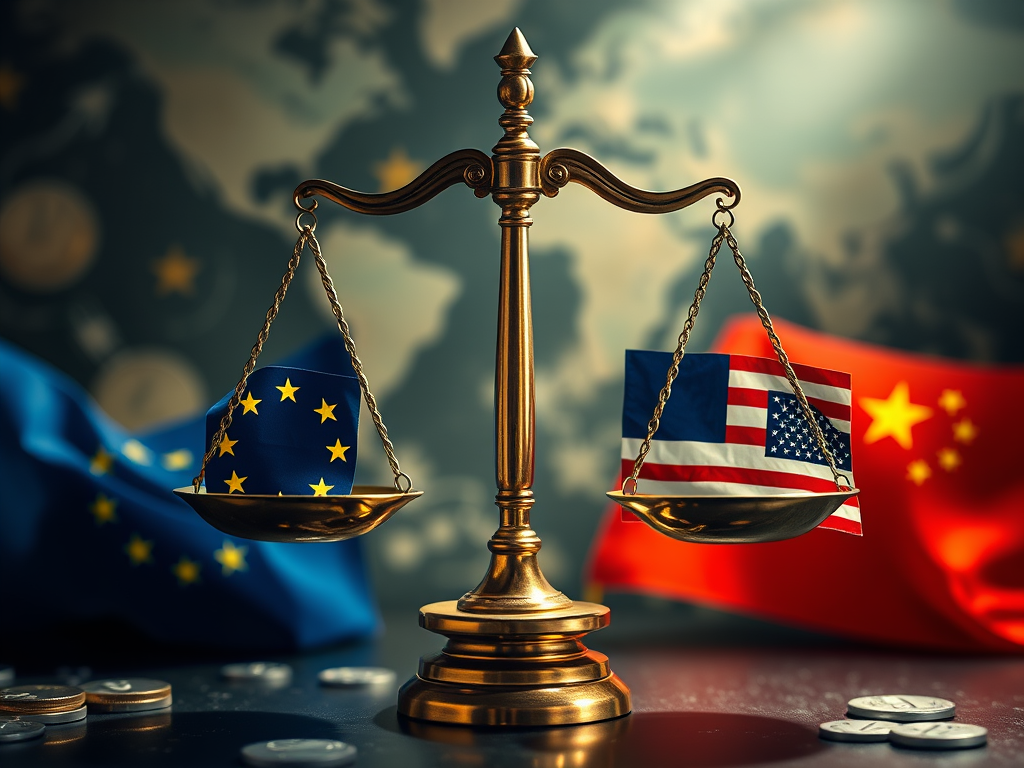

How Europe Got Stuck Between Xi’s China and Trump’s America

At one point, it seemed as though former President Donald Trump’s confrontational trade policies might encourage closer economic ties between Europe and China. His approach to tariffs made little distinction between long-time allies like the European Union and strategic competitors such as China, prompting some to believe that shared economic pressure might unite the two.
However, those expectations have not materialized.
Instead, the European Union now finds itself wedged in an increasingly uncomfortable position—caught in the middle of escalating tensions between the world’s two economic giants, the United States and China.

In Brussels, EU officials are scrambling to reach a provisional trade agreement with Washington before Trump’s administration imposes sweeping tariffs that could deal a serious blow to European industries. At the same time, policymakers are urging Beijing to reduce its support for Russia, scale back substantial state aid to Chinese companies, and limit the flow of inexpensive goods flooding European markets.
Yet amid all this, the EU cannot afford to sever its economic relationship with China, which remains the global manufacturing hub. Stability in that relationship is crucial—even as the political and commercial frictions deepen.
EU leaders are planning a summit in Beijing later this July, although the details remain uncertain and expectations are muted. While China seeks to present Trump’s rejection of multilateral trade as a chance to draw Europe closer, the EU’s frustrations with China are becoming more pronounced, not less.
“There is no China card for Europe,” remarked Liana Fix, a Europe specialist at the Council on Foreign Relations, underscoring the complexity of the EU’s position.

The challenges were apparent during Chinese Foreign Minister Wang Yi’s recent visit to Brussels, which was intended to lay groundwork for the summit. Chinese officials framed the discussions as constructive, downplaying any discord. In contrast, EU representatives highlighted unresolved issues, particularly regarding trade imbalances.
This divergence was reinforced over the weekend. The European Commission moved to limit public spending on Chinese medical devices, citing unfair treatment of European companies by Chinese government agencies. In retaliation, China promptly announced its own countermeasures.

Still, Europe is treading carefully. Its economic links with China are vast and deeply embedded. Many EU member states depend heavily on China for raw industrial inputs, while exports to China—especially from Germany, Europe’s largest economy—remain critical.
Yet the trade relationship is becoming more unbalanced. While European exports to China are stagnating or declining, imports from China are growing rapidly. Discount retailers like Shein and Temu have inundated European markets with low-cost goods, prompting European authorities to tighten import regulations. Meanwhile, leaders complain that China’s heavily subsidized manufacturers enjoy an unfair edge over European competitors, with state-backed banks providing generous support.
But trade isn’t the only area of concern. EU officials are also increasingly frustrated with China’s role in the Ukraine conflict. By purchasing Russian oil and other goods, China has undermined the effectiveness of European sanctions and continued to provide a crucial economic lifeline to Moscow.
Danish Foreign Minister Lars Løkke Rasmussen emphasized that the EU does not aim to sever ties with China. “It’s about engaging on more equal terms and taking a more transactional approach,” he told reporters recently.
As the United States seeks to reshape the global trade landscape—aiming to reduce its trade deficit, increase revenue, and bring manufacturing back home—the EU finds itself isolated. Though it represents the third-largest economy in the world as a bloc of 27 nations, the EU was originally conceived as a champion of cross-border trade and remains a staunch advocate of open, rules-based commerce.
European Commission President Ursula von der Leyen reiterated this vision during a press conference last month, stating that the EU’s mission is to “demonstrate that broad-based, rules-oriented free trade is still viable.”
To that end, the EU has been expanding trade ties with nations that share similar values, such as Canada and Switzerland. Von der Leyen also hinted at the possibility of a deeper alliance with a group of 11 Pacific nations—including Japan, Vietnam, and Australia—that notably excludes both the U.S. and China.

Despite these forward-looking strategies, the EU’s focus in recent months has largely been defensive. The dual pressure from the U.S. and China has left it vulnerable, both politically and economically.
Regardless of the outcome of negotiations with the Trump administration, the EU is bracing for increased tariffs on its exports to the U.S. American officials have made it clear that the proposed 10% universal tariff is non-negotiable.
In order to secure a trade deal, EU negotiators may have to make concessions—such as aligning more closely with the U.S. in its stance toward China. Although the EU shares some of Washington’s concerns over China’s trade practices, it is constrained in how aggressively it can act, given the intricate web of economic interdependence.
Recent developments have highlighted these constraints. In response to U.S. tariffs, China curbed exports of rare earth magnets—essential components in manufacturing everything from electric vehicles and drones to robotics and missile systems. Since China dominates global rare earth production, such restrictions give Beijing considerable leverage.
European leaders had hoped these export controls would primarily affect American firms. However, European businesses have also encountered major delays in obtaining Chinese approval to buy these materials. The hold-up appears to be less about logistics and more tied to ongoing trade tensions with Europe.
For years, Beijing has required foreign companies to share key technologies with Chinese partners as a condition of market access. Recently, European carmakers and other firms have struggled to keep up with their Chinese counterparts, especially in fields like electric vehicle production and solar technology.

Now, the EU is pushing for reciprocity—demanding that Chinese companies transfer technology if they wish to do business in Europe.
In tandem with the United States, the EU has also imposed restrictions on exports to China of advanced semiconductor manufacturing equipment—technology with both civilian and military uses. This move has infuriated Chinese officials.
During discussions on rare earth supply, China’s commerce minister Wang Wentao urged Europe to lift such controls, stating that Beijing hoped the EU would “take effective steps to support and facilitate the legitimate trade of high-tech goods.”
When EU representatives arrive in Beijing for the upcoming summit, they are expected to press for clearer, more reliable access to rare earth supplies.
Jens Eskelund, president of the European Union Chamber of Commerce in China, said the chamber wants the summit to focus on creating a more transparent and predictable regulatory environment for foreign firms operating in China. He also emphasized how much harder it has become for European businesses to navigate the Chinese market.
Still, the chances of any major breakthrough—or of a closer economic partnership—are slim. Sentiment in Europe continues to sour.
In a speech at the recent G7 summit in Canada, von der Leyen warned that China is pursuing a strategy rooted in “dominance, dependency, and coercion.” Her words capture the increasingly cautious and skeptical view that European policymakers now hold toward Beijing, even as they try to maintain a fragile and necessary relationship.




Leave a Reply