
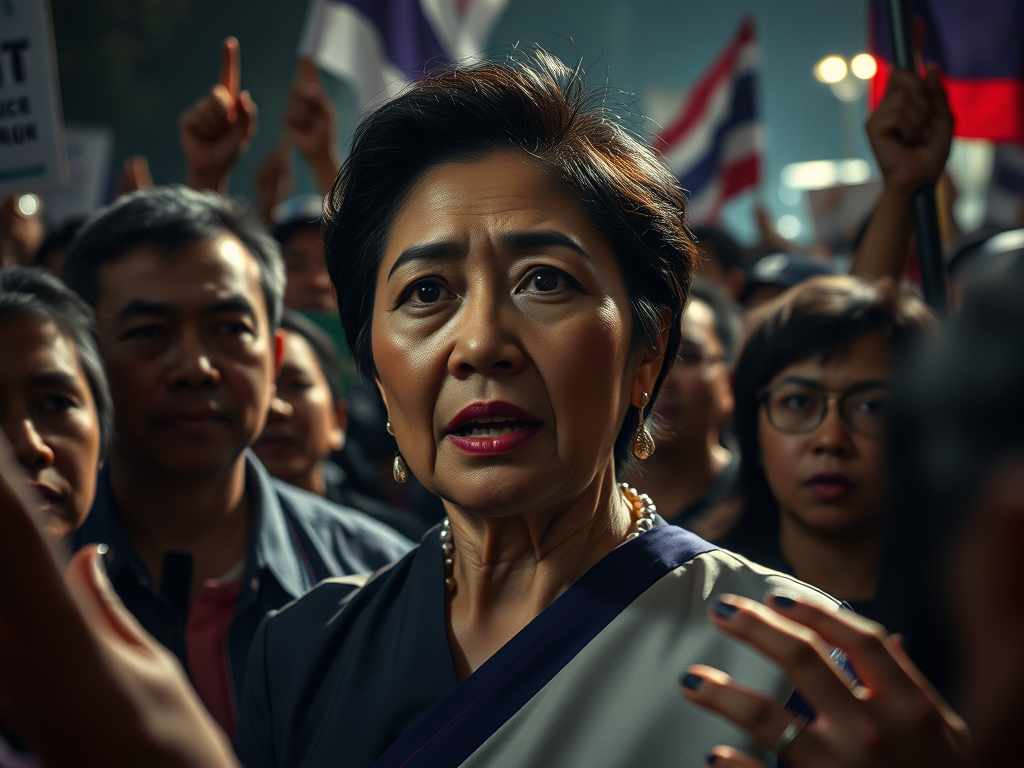

Thai Court Suspends Prime Minister as Political Crisis Spirals

Thailand found itself in the midst of renewed political instability on Tuesday after the Constitutional Court made the dramatic decision to suspend Prime Minister Paetongtarn Shinawatra from her position. The suspension, which comes as Thailand is already grappling with escalating tensions along its border with Cambodia, marks another chapter in the country’s long history of political volatility.
At just 38 years old, Paetongtarn Shinawatra—descended from Thailand’s influential but divisive Shinawatra political family—is now fighting to retain her position less than a year after stepping into the role. The crisis that threatens her leadership was sparked in May when Cambodian Prime Minister Hun Sen released a confidential recording of a private discussion he had with Ms. Paetongtarn regarding sensitive issues related to the ongoing border dispute.
In the leaked audio, Paetongtarn appeared unusually deferential toward Hun Sen and seemed critical of Thailand’s own military, a force known to wield significant political power in the country. Her tone and comments—widely interpreted as undermining national interests—quickly triggered public outrage. Critics, including some within her own coalition, demanded her resignation. The political backlash intensified as the Bhumjaithai Party, the second-largest faction in her ruling coalition, withdrew its support, severely weakening her parliamentary majority.
Although Ms. Paetongtarn issued a public apology and clarified that her conversation with Hun Sen had been misinterpreted and never intended for personal benefit, it did little to calm the growing discontent. Thousands of protestors took to the streets of Bangkok, raising concerns about the potential for another military intervention—a pattern Thailand has experienced repeatedly in its modern political history.

A group of senators soon submitted a petition to the Constitutional Court, alleging that Ms. Paetongtarn had breached ethical standards in her exchange with the Cambodian leader. The court, in a decision announced Tuesday, accepted the petition for consideration and ordered her suspension from duty with immediate effect.
In response, Paetongtarn acknowledged the court’s authority and expressed her willingness to present her case in due course. Speaking to the media, she reaffirmed her commitment to Thailand, saying, “I will do everything I can to demonstrate that my dedication to the country goes beyond 100 percent.” She also reiterated her regret over the controversy, asserting that her intentions were purely diplomatic and aimed at easing regional tensions.
Isra Sunthornvut, a political analyst and head of the Thailand division at Vriens & Partners, a government relations consultancy, believes the prime minister’s path forward is narrowing. He noted three potential courses of action: Ms. Paetongtarn could choose to step down voluntarily; she could dissolve Parliament and call for a new general election; or, in the worst-case scenario, the military might step in. “However, given the Constitutional Court’s active role, a military intervention appears less likely—at least for now,” he added.
Thailand’s political landscape has been marred by frequent episodes of unrest for decades. Since the early 2000s, the country has experienced a series of coups and mass protests, with the military and royalist elites consistently resisting political movements seen as threats to the status quo. Notably, two elected governments associated with Ms. Paetongtarn’s father, former Prime Minister Thaksin Shinawatra, were overthrown by the military.
In the 2023 general election, voters expressed a strong desire to move away from military influence. However, the political party that won the most votes—Move Forward—was later barred from forming a government and subsequently disbanded, leading to accusations that entrenched power structures were suppressing democratic will.
Eventually, the Pheu Thai Party, linked to the Shinawatra family, returned to power. Srettha Thavisin, a Pheu Thai ally, assumed the role of prime minister, but his tenure was cut short when the Constitutional Court ousted him over an ethics violation. Paetongtarn then stepped into the role, raising speculation that her father, Thaksin, continued to wield influence behind the scenes.

Observers have criticized Ms. Paetongtarn as being overly reliant on her father’s legacy. Nevertheless, the immediate cause of her current troubles lies in Thailand’s fragile relationship with Cambodia. The two countries have a long history of disputes, especially over territory along their shared border. In May, a skirmish near the contentious region resulted in the death of a Cambodian soldier, triggering a sharp deterioration in bilateral relations.
Paetongtarn and Hun Sen spoke on June 15 in an attempt to ease tensions. However, her choice of words during the call—calling Hun Sen “uncle” and appearing to marginalize the Thai military by asking him to “ignore the other side”—ignited criticism from all corners of the political spectrum. Both her allies and opponents viewed her remarks as a diplomatic misstep that compromised Thailand’s sovereignty.
Soon after, legal actions against her began to mount, culminating in Tuesday’s suspension. The Constitutional Court has given Paetongtarn 15 days to formally respond to the allegations. While the court has not set a definitive timeline for delivering a verdict, its interim decision has created a power vacuum at the highest level of government.
According to the Secretariat of the Cabinet, Deputy Prime Minister Suriya Jungrungruangkit will serve as acting prime minister while the case is under review.
In an unexpected move on Tuesday, Paetongtarn attempted to retain a role in government by appointing herself as Minister of Culture, though she has yet to be officially sworn in. This decision has drawn mixed reactions, with some interpreting it as a strategic effort to remain politically relevant despite her suspension.
Thailand has a precedent for prime ministers being temporarily removed and later reinstated. In 2022, the Constitutional Court suspended then-Prime Minister Prayuth Chan-ocha—the former general who led the 2014 coup—while it reviewed claims that he had overstayed his constitutionally mandated term. He was restored to office within five weeks.
Yet, even if Paetongtarn is reinstated, her political capital appears significantly diminished. A public opinion poll released last month showed that her approval rating had plummeted from 30.9 percent to a mere 9.2 percent—a dramatic decline that reflects widespread public dissatisfaction.
Adding further complications for the Shinawatra family, Thaksin, now 75, faces legal troubles of his own. On the same day as his daughter’s suspension, Thaksin appeared in court on charges of insulting the monarchy, a serious offense in Thailand that could result in up to 15 years in prison if convicted.
Thailand now stands at another political crossroads. The coming weeks will be critical in determining whether the country moves toward greater democratic stability or slides back into familiar cycles of judicial intervention, military pressure, and public unrest. For Paetongtarn Shinawatra, the challenge lies not only in proving her innocence but also in regaining the public’s trust—an uphill battle in a nation once again caught between reform and resistance.




Leave a Reply