
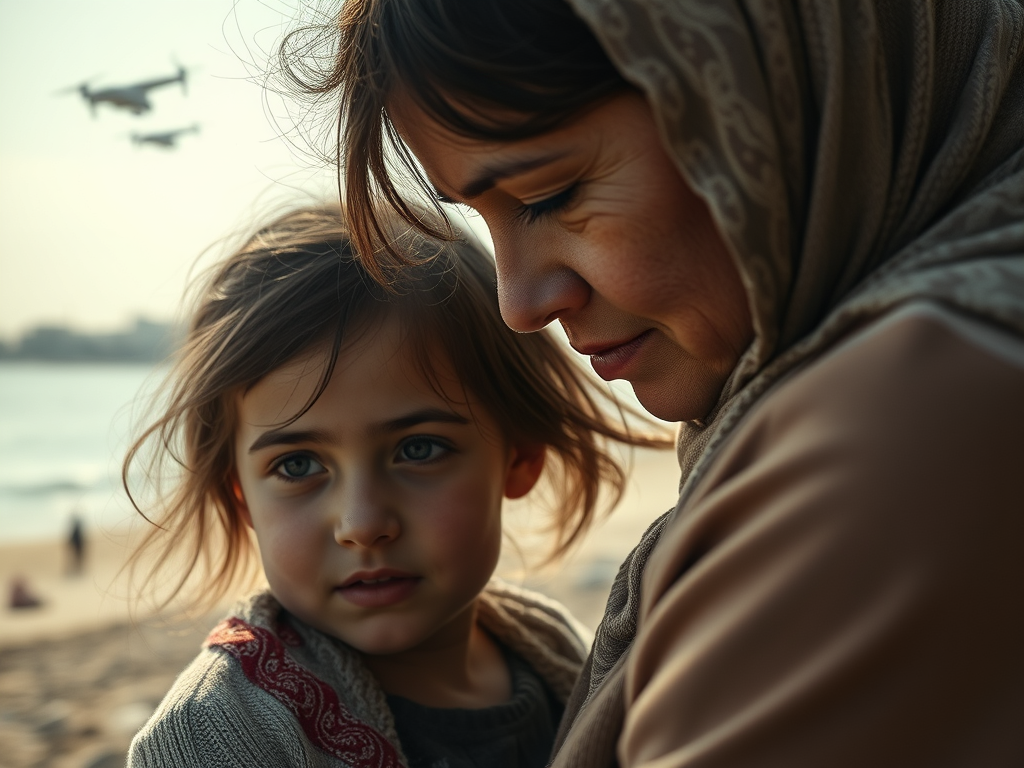

For one Ukrainian family, the promise of Israel was a lifeline — an escape from the ravages of war.
To Mariia Pieshkurova, Israel represented hope — a place where her 7-year-old daughter, Anastasiia, could receive critical treatment for advanced leukemia. In war-torn Ukraine, such medical care had become increasingly difficult to access. For Anastasiia’s two young cousins, Kostiantyn and Illia, the country offered a haven from the nightly barrages of missiles and drones that had become a terrifying routine back home.
They Escaped War in Ukraine. It Found Them in Israel.

So Mariia, her daughter Anastasiia, her nephews, and their grandmother sought refuge in Bat Yam, a coastal city just south of Tel Aviv, hoping to build a new life away from danger.
But in a tragic twist of fate, the war they had tried to escape found them once again.
On June 15, a missile fired from Iran struck their residential building in Bat Yam. All five members of the family — Mariia, Anastasiia, her grandmother Olena, and the two boys — were killed. The attack was part of a rapidly intensifying conflict between Israel and Iran, one that had grown to include direct missile exchanges. The deaths sent shockwaves through Ukraine, sparking both mourning and outrage.
This tragedy humanized the intersection of two separate but geopolitically linked wars — one in Ukraine and one in the Middle East. While these conflicts have often been viewed through the lens of international diplomacy and military alliances, the deaths of the Pieshkurova family served as a painful reminder of their human cost. Iran, a key supplier of drones to Russia in the early stages of its invasion of Ukraine, has long received political and military support from Moscow.
The incident also carried a haunting irony: the family had sought sanctuary in a nation known for its superior air defense — a system Ukraine has long aspired to emulate. Yet it was in this perceived safe haven that they met the same fate they had tried so desperately to avoid.
“I truly believed they would be safe there,” said Artem Buryk, Anastasiia’s father and Mariia’s former partner. “I never imagined that they would flee from war in Ukraine only to be caught in one in Israel.”
Buryk, a 39-year-old volunteer soldier in the Ukrainian military, had been fighting to defend his country against Russia’s full-scale invasion, which began over three years ago. Like many other Ukrainian fighters, he had hoped his family would be shielded from the horrors of war by seeking safety abroad.
He received the heartbreaking news of his daughter’s death on the same day it happened, just after returning from the front lines near Sumy in northeastern Ukraine — one of the most active battle zones at the time. “I still can’t process it,” he said in a phone interview last week. “I’m struggling to believe this is real.”

When the war began in early 2022, Anastasiia and Mariia were living in Odesa, the Ukrainian port city on the Black Sea. Life was increasingly disrupted by conflict, yet the pair tried to maintain a sense of normalcy. Anastasiia would ride her scooter through the city’s streets and wear her favorite red-striped Minnie Mouse shirt in the summer heat. Her mother documented these moments on Instagram, even celebrating Anastasiia’s fifth birthday outdoors despite the looming threats of war.
But that same summer, Anastasiia fell ill with a persistent fever. Soon after, she was diagnosed with leukemia. During a hospital visit that September, Buryk recalled seeing his daughter in bed wearing his military cap and flashing a victory sign — a tiny gesture of strength amidst her ordeal.
As her condition worsened, the family explored transferring her to Kyiv’s Okhmatdyt Children’s Hospital — Ukraine’s largest pediatric facility — which was eventually destroyed in a Russian missile strike. But the availability of cancer treatment had become severely limited as hospitals focused on treating war-related injuries. Hoping for better options, the family turned to Israel, renowned for its advanced medical system.

In December 2022, Mariia, Anastasiia, and her grandmother relocated to Bat Yam, joining a growing community of Ukrainians seeking refuge. According to Ukraine’s ambassador to Israel, approximately 20,000 Ukrainians had made similar journeys by that time.
Anastasiia’s treatment began immediately, but the costs were overwhelming. Mariia used social media to appeal for financial support, sharing photos of her daughter — pale, often bald from chemotherapy — lying in hospital beds. Sometimes, Buryk would appear in videos from the front lines, fully geared in military attire, pleading for donations during short breaks from combat.
“Masha gave everything for her daughter,” said Khrytsyna Chanysheva, Anastasiia’s godmother, referring to Mariia by her nickname. “She completely devoted herself to saving her child, even moving across borders for her care.”
Despite the painful procedures, Anastasiia endured with remarkable resilience. “Every time I walked into her room, she would smile,” said Lada Fichkovsi, a charity worker who assisted the family in Israel. “Even through the pain, she would close her eyes briefly — and still smile.”
In May of the following year, Anastasiia’s world brightened with the arrival of her cousins Illia, 14, and Kostiantyn, 10. Odesa, which had initially been relatively spared from the worst of Russia’s assault, had become a frequent target of missile attacks.
“The constant shelling had left my children traumatized,” said Hanna Pieshkurova, Mariia’s sister and the boys’ mother. “They cried every night. That’s when I decided to send them to Mariia.”
By then, Israel itself was embroiled in escalating violence. Its ongoing conflict with Hamas meant that cities frequently faced rocket attacks. But Mariia had reassured her sister that Bat Yam was largely peaceful. “She told me the sirens had only gone off once or twice. That it was safe and calm. The shelters there were much better,” Hanna recalled.
Adding to this sense of security was Israel’s Iron Dome — a sophisticated missile interception system capable of neutralizing many incoming threats. Ukrainians have long admired the technology, hoping one day to replicate its effectiveness.

“Many Ukrainian families thought, ‘This isn’t like home. It’s much safer here,’” said Inna Bakhareva, director of Chance4Life, a nonprofit that supports families of seriously ill children receiving treatment in Israel. “They trusted the Iron Dome. They genuinely believed Israel was a place where danger could be avoided.”
But the illusion of safety shattered after Israel launched a surprise air assault on Iranian targets, prompting a massive retaliation from Tehran. Suddenly, the war was no longer a distant issue.
In a voice message to her father on the night of June 14, Anastasiia described what she had witnessed: “Dad, I saw the missiles falling.”
The next morning, she and her mother were scheduled for a hospital visit to plan the next steps in her treatment. But they never got there.
In the early hours of June 15, an Iranian missile hit their apartment building, causing catastrophic destruction. It took rescue teams four days to recover and identify Mariia’s body from the rubble.
For Hanna Pieshkurova, the loss is almost unfathomable: her mother, her two children, and her sister — all gone in an instant. For Artem Buryk, the heartbreak of losing both his former partner and his only daughter is immeasurable.
“Whenever I spoke to her, I’d promise, ‘Sweetheart, we’ll go fishing together. Just us two,’” he said. “That’s all we ever talked about — fishing. Now I can’t even begin to comprehend that she’s gone. Just last night, I sent her another voice message.”





Leave a Reply