
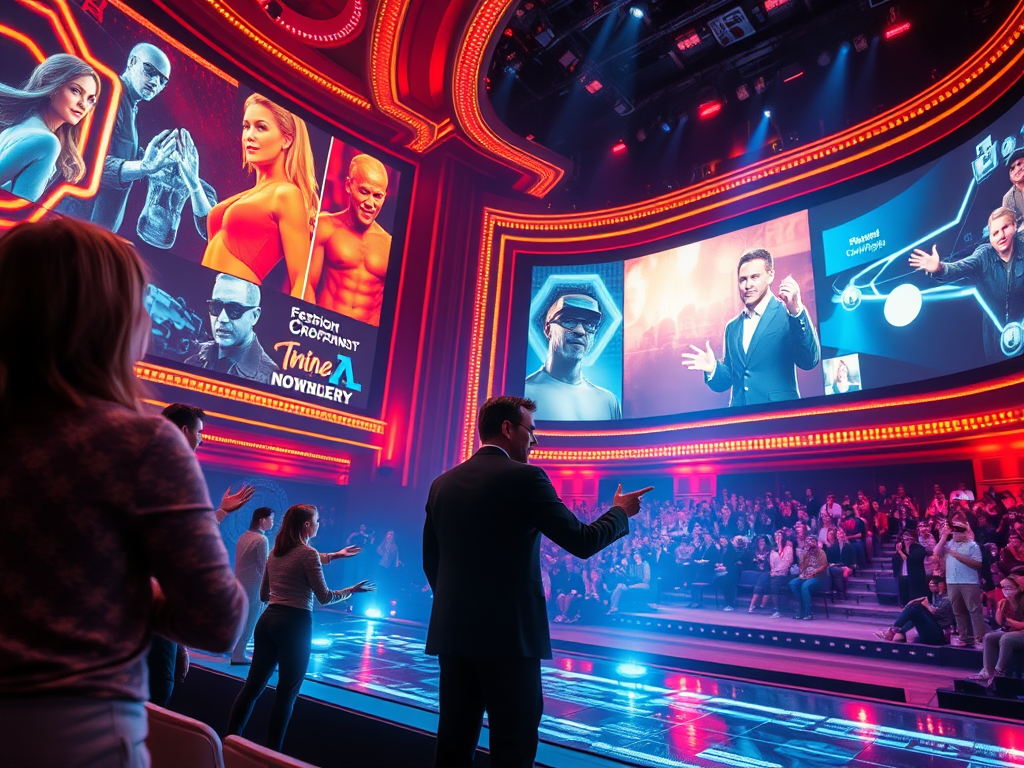

On today’s Broadway, technology is not just an accessory—it’s fast becoming the main event. Audiences are seeing Sarah Snook project selfies through augmented reality filters, Nicole Scherzinger filmed live as if on a movie set, George Clooney broadcasting in a television-style production, and Robert Downey Jr. acting alongside a digital double.
Broadway’s Season of Screens

This is no longer an occasional novelty. Over the past year, Broadway has increasingly embraced cutting-edge visual effects—giant screens, real-time video feeds, high-definition projections—not simply as flashy stage backdrops, but as active participants in storytelling. Thanks to improvements in camera gear, computer processors, projection technology, and stage surfaces, immersive visuals are now easier to integrate, more affordable, and far more stable, enabling directors and designers to push the boundaries of traditional theater.
What’s happening on stage mirrors a broader shift in society. As digital screens dominate our daily lives—from smartphones and smartwatches to car dashboards and supermarket checkout displays—it’s only natural that live performance would absorb and reflect this change. The stage is catching up with the screen.
Designer Jake Barton, who worked on last year’s production of McNeal, sees this trend as part of theater’s natural evolution. In that play, Robert Downey Jr. portrayed a novelist whose relationship with generative AI was embedded into the production’s visual design. “Americans spend most of their waking hours looking at screens,” Barton noted. “It only makes sense that theater, a reflection of life, would follow suit.”

Just weeks ago, the Tony Awards celebrated several productions that leaned heavily into digital storytelling. Maybe Happy Ending, which follows the journey of two robots reliving their digital memories, took home the Tony for Best Musical. Meanwhile, Sunset Boulevard won Best Musical Revival, partly for its innovative use of handheld camera rigs operated by actors to broadcast live footage onto a massive screen—turning the audience into moviegoers mid-performance. And Eureka Day, honored as Best Play Revival, became a crowd favorite for a scene where live chat comments from a fictional school board Zoom meeting were hilariously projected above the actors.
Darren Criss, who portrayed one of the robots in Maybe Happy Ending, acknowledged how these changes reflect modern habits. “The audience gets to decide where to look—that’s the beauty of theater,” he said. “And let’s face it, we’re already talking to screens all day. Adding another one onstage isn’t a big leap.”
Still, not everyone is convinced this digital turn is a good thing. Critics have voiced concerns about the overwhelming presence of screens. In his review of Sunset Boulevard, New York Times chief theater critic Jesse Green noted that the towering 23-foot screen displaying live video nearly eclipsed the live action on stage. Similarly, television critic James Poniewozik wrote that watching Good Night, and Good Luck—which starred George Clooney—felt more like watching a television broadcast than a play, as audiences focused more on the magnified screen image than the actor himself.
Wendall K. Harrington, a trailblazer in projection design and a recent recipient of a Tony honor for lifetime achievement, expressed her own reservations. “I don’t want to sound like the curmudgeon in the room,” she said, “but some of it feels more like a grab for attention than thoughtful storytelling. It’s flashy, but not always deep.”
Yet in some productions, the use of digital effects is not only justified—it’s essential. Good Night, and Good Luck, which explores the golden age of broadcast journalism, takes place within a fully realized TV studio set, complete with 26 functional screens. And in a twist of modern media synergy, the stage adaptation of a film about television was livestreamed by CNN, blurring the lines between performance and broadcast.

Sunset Boulevard, centered on the decline of a silent film star, integrates cinematic techniques in a thematically fitting way. Cameras track Scherzinger’s performance closely, magnifying her image on screen in real-time. “My director never let me watch the footage,” Scherzinger revealed. “I’ve only seen stills in the press. That helped me stay in the moment and not get distracted by my own close-ups.”
Other productions go further, turning digital tech into a narrative element. In Maybe Happy Ending, the robots’ emotional journeys are intertwined with projections of their stored digital experiences. McNeal delves into a writer’s dependence on AI. And in a modern retelling of Oscar Wilde’s The Picture of Dorian Gray, Sarah Snook portrays every character in a play that reimagines the cursed portrait as a digital rendering, placing digital media at the heart of the story.
Even Redwood, a musical featuring Idina Menzel, used LED walls to shift perspectives on a forest setting, giving audiences a dynamic, immersive experience that traditional sets could not replicate.
For Jere Harris, executive chairman of entertainment technology company PRG, these changes are more than aesthetic—they’re necessary. “Younger audiences grew up on TikTok and Instagram. Their way of consuming stories is different,” he said. “If theater wants to stay relevant, it needs to adapt. And with more young designers entering the field, we’re going to see that happen even faster.”
Surprisingly, despite the increasing reliance on digital visuals, the Tony Awards have yet to introduce a category for projection design. Video and projection artists must negotiate to be included in either the scenic or lighting design categories. This year, both Best Scenic Design in a Musical and a Play were shared by traditional and video designers: Dane Laffrey and George Reeve for Maybe Happy Ending, and Miriam Buether and the collective 59 Productions for Stranger Things: The First Shadow.

A coalition of designers is now lobbying for the Tonys to formally recognize projection design. In an open letter, they emphasized that doing so would honor “a vital storytelling medium that resonates strongly with new generations of theatergoers.”
Theater has always embraced innovation. From the ancient Greeks using rotating platforms and aerial lifts, to 20th-century experiments with projected scenery, artists have long sought ways to heighten dramatic impact through new tools. The avant-garde Wooster Group pioneered live camera use decades ago, and recent visionaries like Ivo van Hove have made video central to their theatrical language.
What’s different now is the quality—and accessibility—of the technology. Derek McLane, a seasoned Broadway designer, recalled experimenting with video in the late 1970s. “Back then, the equipment was so clunky—huge cameras, awful projectors, tons of wires. It was hard to do anything subtle,” he said. “Now, we have media servers that can handle complex visuals in real time, tiny high-resolution cameras, and crisp LED screens. It’s a completely different level.”
Affordability has improved as well. “LED screens used to be far too expensive for theater,” said Ben Pearcy, the video designer behind Stranger Things. “Big stadium tours adopted them first. As the price dropped, theater productions could finally catch up.”

The gaming industry has also helped, providing server technology that enables smooth, real-time visual transitions. But Broadway isn’t always the testing ground. According to David Bergman, video designer for The Picture of Dorian Gray, experimentation often begins in subsidized venues. That production originated in Australia, where live and filmed elements were first synchronized before being brought to London and eventually Broadway. For Snook, familiar with the camera intimacy of HBO’s Succession, the transition to blending live action and screen work was seamless.
As for what lies ahead, even the experts aren’t sure. Projection designer David Bengali, who worked on both Eureka Day and Good Night, and Good Luck, believes the field is still evolving. “Technology will always change,” he said. “But the real challenge is in how we use it. With all the incredible things video can do, we must not lose sight of the human element—because ultimately, audiences come to the theater for a connection, not just a spectacle.”
In this rapidly changing landscape, one thing is clear: screens aren’t just invading the stage—they’re becoming a fundamental part of it. The question for the future isn’t whether Broadway will embrace technology, but how it will maintain the balance between digital dazzle and timeless storytelling.at balance between all the things that technology can do and the human scale of the events and the stories that people are coming to see.”




Leave a Reply