
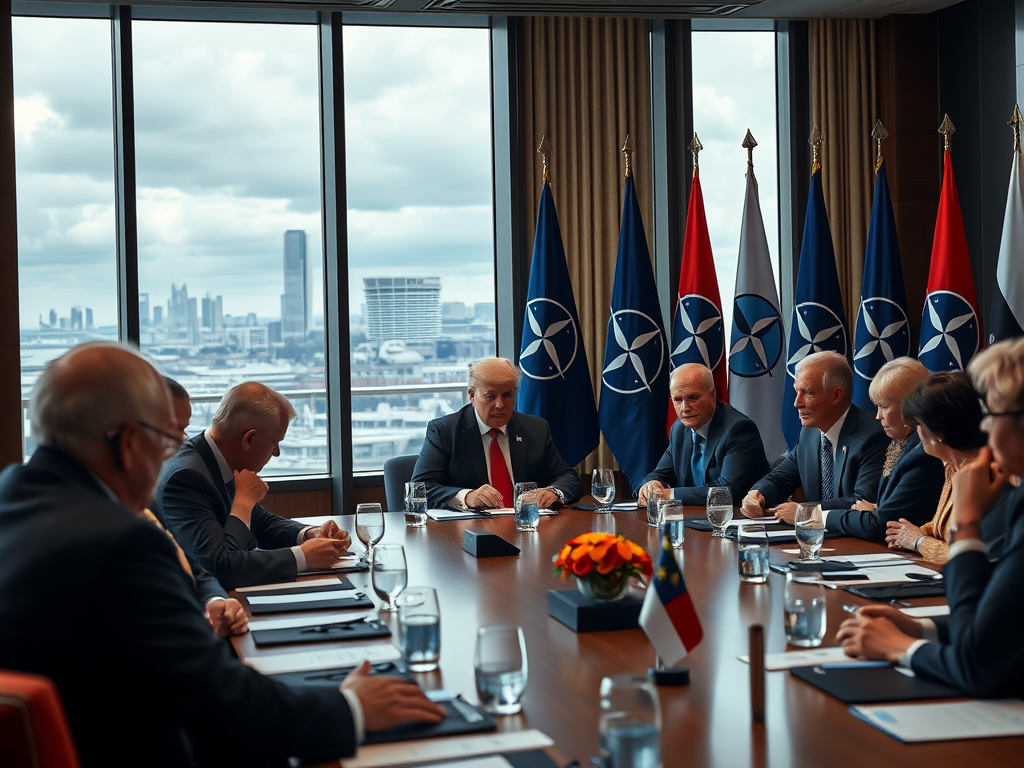

A Show of Unity May Be the Best NATO Can Hope for at Its Summit

NATO convened a high-level summit on Tuesday amid a complex geopolitical landscape, as attention is increasingly drawn to escalating tensions in the Middle East. The recent conflict between Israel and Iran, and the tentative cease-fire reportedly brokered the night before by former President Donald Trump, has overshadowed NATO’s ongoing concerns with the war in Ukraine. This cease-fire is expected to dominate conversations throughout the meeting, temporarily pushing the topic of Russia’s ongoing invasion of Ukraine into the background. Although the alliance was originally formed to address threats closer to home, the Middle Eastern conflict now occupies much of its focus, shaping the tone and priorities of this year’s summit.
Despite the pressing developments abroad, NATO must still grapple with internal issues, particularly surrounding defense spending among member states. The summit, held in The Hague, Netherlands, was initially expected to reinforce alliance unity. However, disagreement over military budget commitments threatens to undermine this goal. President Trump, who arrived at the summit after announcing the proposed cease-fire between Israel and Iran, expressed hope that this development might help ease tensions among NATO members and foster a more unified stance. Some analysts, such as Liana Fix of the Council on Foreign Relations, even suggested that this unexpected turn of events might serve as a helpful distraction from the alliance’s internal disputes, potentially easing the pressure on divisive topics.

Nevertheless, confusion remains over whether the cease-fire between Israel and Iran has effectively taken hold. In a post on Truth Social, Mr. Trump hinted that hostilities may have continued despite the agreement, casting doubt on its success. As he prepared to join NATO leaders, he remarked that even if the cease-fire was not fully in place, the situation he had just left behind was more volatile than the one he was entering, suggesting that the NATO summit would be relatively calm by comparison. He voiced optimism that progress could be made during the gathering.
NATO Secretary General Mark Rutte, known for his pragmatic and diplomatic leadership, downplayed the idea that the Middle East conflict would derail the summit’s agenda. He emphasized that the alliance should be capable of managing multiple global crises simultaneously. According to Rutte, failing to handle both the Israeli-Iranian cease-fire and the situation in Ukraine would indicate a failure in NATO’s broader political and military responsibilities. However, despite Rutte’s confidence, concerns lingered that the summit might not proceed as smoothly as planned, especially given the unresolved tensions among member nations regarding shared defense commitments.
Further complicating matters, Mr. Trump refrained from explicitly affirming his support for NATO’s foundational Article 5 — the mutual defense clause stipulating that an attack on one member is considered an attack on all. When questioned by reporters, he gave an ambiguous response, saying that it “depends on your definition.” Although he reassured that he had forged strong relationships with many NATO leaders and remained committed to aiding them, the lack of a clear endorsement of Article 5 introduced further uncertainty into the summit proceedings.
One of the more contentious topics was Mr. Trump’s proposal that all NATO members increase their defense spending to 5 percent of their gross domestic product, a substantial leap from the current 2 percent benchmark. While some allies had already agreed to significantly boost their military budgets, including investments in air defense systems, fighter jets, tanks, drones, and troop deployments, the specifics of financing these enhancements remained unresolved. Trump argued that a 5 percent defense spending threshold would empower Europe and strengthen its strategic position, but this proposal was met with resistance by some leaders.
Spain’s Prime Minister Pedro Sánchez publicly rejected the 5 percent target, stating that his country would allocate precisely 2.1 percent of its GDP to defense and no more. He explained that exceeding this level would be incompatible with Spain’s commitment to maintaining its welfare state and broader social priorities. Trump criticized this stance, calling it unfair to other nations that were willing to meet the proposed target. Sánchez’s office later released a statement clarifying that not all NATO members would be bound by the 5 percent figure, suggesting a lack of consensus. Despite this, Rutte maintained confidence that the alliance would eventually support the higher target, stating that there should be “no opt-out” clause for any country. Experts such as Matthew Kroenig from the Atlantic Council proposed that ambiguity in the timeline for achieving the 5 percent goal could facilitate broader agreement. However, he also cautioned that if exceptions were made for some countries, others would likely demand similar flexibility, potentially undermining the proposal’s effectiveness.

Meanwhile, the summit’s attention to Ukraine appears significantly diminished compared to previous years. In contrast to the past three NATO summits, which prominently featured Ukraine following Russia’s 2022 invasion, this year’s meeting offers limited focus on the embattled country. President Volodymyr Zelensky of Ukraine is expected to attend a dinner with other heads of state, while foreign ministers will conduct consultations on battlefield developments. However, major new pledges of military aid from NATO nations are not expected, nor are there plans to revisit Ukraine’s potential membership in the alliance.
Nevertheless, European and Canadian allies have already contributed approximately $35 billion in military aid to Ukraine this year, as Rutte noted. This figure represents substantial progress toward a broader goal of $50 billion in security support by 2025. Kurt Volker, a former U.S. ambassador to NATO and special envoy to Ukraine during the Trump administration, observed that Ukraine is receiving less attention at this summit because European leaders and the Trump administration hold differing views on the risks posed by Russia if Ukraine were to lose its sovereignty. This divergence in perspectives has made Ukraine a less unifying topic than it was in past gatherings.
The combination of disagreements over defense spending and the reduced focus on Ukraine has raised broader concerns about the strength and cohesion of the NATO alliance. Critics are questioning the current level of U.S. commitment to European defense, especially under a potential second Trump presidency. Reports suggest that the Pentagon is reevaluating troop deployments around the globe, a process that may eventually result in the withdrawal of thousands of personnel from NATO’s eastern front. A final decision is expected in the coming months. According to Michael R. Carpenter, a former White House official responsible for European affairs under President Biden, confidence among European leaders in America’s commitment to Article 5 has noticeably eroded over the past year.

Moreover, some NATO members are beginning to question the relevance of the alliance itself. Italy’s defense minister, Guido Crosetto, recently suggested that NATO must reassess its strategic objectives in light of changing global conditions. In his words, the alliance in its current form “doesn’t have reason to exist,” highlighting a growing sentiment among some members that the organization needs to evolve.
Despite these challenges, Secretary General Rutte remains hopeful. He expressed confidence that the threat posed by Russia would ultimately serve as a unifying force among NATO members. Addressing concerns about waning U.S. support, Rutte advised his European counterparts not to panic. In his view, the United States remains firmly committed to the alliance and continues to stand alongside its allies. His message was simple but firm: unity may be tested, but NATO’s foundation remains intact.s is, stop worrying so much,” he said on Tuesday. “They are there. They are with us.”




Leave a Reply