
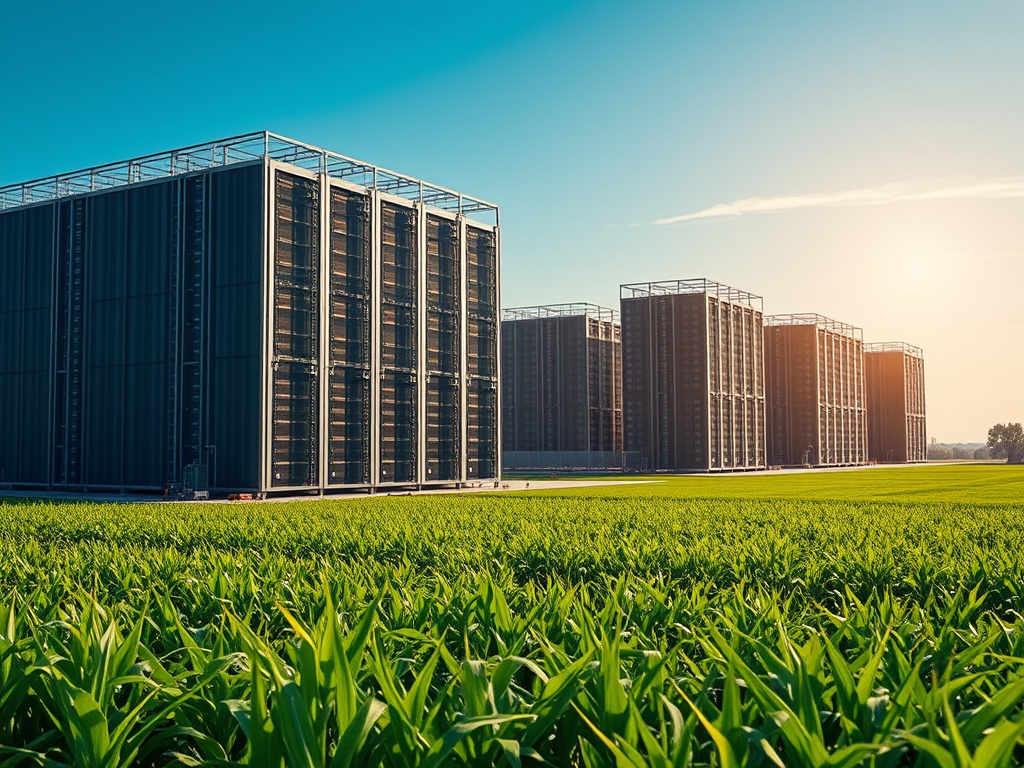

At Amazon’s Biggest Data Center, Everything Is Supersized for A.I.

Just a year ago, the vast farmland near New Carlisle, Indiana—spanning 1,200 acres—was nothing more than rows of corn swaying in the breeze. Today, that same expanse has been dramatically transformed. Towering over the soil now stand seven massive data centers built by Amazon, each one covering more space than a football stadium.
This is only the beginning. Amazon has announced its intention to construct approximately 30 data centers at this location in the coming years. These facilities will house hundreds of thousands of high-performance computer chips, all connected through hundreds of thousands of miles of fiber-optic cables. The result will be a unified computing system of unprecedented scale, designed specifically to support artificial intelligence operations.
To power such a colossal digital infrastructure, the complex will draw an enormous 2.2 gigawatts of electricity—enough to sustain a million homes. Cooling these chips will require millions of gallons of water annually to prevent overheating. Importantly, the entire undertaking was created with a single client in mind: Anthropic, an AI startup focused on developing a system that rivals the capabilities of the human brain.
This development represents the first in a new breed of mega data centers being rolled out by Amazon under an initiative known as Project Rainier, named after the iconic mountain near the company’s Seattle headquarters. While the Indiana facility is the flagship site, additional locations are planned in Mississippi, and possibly in other states such as North Carolina and Pennsylvania.
Project Rainier marks Amazon’s major move into a high-stakes race among tech giants to build data centers of a scale that would have seemed unimaginable just a few years ago. Meta, the parent company of Facebook, Instagram, and WhatsApp, is constructing a two-gigawatt facility in Louisiana. Meanwhile, OpenAI is developing a 1.2-gigawatt data center in Texas and is working on another similarly sized site in the United Arab Emirates.

These new-generation data centers far outstrip older facilities, most of which predate the release of ChatGPT in late 2022—a key moment that ignited today’s AI boom. The exponential growth in AI capabilities demands an equally massive leap in infrastructure. Advanced artificial intelligence systems rely on immense networks of custom-built chips and the data centers to support them—investments totaling hundreds of billions of dollars. The resulting facilities push the limits of electrical grids and are reshaping how the world views the role of computers.
Amazon, which has committed $8 billion to support Anthropic, will lease computing capacity from this vast infrastructure to its startup partner. Tom Brown, a co-founder of Anthropic who oversees its partnership with Amazon, explained that the co-location of so much computing power opens the door to training large-scale AI models in one centralized location.
“If you want to run a massive training session,” he said, “you can do that here.”
The journey to this point has taken Amazon nearly a decade. In 2015, the company acquired Annapurna Labs, an Israeli chip-design firm. A year later, work began at a lab in Austin, Texas, where Annapurna—operating independently within Amazon—started designing AI-focused chips.
The first product, called Inferentia, saw limited adoption. But chip development is a long-term endeavor. Annapurna has since released a new chip, Trainium 2, developed in close collaboration with Anthropic’s engineers. It’s specifically optimized for the scale and design of facilities like the one in New Carlisle.
“This has been a long road,” noted Gadi Hutt, a senior director at Annapurna Labs responsible for customer and product engineering.
Although Amazon’s chips don’t rival the complexity or raw power of Nvidia’s leading-edge AI chips, the company believes its approach offers a competitive edge. By integrating more of these simpler chips into each data center, Amazon can deliver high performance while maintaining energy efficiency.
“If the performance meets our customers’ needs,” Hutt explained, “there’s no need for exotic engineering that adds complexity and delays.”
Amazon is no newcomer to building data centers. For over 18 years, the company has constructed facilities to support its vast online retail operations and cloud computing services. However, the pace has accelerated significantly in the wake of ChatGPT’s release. Prasad Kalyanaraman, a vice president at Amazon, said AI-focused expansion has increased “pretty significantly,” speaking from a construction site trailer in Indiana.

Shortly after ChatGPT took the world by storm in late 2022, Amazon began exploring potential sites for a major AI infrastructure project. Discussions with electrical providers led them to farmland about 15 miles west of South Bend, Indiana—land that had recently been rezoned for industrial use. By May 2023, over a dozen Amazon staff members had toured the site.
By early 2024, Amazon had secured ownership of the land, still covered in corn and soybeans at the time. Indiana legislators approved a 50-year sales tax exemption for the project, potentially saving Amazon around $4 billion, according to the Citizens Action Coalition. Additional property and technology-related tax incentives could provide another $4 billion in savings over the next 35 years.
The final cost of the data center project remains uncertain. Amazon initially committed to investing $11 billion to construct 16 buildings, but the current plan now involves nearly doubling that number. The final count will depend, in part, on whether Amazon is permitted to build on a 10-acre wetland within the site—an idea facing strong local opposition. The company argues that the area is a minor, shallow wetland and not an ecologically significant preserve.
To accelerate the construction timeline, Amazon enlisted four general contractors to work in tandem across the site.
“It’s like a race,” said Bill Schalliol, a local economic development official. “One day they’re putting up steel here, the next it’s rising over there.”


According to Schalliol, around 4,000 workers are on site in any given week. The influx has filled nearby hotels and strained local roads, prompting Amazon to pay $120,000 for increased traffic enforcement and an additional $7 million toward road infrastructure upgrades.
Massive amounts of underground work have been necessary as well, including laying fiber optics and water management systems. Amazon applied for a permit allowing it to pump up to 2.2 million gallons of water per hour over a two-year span to dewater the site. This process is now under investigation by state officials after nearby residents began reporting their wells had dried up.
Community concerns extend beyond water. Residents have voiced frustration over the increased noise, traffic, and rapid changes to the landscape. Some are particularly upset over the potential loss of the small wetland.
“You can see the dirt piled up, ready to be pushed into that wetland,” said Dan Caruso, a retired mailman from New Carlisle, pointing to a line of tall trees bordering the construction site. “That’s a habitat for wildlife.”
By early June, seven buildings had been completed, with an eighth underway and a ninth set to rise where a temporary parking lot currently sits.

Amazon’s strategy differs from that of companies like Google, Microsoft, and Meta, which use more powerful—but energy-intensive—chips that require advanced cooling systems. Instead, Amazon opts for smaller chips that can be cooled more simply, using large air handlers and municipal water during hotter months. This design allows more of the facility’s energy to be devoted directly to AI computations.
Kalyanaraman explained that this setup maximizes efficiency, allowing Amazon to get the most out of the electricity it uses.
American Electric Power (AEP), which services the region, has informed regulators that rising demand from data centers will more than double Indiana’s peak power requirements—from 2.8 gigawatts in 2024 to over 7 gigawatts by 2030. Amazon’s project alone accounts for roughly half of that growth.

“It’s going to be the single biggest electricity user in the state—by far,” said Ben Inskeep of the Citizens Action Coalition.
To meet that demand, AEP expects to rely on natural gas for about 75% of the additional electricity needed by the end of the decade.
As Amazon rapidly scales this operation, some observers are questioning whether the astonishing pace of AI advancement can continue. While a few studies suggest progress may be slowing, Kalyanaraman is confident that the infrastructure will remain useful.
While Anthropic’s current plan is to train AI systems using this facility, the space can easily pivot to other functions if necessary.
“We’re building such a large amount of infrastructure that using it only for training wouldn’t be efficient,” Kalyanaraman said. “We anticipate it’ll serve multiple purposes over time.”




Leave a Reply