

Arkansas May Not Be Ready for a ‘Healing’ Anti-Abortion Monument

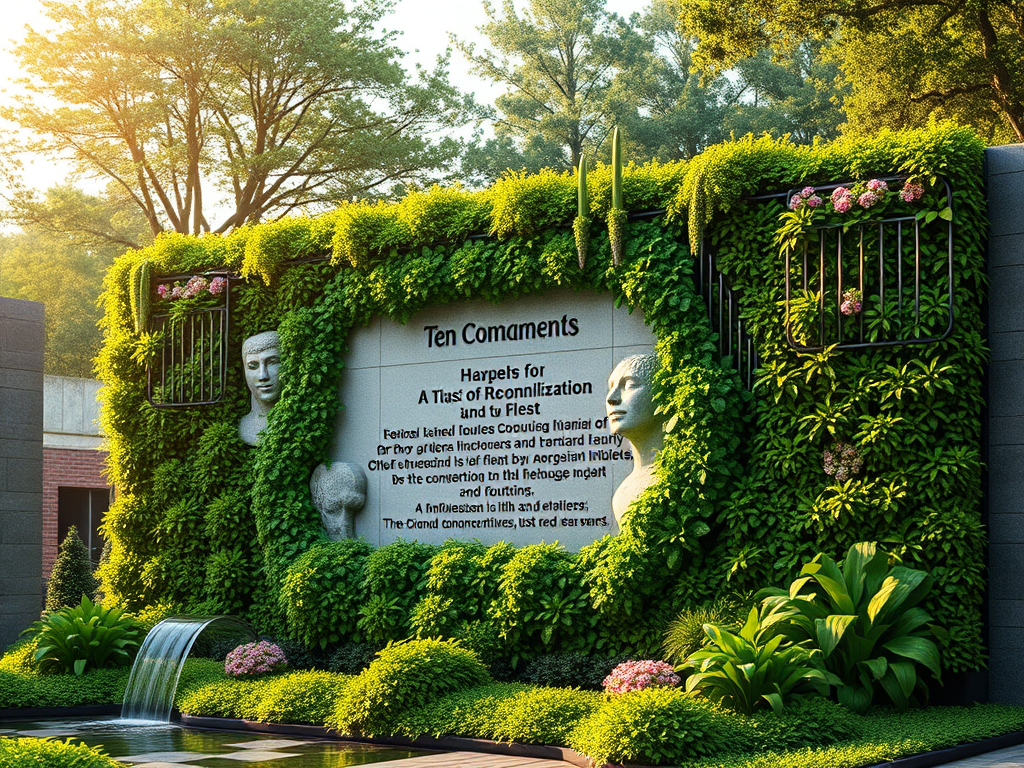
On the grounds of the Arkansas State Capitol, just behind a prominent stone slab engraved with the Ten Commandments, a grassy patch of land has been earmarked for a second state-supported installation. This future monument, envisioned as a long, living wall covered in lush greenery, has been designated the “Monument to Unborn Children.”
In 2023, a public design contest resulted in the selection of an unconventional memorial concept by artist Lakey Goff. Her proposal diverged significantly from more graphic entries portraying fetuses or infants. Instead, Goff’s design called for a wall composed of 1,400 plants, accompanied by a verse from the Bible and the ambient sound of waterfalls from around Arkansas. She referred to her idea as a “living wall,” one meant to foster healing and reconciliation following decades of fierce national debate over abortion.
“We’re not enemies anymore,” Goff told members of the state commission who ultimately approved her vision. “This is about moving forward and finding peace.”
Yet the monument has not yet materialized, despite a scheduled start months ago. One key reason is that the political and social turmoil surrounding abortion in the United States — and in Arkansas in particular — has not subsided. Even in a deeply conservative state, division and resentment persist, three years after the U.S. Supreme Court revoked the constitutional right to abortion. The notion of collective healing remains out of reach.
For many years, Arkansas has been recognized by the anti-abortion group Americans United for Life as the most “pro-life” state in the country. When Roe v. Wade was overturned on June 24, 2022, Arkansas quickly enacted one of the most stringent abortion bans in the nation. The law prohibits the procedure in nearly all circumstances, offering no exceptions for cases of rape or incest.
Despite this, in 2023, supporters of abortion rights mobilized across the state, gathering over 100,000 signatures in support of a ballot initiative that would have restored abortion access up to 18 weeks into pregnancy. Opponents of the initiative labeled it extreme and launched a vigorous “decline to sign” campaign to dissuade voters from backing the measure.
Ultimately, procedural issues derailed the campaign. The then-secretary of state rejected the initiative, stating that organizers had not submitted the necessary paperwork. This decision was upheld by the Arkansas Supreme Court.

In the most recent legislative session, which concluded in late April, the Republican-controlled legislature passed new laws that tighten requirements for placing initiatives on the ballot. Many of these lawmakers claimed that the previous signature-gathering process had been marred by fraud.
The League of Women Voters in Arkansas has challenged these laws in court, arguing that they effectively kill the possibility of direct democracy in the state. Ezra Smith, a lawyer based in Fayetteville who worked on the 2023 initiative, said supporters are likely to try again, aiming for a place on the 2026 ballot.
Meanwhile, the focus has shifted away from the living wall project. By law, the monument must be funded entirely by private donations. As of late April, less than $20,000 had been raised — a small fraction of the estimated $950,000 needed for construction. For many anti-abortion advocates, pressing political fights have taken precedence over symbolic tributes.
State Senator Kim Hammer, a Republican and one of the lawmakers behind the monument legislation, acknowledged the shift in priorities. “The ballot campaign really consumed a lot of attention,” he said.
This has left much of the burden for fundraising on Goff herself. A native Arkansan, Goff was working in a flower shop when she says she received divine inspiration for the wall’s design.
Over the years, Goff has navigated both liberal and conservative cultural spaces in Arkansas. She was once known in progressive circles in Little Rock for her artistic endeavors, yoga instruction, and spiritual readings. At the time, she had little interest in the abortion issue. But before the contest, she experienced a religious reawakening and recommitted to the Christian faith she grew up with, taught by her missionary parents.

While she gave an interview to The New York Times in June 2024, she has since declined further media inquiries. In recent months, Goff has appeared at faith-based gatherings and Christian talk shows, presenting her wall as the culmination of a personal journey toward redemption.
On a religious podcast earlier this year, she described the memorial as a space for emotional restoration. “It’s about healing — for mothers, for families, even for fathers who have experienced the loss of a child through abortion,” she said. “There’s so much pain — the guilt, the shame, the grief.”
Arkansas Governor Sarah Huckabee Sanders, who previously served as White House press secretary during Donald Trump’s administration, signed the bill authorizing the monument in March 2023, shortly after taking office. The legislation passed swiftly through the GOP-majority statehouse, though not without some internal reservations.
Some Republican lawmakers voiced concern about the message the monument might send. Representative Steve Unger, a Baptist minister who personally opposes abortion, questioned whether the display might be interpreted as an insensitive victory lap. “Memorials for wars against external enemies are appropriate,” he said. “But creating a monument in the middle of a culture war — one that still deeply divides our society — may only provoke more hostility.”
Critics on the left mocked the design competition itself, predicting it would result in distasteful or garish outcomes. Satirically, Arkansas Times editor Austin Gelder proposed ideas like a transparent statue of a pregnant woman with a fetus inside, or sperm and egg meeting under divine light.

On December 12, 2023, nine submissions were reviewed by the state’s Capitol Arts and Grounds Commission, which consists of nine members. Among the proposals were a depiction of an empty tomb and another showing a fetus, blindfolded and dangling from an umbilical cord.
Architect Tony Leraris, a member of the commission, said Goff’s vision was the “least provocative” among the options. Goff herself pointed out that living memorials like hers had received public support elsewhere, such as the green wall installed near the 9/11 Memorial in Manhattan.
Speaking to The New York Times last year, Goff explained that her wall was meant to honor not only unborn children, but also all people who are alive and breathing. However, not all of her public statements have been conciliatory. On one podcast, she described Roe v. Wade — the former legal foundation of abortion rights — as “a death covenant with the enemy.”
As the project faces logistical challenges, Goff has emerged as its most vocal champion. She has confronted practical concerns during commission meetings, including how the plants will be maintained over time and protected from damage.
Leraris, who is conflicted about the abortion debate, raised concerns this spring about potential acts of vandalism. Emotions still run high, he noted, citing an earlier incident when someone deliberately destroyed the Ten Commandments monument at the Capitol by crashing a car into it. “What’s to stop someone from poisoning all the plants?” he said. “It’s like when people torch Teslas out of spite for Elon Musk.”

Although the American Civil Liberties Union of Arkansas previously filed a federal lawsuit challenging the Ten Commandments monument on church-state separation grounds, its president Christine Althoff said they have no current plans to contest the new memorial. Still, she acknowledged that the inclusion of a Bible verse could spark legal challenges related to the First Amendment.
State Representative Stephen D. Bright, who chairs the grounds commission, said he is currently working on revising the plan to reduce construction costs, aiming to bring the total budget down to roughly $700,000.
As for Leraris, he wonders if a simpler solution might be best. “Maybe just a plaque would be easier,” he said.Stephen D. Bright, the chair of the grounds commission, said he was hoping to tweak the design of the wall to bring the cost down to about $700,000.
Mr. Leraris has wondered if it might be easier to put up a simple plaque.




Leave a Reply