
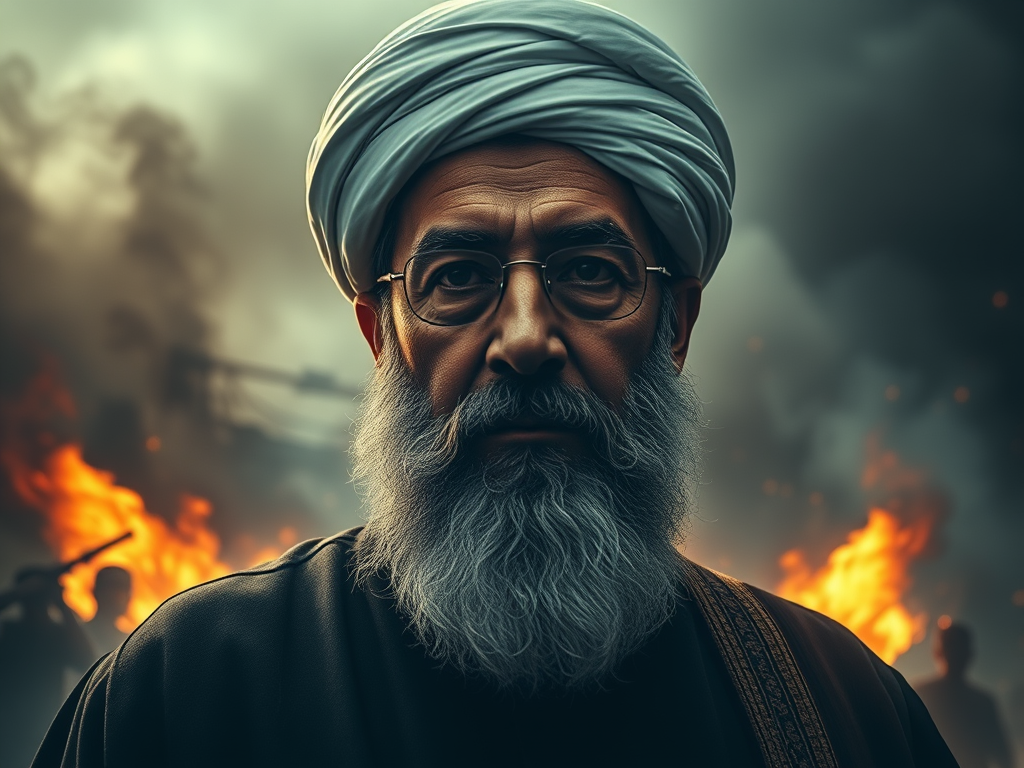

An Islamic Republic With Its Back Against the Wall

Underneath the fire and smoke of Israel’s ongoing military campaign lies an Iranian regime that has long lost popular favor and remains deeply authoritarian. The Islamic Republic has poured billions into developing a nuclear program and funding a network of armed proxies across the Middle East, all while overseeing an economic collapse at home and enforcing severe social repression.
At the helm of this troubled state is Ayatollah Ali Khamenei, Iran’s Supreme Leader, who has ruled for 36 years. Now 86, he holds the title of guardian of the Islamic Revolution—a role he has performed with staunch conservatism and little tolerance for dissent. Though Khamenei is known for his cautious nature, many Iranians now view his leadership and the political system he upholds as out of touch and rigid. The country, especially its young and ambitious population, sees a leadership that is increasingly incapable of responding to their aspirations.
In the span of just six days, Israel has launched a series of coordinated attacks targeting key Iranian infrastructure. These strikes have hit the Natanz nuclear enrichment facility, the primary site for Iran’s nuclear fuel production, killed at least eleven high-ranking military officers and several nuclear scientists, damaged vital oil and energy infrastructure, seized control of Iranian airspace, and triggered mass panic, causing tens of thousands to flee Tehran.
By Sunday, Iranian health ministry officials reported that 224 people had been killed nationwide, the majority of them civilians. That number has likely grown as Israel’s bombardment continues. Iranian retaliatory missile strikes have resulted in at least 24 Israeli deaths.
“The Islamic Republic resembles a decaying tooth ready to be pulled, much like the Soviet Union in its final years,” said Karim Sadjadpour, a senior fellow specializing in Iran at the Carnegie Endowment for International Peace in Washington, D.C. “Khamenei is now facing the greatest challenge of his tenure.”

Though this isn’t the first time the ayatollah has encountered internal threats to his authority, previous confrontations have left the regime unshaken. In 2009, widespread protests erupted following a disputed presidential election. Millions marched in Tehran, demanding accountability and reform. The regime responded with brutal force. I witnessed government-sanctioned militia beat women in the streets—women who had dared to demand basic dignity and freedom. For a brief moment, the regime’s future seemed uncertain. But the crackdown was merciless. Many protesters were tortured, some raped, and hundreds killed.
Whether the current crisis will finally mark the regime’s collapse is still unclear. Although sporadic chants of “Death to Khamenei” echo across Iran at night, the presence of foreign bombs makes organized protests nearly impossible. Even in times of peace, Iran’s tight state surveillance and heavy-handed security forces make dissent dangerous. The absence of a clear opposition leader or political alternative leaves any possible transition in a vacuum.
Nevertheless, Ayatollah Khamenei remains defiant. On Wednesday, in response to U.S. President Donald Trump’s threats and demands for Iran’s “unconditional surrender,” the Supreme Leader declared, “Iran will stand firm against an imposed war, just as it will resist an imposed peace. We will not yield to coercion.”
This rhetoric echoes the revolutionary zeal that defined Iran’s 1979 Islamic Revolution, when Ayatollah Ruhollah Khomeini led a successful uprising against the pro-Western Shah. In the years that followed, “Death to America” became a common refrain in Friday sermons across the country.
But the revolution, which promised liberty and justice, never delivered them. Over the decades, public disillusionment has deepened—spurred by mandatory hijab laws, corruption, and chronic mismanagement. Iran’s economy has deteriorated sharply: since 2012, GDP has fallen by approximately 45%. Sanctions over the nuclear program have certainly contributed to this economic decline, but so have failed privatization efforts, bloated state enterprises, and rampant graft.
A brief moment of hope emerged when Iran reached a nuclear accord with the U.S. under President Obama, but that deal was later abandoned by President Trump during his first term, further isolating Iran and worsening its financial woes.

“Iranians want to send a clear message,” said a Tehran-born businessman now living in the UAE, who requested anonymity for safety reasons. “After everything we’ve endured—this destruction, this pain—the one thing that must come from it all is the end of this monstrous regime.”
At the same time, Israel’s bombing campaign has triggered a surge of nationalism even among those who oppose the Islamic Republic. Some now argue that Iran’s exposure to foreign attack justifies the need for a nuclear deterrent, similar to that of North Korea. With nuclear-armed neighbors like Pakistan, India, Russia, and Israel, Iran’s perceived vulnerability is a source of anxiety for many.
“We may oppose the regime, but we cannot ignore an invasion of our homeland,” wrote Sadegh Zibakalam, a political science professor who made headlines in 2016 for refusing to step on U.S. and Israeli flags at a university event. “Remaining silent—or worse, siding with the attacker—is not an option.”
This tension was visible when Israeli warplanes targeted Iran’s state-owned broadcaster headquarters. The strike interrupted a live broadcast, forcing the anchor—clad in the black chador that symbolizes the regime’s conservative ideology—to flee mid-speech. Some Iranians took joy in the symbolism of the moment, seeing it as a blow to state propaganda. Others felt conflicted.
“I can’t believe I’m defending the state TV channel,” tweeted Hossein Dehbashi, a historian once jailed for suggesting that Khomeini’s son died from a drug overdose. “Damn you, Israel.”
Observers like Sadjadpour argue that with the vast majority of Iran’s 92 million citizens opposing clerical rule, Israel’s campaign was likely to broaden. Prime Minister Benjamin Netanyahu initially described the strikes as a “preemptive measure” to stop Iran from rushing to build a bomb with its enriched uranium stockpile. But that mission now appears to be expanding into something far more ambitious.
This raises a key question: Even if the regime survives, what would stop it from resuming uranium enrichment? Iran’s nuclear program, while not yet producing a bomb or substantial energy output, has become a powerful nationalist symbol. It recalls the emotional resonance of Iran’s 1951 nationalization of its oil industry—a move that angered Britain and led to the infamous 1953 CIA-British-backed coup that ousted Prime Minister Mohammad Mossadegh.

That history has deeply influenced Iran’s suspicion of foreign intervention, just as the country’s long-standing aspirations for constitutional and democratic governance date back to the 1905 Persian Constitutional Revolution. These tensions—between sovereignty and oppression, nationalism and freedom—define Iran’s modern struggle.
Now, President Trump insists the goal is “a real end, not just a ceasefire,” and Netanyahu claims that Iranian leaders are already “packing their bags.” But there’s no verified evidence of such evacuations. Nor is it clear how Israel’s military actions could actually bring down the Islamic Republic.
The prospect of regime change through military intervention carries serious risks. The chaos that followed the U.S.-led invasions of Iraq in 2003 and NATO’s intervention in Libya in 2011 serve as grim reminders of the dangers of foreign-imposed transitions.
Russia’s President Vladimir Putin, embroiled in his own war in Ukraine, would almost certainly point to any U.S.-backed regime change in Iran as proof of Western hypocrisy.

Already, Europe is showing signs of division. German Chancellor Friedrich Merz openly supported Israel’s actions, declaring, “Israel is doing the dirty work for all of us. This regime has spread death and destruction, and I doubt it can ever go back to how it was.” In contrast, French President Emmanuel Macron urged restraint. “The biggest mistake would be trying to change the Iranian regime by force,” he warned. “That would only create chaos.”
No one should underestimate the Islamic Republic’s determination to survive. As Vali Nasr, former dean at Johns Hopkins School of Advanced International Studies, put it: “The regime is cornered and humiliated, but it may still last long enough to wear Israel down and drag the U.S. into a conflict it never wanted.”
Should America intervene directly, the consequences would be long-lasting. Any U.S. role in toppling the Iranian regime would become part of a dark, entangled history between the two nations—one marked by coups, revolutions, hostage crises, the downing of civilian planes, and ideological warfare.
That bitter history runs deep. But as history has shown, no regime lasts forever. The fall of the Berlin Wall in 1989 shocked the world. Could the same be said of Tehran one day?
“The Islamic Republic is like a zombie,” Sadjadpour concluded. “It’s fed on disorder and spread chaos for decades. But it’s terminal, even if it’s still standing.”ostage crisis from 1979 to 1981, the American shooting down in 1988 of Iran Air flight 655 with 290 people aboard, and an ideological war that has persisted since the Iranian Revolution in 1979.
That is a lot of bitter history, but one of history’s lessons is that nightmares do end. Almost nobody predicted the fall of the Berlin Wall in 1989. “The Islamic Republic is a zombie regime,” Mr. Sadjadpour said. “It’s fed off and spread disorder for a long time, but it’s terminally ill even if it’s still standing.”





Leave a Reply