
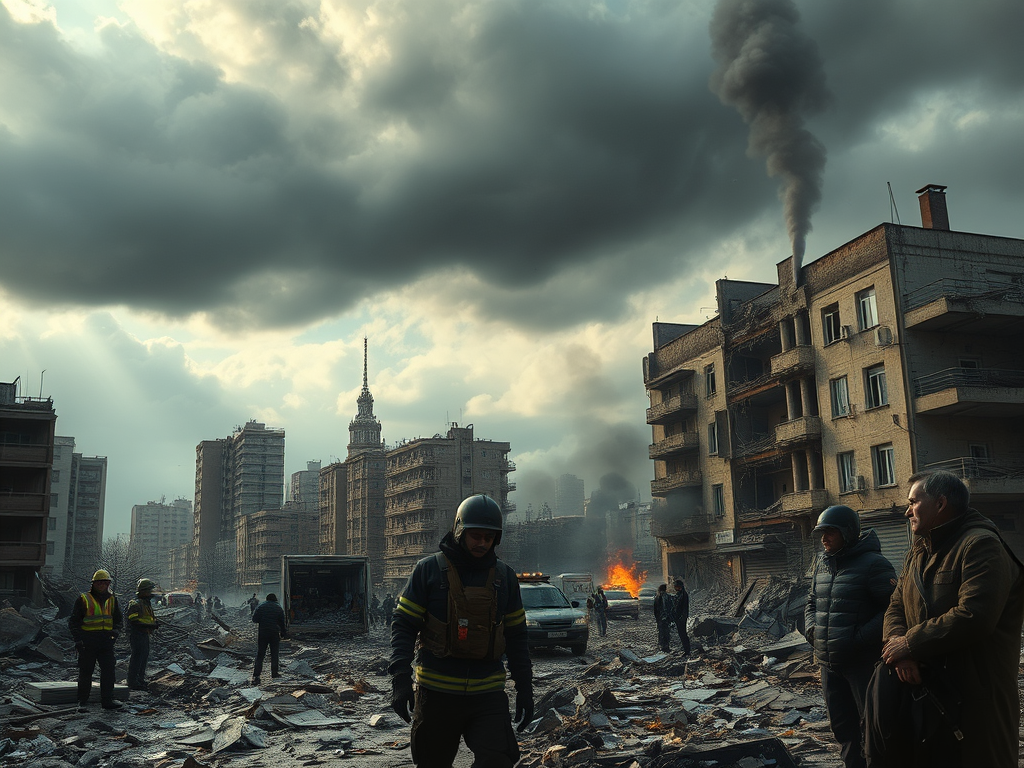

Russian Drone and Missile Strikes on Kyiv Kill at Least 10

In the early hours of Tuesday morning, Russia launched a devastating wave of drone and missile attacks on Kyiv, resulting in the deadliest assault on the Ukrainian capital in nearly a year. Local officials reported that at least ten people lost their lives, including a U.S. citizen, and over 100 others sustained injuries. This violent escalation marked another grim milestone in a war that has dragged on with relentless ferocity.
The Ukrainian government described the attack as part of a broader pattern of intensifying Russian aerial bombardments. These increasingly frequent strikes have effectively crushed any remaining optimism for a cease-fire. The timing was especially notable, coinciding with the convening of the Group of 7 (G7) summit in Canada—a gathering of global leaders that few now believe will meaningfully contribute to ending the conflict.
Ukrainian President Volodymyr Zelensky, attending the summit, offered a stark interpretation of the assault. He laid the blame squarely on Russian President Vladimir Putin, asserting that Putin continues to prosecute the war simply because he retains the capacity to do so. “He wants this war to go on,” Zelensky declared, expressing frustration at the ongoing destruction and the international community’s limited ability to stop it.

Zelensky planned to use the summit as an opportunity to push Ukraine’s allies for additional support, both militarily and economically. He also sought to advocate for tougher sanctions against Russia. However, his mission was complicated by renewed expressions of support for Putin from former U.S. President Donald Trump. At the summit on Monday, Trump reiterated his criticism of the decision to expel Russia from the G7 after the annexation of Crimea in 2014. He left the summit abruptly later that evening.
Deeply disappointed by what he characterized as insufficient global condemnation of Russia’s actions, Zelensky did not hold back. “It is shameful when those with power in this world look the other way,” he said, decrying what he views as a collective moral failure to confront Russian aggression.

According to Ukraine’s Air Force, the latest bombardment involved a barrage of approximately 440 drones and decoy aircraft, alongside 32 missiles. The strikes were not limited to Kyiv; they extended across southern and western regions, including the strategic port city of Odesa, where two additional fatalities were reported. While Ukrainian forces claimed to have intercepted a majority of the drones and nearly 75% of the missiles, these numbers could not be independently verified.
Interior Minister Ihor Klymenko initially stated that 14 individuals had been confirmed dead in Kyiv. However, that figure was later revised to 10, after forensic analysis revealed that some body parts initially thought to belong to multiple victims were from the same individual. Klymenko also confirmed the identity of one of the deceased—a 62-year-old American citizen who died from shrapnel wounds. Kyiv Mayor Vitali Klitschko had earlier reported that an American had been discovered dead in a home near one of the attack sites.
Residents of Kyiv endured nearly 10 hours of continuous air-raid sirens. The haunting sounds of drones buzzing overhead, machine guns firing into the night sky, and the thudding explosions of intercepted missiles created a terrifying backdrop for the night’s events.
By sunrise, thick, dark smoke could be seen billowing over the city. The smell of burning material filled the air. Over two dozen locations across the capital sustained damage, including a nine-story apartment building just outside the city center that was heavily damaged by a direct missile strike.

Rescue teams spent the morning clearing debris from the destroyed building, which now featured a massive hole where an entire section once stood. Amid the rubble were fragments of daily life—a kitchen pot, a glove, a dented soda can—each a reminder of lives violently interrupted.
A crane lifted one survivor out of a precariously positioned apartment teetering on the edge of the destroyed structure. Shattered glass crunched under the boots of emergency responders as they continued their search, warning that others could still be trapped beneath the wreckage.
Among the survivors was Evgeniy Povarenkov, who stood near the ruins of the building with blood-streaked cheeks and minor injuries. Pointing to a destroyed window, he said simply, “That was my apartment.” He described being thrown unconscious by the force of the explosion around 3:45 a.m. When he regained awareness, he discovered his mother badly injured. He managed to carry her out, and she was later taken to a hospital. Now, he waited for permission to return and retrieve essential documents.

“They are killing us—they’re trying to destroy the Ukrainian people,” Povarenkov said bitterly. “And now the United States is refusing to help.”
Meanwhile, Mykola Leschenko sorted through the ruins of his home. The blast had dislodged his front door from its frame, which he had since attempted to prop back into place. He explained that the missile struck just as he was leaving a nearby bomb shelter, mistakenly believing the worst had passed. He immediately returned to the shelter and remained there until after 5 a.m. He was still trying to contact a friend who lived in the now-collapsed section of the building but had received no response.
Leschenko’s mother-in-law, Tetiana Berestova, stood nearby smoking a cigarette. “This is what the ‘Russian world’ means,” she said coldly—an ironic reference to Moscow’s ideological claim that Ukraine belongs to a broader cultural and linguistic Russian civilization.
The pattern of this attack echoed recent trends, with Russia unleashing hundreds of drones during the night in a strategy designed to overwhelm Ukraine’s already strained air defenses before launching harder-to-intercept missiles. According to the United Nations, this was the fourth time in a month that Russia had launched over 400 drones and missiles in a single night. For comparison, during the entire month of June 2024, Russia fired approximately 550 aerial weapons.
Russia maintains that it targets only military infrastructure. However, Ukrainian authorities rarely report successful strikes on military sites, and the heavy toll on civilian lives suggests a broader—and more indiscriminate—approach. The United Nations has noted a 50% increase in civilian casualties in Ukraine during the first five months of 2025 compared to the same period in 2024.

These continued strikes are not only straining Ukraine’s air defense capabilities but are also wearing down the civilian population. Many Ukrainians now routinely spend several nights each week sleeping in subways, building corridors, or bomb shelters to avoid the next assault.
Despite ongoing peace talks, which have thus far yielded little more than limited exchanges of prisoners and the repatriation of fallen soldiers, many in Ukraine believe that Russia has no real interest in ending the conflict. On the contrary, Russian forces have made significant advances on the eastern front, pushing toward key cities like Sumy, Kostiantynivka, and Pokrovsk. Data from the Black Bird Group, a Finland-based organization that monitors battlefield developments, indicated that in May alone, Russia captured over 200 square miles of Ukrainian territory—more than double its gains from the previous month, and the second-highest monthly territorial gain since the war began.
“Putin doesn’t want negotiations; he wants to conquer us,” said 63-year-old Tetiana Pokholovich, who lives in the damaged apartment complex. Though her unit was spared major destruction, the broken windows and the psychological trauma of yet another sleepless night weighed heavily on her. As she turned back toward her home, her eyes filled with tears.
“All we want is peace,” she whispered.




Leave a Reply