

Appeals Court Seems Inclined to Let Trump Control National Guard in L.A. for Now

On Tuesday, a federal appellate court appeared ready to allow President Trump to continue utilizing the California National Guard, despite objections from Governor Gavin Newsom. This move aims to support immigration enforcement operations and manage protests taking place in Los Angeles.
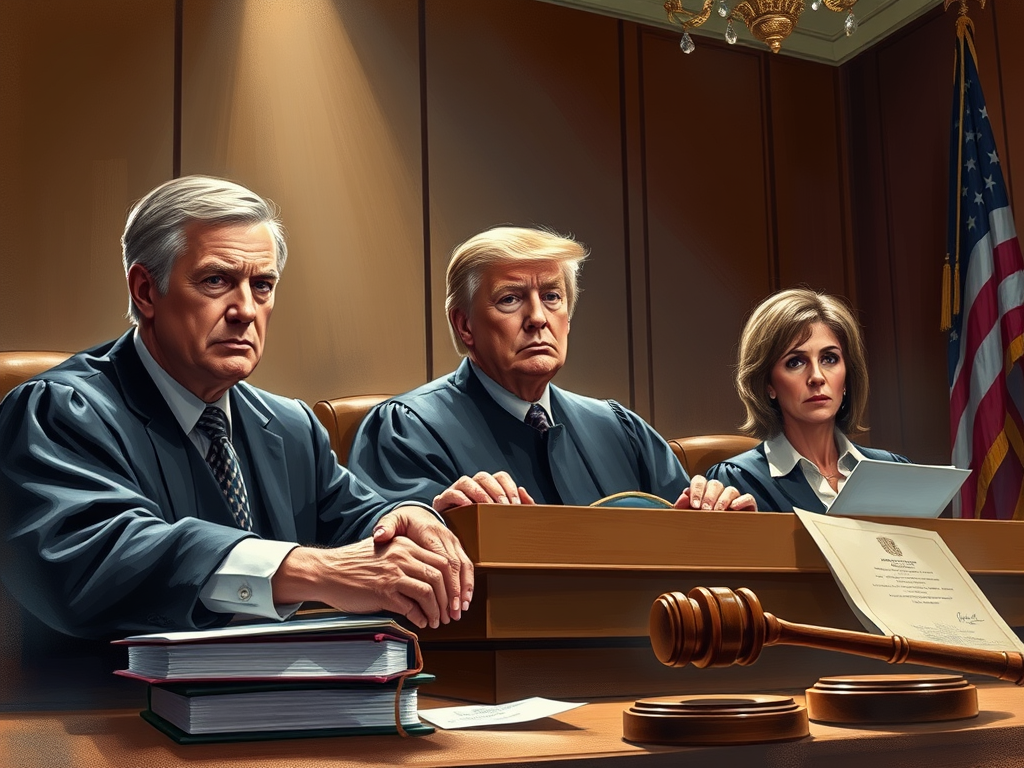
During a 65-minute session, the three-judge panel from the U.S. Court of Appeals for the Ninth Circuit showed reluctance to challenge President Trump’s judgment regarding the need for National Guard deployment to safeguard federal agents and property in the city.
The hearing unfolded while local activists pledged to continue opposing immigration raids. Though tensions have eased slightly since the weekend, the underlying dissent remains unresolved.
Last week, District Judge Charles Breyer ruled that the president’s use of the National Guard violated the law and issued a temporary order requiring the president to return authority over the troops to Governor Newsom. However, the Trump administration swiftly appealed, and the Ninth Circuit responded by placing a hold on the district court’s decision while the legal issues were reviewed. Based on Tuesday’s proceedings, the panel—comprised of two Trump appointees and one appointee of President Biden—seems inclined to maintain that stay for the time being.
Judges Mark J. Bennett and Eric D. Miller, both appointed by Mr. Trump, led most of the discussion. While they appeared unconvinced by the Justice Department’s assertion that the courts lacked jurisdiction to assess the president’s actions under the relevant statute, they nonetheless suggested that the protests—some of which turned violent—might justify the president’s decision.

Meanwhile, California’s legal representative argued that Congress had not authorized the president to unilaterally decide when to federalize a state’s militia. But Judge Jennifer Sung, the Biden appointee, expressed doubts about this perspective. She noted that while she might otherwise be sympathetic, historical precedent seemed to contradict the state’s argument. Referring to a Supreme Court decision from 1827, she pointed out that it had already addressed and dismissed similar claims about the limits of presidential authority under a comparable law.
Ultimately, the issue may need to be resolved by the U.S. Supreme Court, which could determine whether any constitutional constraints limit a president’s ability to federalize the National Guard without a governor’s consent. The ruling could set a precedent affecting future uses of military force within the U.S. borders.
Samuel Harbourt, representing the state, contended that local and state law enforcement agencies were already managing the protests and that the president’s intervention was unnecessary and potentially harmful. He warned that such actions could undermine public confidence in the military’s political neutrality.
“This creates a dangerous precedent,” Mr. Harbourt said, “making it too easy for a sitting president to use the National Guard to pursue a domestic political agenda, eroding the perception of the military as a neutral and impartial institution.”
On the other hand, Brett Shumate, a lawyer from the Justice Department, defended the president’s actions. He claimed that the lower court’s order improperly interfered with the commander in chief’s authority and jeopardized public safety.
While the broader implications of the case are significant, the immediate question facing the appellate court is more limited in scope. The judges are currently reviewing a temporary restraining order, which is a short-term measure. Even if they take no further steps, the existing stay will remain effective until the order expires.
Judge Breyer is scheduled to hold another hearing on Friday to decide whether a more lasting injunction should be granted. He will also address additional legal questions, such as whether President Trump’s activation of active-duty Marines in Los Angeles complies with the law.
Shortly before Tuesday’s hearing, Governor Newsom participated in a livestreamed event where he acknowledged the makeup of the panel—dominated by Trump-appointed judges—but emphasized the importance of the judiciary as a safeguard against executive overreach. He criticized Congress, now under Republican control, for failing to hold the president accountable.
“We’re putting our faith in the courts,” Mr. Newsom said. “And in the incredible turnout we saw this past weekend—unprecedented protests—to defend our democracy.”

The protests began earlier in the month after Immigration and Customs Enforcement (ICE) conducted high-profile raids at workplaces in Los Angeles. These actions were part of the Trump administration’s broader immigration crackdown. Many Democrats and advocacy groups condemned the operations, accusing ICE of targeting Latino communities indiscriminately rather than focusing on individuals with serious criminal records.
In reaction to the growing backlash, President Trump invoked an infrequently used statute to federalize the National Guard. He claimed the move was necessary to ensure the safety of immigration officials and federal buildings from protesters. Governor Newsom strongly opposed the decision, arguing that it inflamed tensions unnecessarily and that local authorities were equipped to deal with any disruptive elements within otherwise peaceful protests.
By Monday, downtown Los Angeles had begun to return to its usual rhythm, just two days after a massive demonstration called the “No Kings” rally drew tens of thousands. However, signs of the protests lingered. Buildings were tagged with anti-ICE graffiti, and discarded protest signs still littered the area.
Law enforcement presence had visibly diminished. Police were no longer gathered in large numbers outside Los Angeles City Hall, and many areas where federal troops had been stationed appeared unguarded.

Mayor Karen Bass lifted the downtown curfew on Tuesday, a full week after its implementation. She stated that she remained prepared to reinstate restrictions if necessary, but she believed the curfew and policing had been “largely effective” in maintaining order.
The recent federal mobilization marked the first time troops under federal command were sent into a state over its governor’s explicit objections since 1963. That year, President John F. Kennedy federalized the Alabama National Guard to enforce a court ruling on the desegregation of the University of Alabama, against Governor George Wallace’s resistance.
President Lyndon B. Johnson followed suit in 1965 when he used the federalized National Guard to protect civil rights marchers in Alabama. However, in that instance, the state’s governor did not voice opposition.
Unlike Kennedy, who relied on the Insurrection Act, President Trump invoked a different statute. This law permits federal control over a state’s National Guard under limited circumstances, such as when federal authority faces rebellion or cannot be enforced by regular means. Crucially, it requires that such actions be coordinated “through” the state’s governor.

Judge Breyer’s ruling stated that the situation in Los Angeles did not meet the threshold of a “rebellion.” He observed that immigration officers continued to carry out their duties, even when confronted by demonstrators. The judge also noted a procedural error in the Trump administration’s execution of the order: Secretary of Defense Pete Hegseth had sent the directive directly to the commanding general of the state militia, bypassing Governor Newsom entirely.
At the appellate hearing, Judge Bennett questioned whether this procedural misstep—failing to route the order through the governor or even inform him—was substantial enough to invalidate the entire deployment.
In addition to the National Guard, President Trump and Secretary Hegseth activated around 700 Marines to support federal immigration enforcement. During Thursday’s hearing, Judge Breyer refrained from addressing the Marines’ involvement, as they had not yet entered the city. However, they have since arrived and were recently filmed detaining a man attempting to enter a federal building. The man was later found to be trying to visit the Veterans Affairs office.
Local officials from Los Angeles and dozens of other municipalities nationwide submitted legal briefs to the appellate court. They argued that local law enforcement is capable of managing civil unrest and that uncoordinated military presence poses increased risks to both officers and civilians.




Leave a Reply