
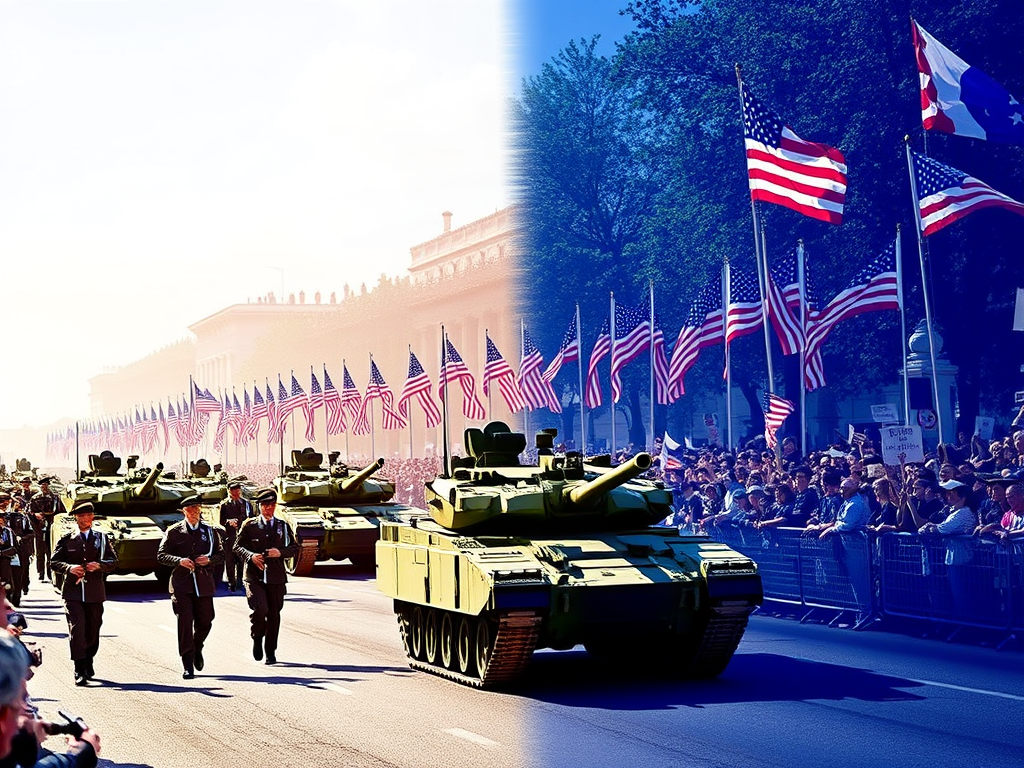

Trump’s Parade Drafted the Army Into a War of Images

The military parade, officially designed as a tribute to the Army’s enduring legacy, quickly became entangled in the political and cultural divisions gripping the nation. The celebration coincided with President Trump’s birthday, casting an unavoidable political shadow over what might have otherwise been a routine patriotic event. For critics, the lavish affair bore the hallmarks of authoritarian theatrics, drawing uncomfortable comparisons to parades held by foreign strongmen. For supporters, however, the display was a bold expression of American military might and a renewal of national pride.
Perhaps in a less turbulent period, the parade would have passed as a simple civic ritual — a marching procession with flags and bands, observed with mild public interest. But amid today’s charged political climate, and under Mr. Trump’s gaze, even a tank ceased to be a neutral object. It became part of an image war — a weaponized piece of symbolism.
The timing of the event could hardly have been more fraught. The parade came at the tail end of a chaotic and violent week in the United States and abroad. The National Guard and Marine units had been deployed to Los Angeles in response to civil unrest, over objections from local officials. Senator Alex Padilla of California was handcuffed after attempting to confront Homeland Security Secretary Kristi Noem at a press briefing. Earlier that week, Mr. Trump had delivered a speech at Fort Bragg that more closely resembled a campaign rally than a military address.

Meanwhile, deadly missile exchanges between Israel and Iran dominated international headlines. And on the morning of the parade, tragedy struck in Minnesota when a state lawmaker was assassinated and another nearly killed in what authorities described as a politically motivated attack.
With all these dramatic developments converging in the same news cycle, the parade felt less like a celebration and more like a political Rorschach test — its meaning morphing depending on the viewer’s stance. It was not just a display of historical reverence, but a manifestation of America’s fractured state, unfolding in real time across a fragmented media landscape.
The nation’s major broadcast networks opted not to air the event. CNN and MSNBC only dipped in and out, their focus split between the parade, updates on violence in the Middle East, the Minnesota assassination, and nationwide protests labeled “No Kings” — a rebuke of what many perceived as President Trump’s authoritarian inclinations.
The images viewers encountered were jarring in their contrasts. One moment, robotic dogs and surveillance drones graced the screen; the next, crowds of protestors hoisting handmade signs filled the airwaves. One click showed dramatic aerial maneuvers by the Army’s Golden Knights parachute team, while another displayed mounted police officers moving through tense protest zones. The parade’s fife-and-drum corps in colonial garb gave way to present-day Marines wielding riot gear. In one particularly intense moment, MSNBC’s Jacob Soboroff was mid-interview when federal agents deployed flash-bang grenades to disperse demonstrators nearby.
Conversely, conservative networks like Fox News and Newsmax embraced the parade wholeheartedly, offering full coverage and commentary that bordered on reverent. Fox’s on-air personalities, including Emily Compagno and Lawrence Jones, framed the event in glowing terms. Jones lauded the president’s address as a “great speech by the commander in chief,” while dismissing dissenting views as unpatriotic.
Though the parade’s formal programming avoided overt political commentary, Fox’s guests made sure to deliver their share. Defense Secretary Pete Hegseth appeared on Fox & Friends Weekend, a show he formerly co-hosted, to declare, “The haters can hate. Let ’em. We don’t care.” Columnist Marc Thiessen brushed off criticism comparing the parade to North Korea’s infamous military shows, saying anyone who drew such a parallel should feel ashamed.
Whether the parade truly mirrored North Korea’s militaristic spectacles is debatable, but Fox’s uncritical coverage had the unmistakable tone of state media.
Though it lacked the missile displays of a Pyongyang demonstration, the Trump-led event was also distinct from the restrained dignity of France’s Bastille Day celebration. Instead, the production bore all the signature elements of Trump’s branding style — ostentatious, theatrical, and unapologetically promotional.
The president’s reviewing platform, flanked by two tanks and two towering video screens, was a visual extension of his political persona. In Trump’s worldview, both tanks and television screens can serve as instruments of power. The stage itself shimmered with golden hues reminiscent of his previous campaign stages, his Mar-a-Lago estate, and even the White House during his tenure. While gold and black are, coincidentally, the official colors of the Army, the design choices couldn’t have aligned more neatly with Trump’s aesthetic preferences.
At intervals, the event’s announcer broke from military narration to thank corporate sponsors — names like Coinbase, Oracle, and the UFC lit up the jumbo screens. In today’s media landscape, even a military parade can double as a marketing platform. On Newsmax, footage of parachutists aired beside an advertisement for Trump-branded wristwatches.
It was a bizarre blend of solemnity and spectacle. While on-site reports suggested that the crowd’s demeanor was generally reserved and respectful, the televised version told a far different story — a collage of celebration, protest, violence, and chaos.
Because military parades are never purely ornamental. They carry meaning — they are, by design, performances of strength. But amid recent clashes between protesters and troops, the question becomes: strength demonstrated to whom?
This line of critique was echoed by California Governor Gavin Newsom, who delivered a nationally broadcast speech denouncing what he characterized as Trump’s authoritarian tendencies. He accused the president of “forcing” the Army into staging what he described as a “vulgar display” for his birthday. Meanwhile, Trump had issued a warning that demonstrators in Washington would face a “very big force.”
It felt as though each leader was speaking to a completely different audience, divided by political ideology and shaped by divergent media narratives. One segment of America watched the parade as an affirmation of unity and strength; another saw it as a dangerous step toward authoritarianism.
Ironically, the most surprising element of the event came at the end, when President Trump concluded with an unusually restrained address. He stayed largely on message, commending the military and avoiding his typical inflammatory rhetoric — save for a few classic Trump lines like, “They fight, fight, fight and they win, win, win.”
The final note of the evening was delivered not by the president, but by country singer Lee Greenwood, performing “God Bless the U.S.A.” — a song frequently featured at Trump rallies. As Greenwood concluded, he turned toward the president with a flourish: “Happy birthday, Mr. President!”
Viewers of Fox News were then treated to a fireworks show, a dramatic finale to an already surreal evening. But when the broadcast returned to the regular news cycle, the explosions were of a more figurative kind — and they showed no sign of stopping.th fireworks. Then it was back to the news, where the pyrotechnics showed no sign of ending.




Leave a Reply